
SciSpace Review, Pricing & Alternatives (2026)
A research workspace for finding, reading, comparing, and writing scientific literature
Last updated: October 22, 2026
What is SciSpace?
SciSpace is an academic research workspace for finding papers, comparing evidence, chatting with PDFs, and drafting scholarly work. Its Agent combines search, synthesis, writing, and presentation tasks for students, researchers, and R&D teams. A free Basic tier includes 100 monthly credits, while paid plans start at $12/month when billed annually or $20/month monthly.
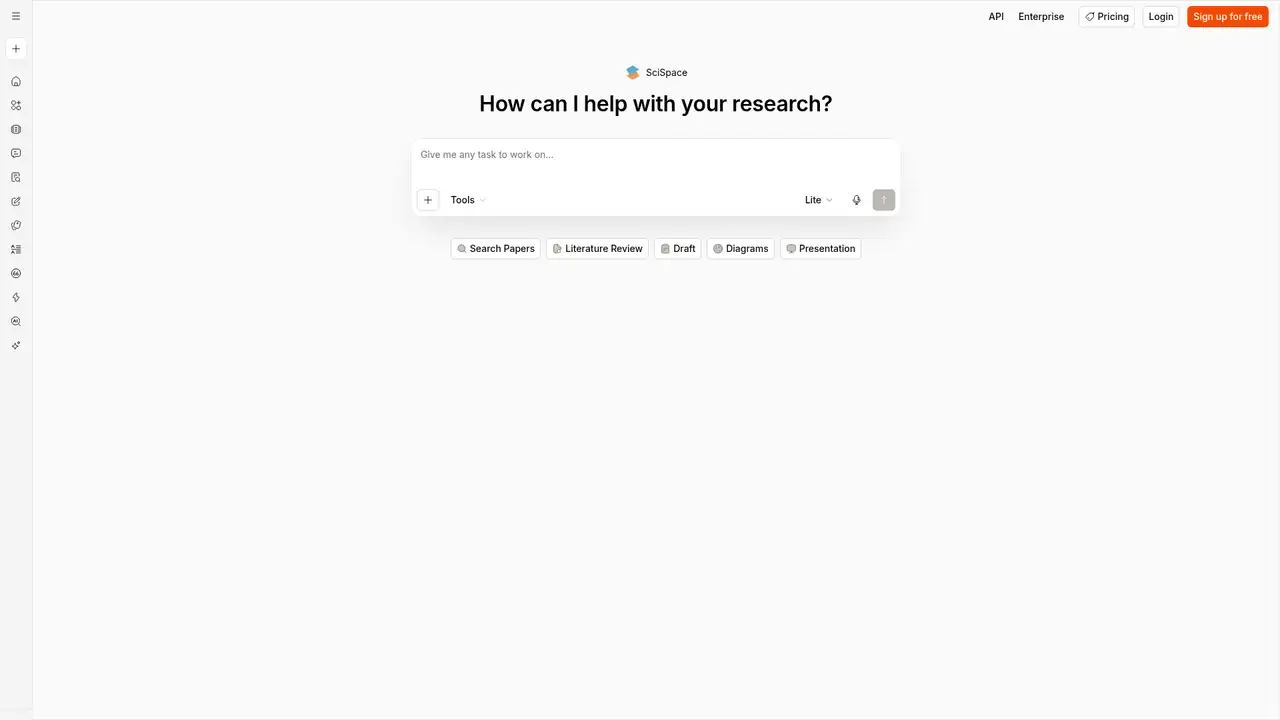
SciSpace is a hosted academic research workspace made by PubGenius, Inc., formerly known as Typeset. The company says its founders started the product in 2015 as a research formatting tool, then expanded it into discovery, reading, analysis, citation, and writing. It adopted the SciSpace brand in 2022. The platform reports metadata for more than 200 million papers and access to more than 50 million open access full text PDFs, while a 2025 Agent announcement cites more than 280 million papers. SciSpace says over 1 million researchers use its services. Historical reporting records $850,000 in 2017 funding, while company databases list later financing, including a $3 million 2022 deal. Its current focus is the full scholarly workflow.
A typical SciSpace workflow starts with a keyword or natural language query in Literature Review. Users can filter papers by year, author, publication type, citation count, and PDF availability, then sort results and compare findings in a customizable table. The service produces summaries and extracted insights, and users can save papers to a Library or export results as CSV. Copilot, formerly ChatPDF, answers questions about papers, tables, equations, diagrams, and highlighted passages. Its citation interlinking feature points answers to the relevant PDF section. Agent extends this sequence across search, synthesis, drafting, citation checking, reports, diagrams, and presentations. Users can upload PDFs, connect a Zotero Library, annotate documents, and ask follow-up questions in more than 75 languages.
SciSpace's documented technology centers on an academic repository, retrieval from papers, PDF understanding, and AI agents that coordinate research tasks. The company says Agent unites more than 150 academic tools and databases, while its 2025 announcement describes a research focused assistant for literature review, data extraction, manuscript writing, peer review, grant drafting, and presentations. Copilot can answer from one paper, all SciSpace papers, or a user's Library, with citations linking back to source sections. Notable documented releases include Copilot in November 2022, citation interlinking in September 2023, the Literature Review workspace in 2023, and SciSpace Agent in July 2025. In October 2026, SciSpace announced unlimited Agent usage for Advanced and Max, subject to fair use.
Pricing is freemium and centers on Agent credits. Basic costs $0 per month and includes 100 monthly credits with four concurrent tasks. Premium costs $20 monthly, or $12 per month when billed annually, and includes 1,200 credits with four concurrent tasks. Advanced costs $90 monthly, or $70 per month billed annually, and offers unlimited monthly credits with fair use limits and eight concurrent tasks. Max costs $200 monthly, or $160 per month billed annually, with the same fair use qualification and 16 concurrent tasks. Credits apply to Agent tasks, while standalone tools outside Agent do not consume them. Monthly credits expire at the end of each subscription cycle. Enterprise pricing is custom and adds institutional controls rather than a published individual allowance.
SciSpace's main limitation is that its strongest usage promises still depend on credits, concurrent task caps, or fair use. The uploaded PDF privacy policy says Library PDFs are private and excluded from model training, but it does not grant a blanket commercial license for generated text or cover every account record. SciSpace also does not document a public developer API, local hosting, or open source edition. Elicit is a focused alternative for literature research, scite emphasizes citation statements and supporting or contrasting evidence, and Consensus centers on research question answers. SciSpace is the better choice for students, academics, and R&D teams wanting one hosted workspace for paper discovery, cited PDF explanations, synthesis, drafting, and presentations, provided they verify outputs and publisher rights.
Who is SciSpace best for?
- Graduate students building literature reviews from large paper collections.
- Researchers who need cited explanations while reading PDFs.
- Teams combining literature search, synthesis, drafting, and presentations.
- R&D groups that need enterprise controls such as SSO and RBAC.
SciSpace Pricing (2026)
Pricing model: Freemium. All prices in USD.
| Plan | Price | What you get |
|---|---|---|
| Basic | $0/month | Includes 100 monthly credits and 4 concurrent Agent tasks. Credits expire at the end of the subscription cycle. |
| Premium | $12/month billed annually, or $20/month billed monthly | Includes 1,200 monthly credits and 4 concurrent Agent tasks. Credits expire at the end of the subscription cycle. |
| Advanced | $70/month billed annually, or $90/month billed monthly | Includes unlimited monthly credits subject to fair use and 8 concurrent Agent tasks. |
| Max | $160/month billed annually, or $200/month billed monthly | Includes unlimited monthly credits subject to fair use and 16 concurrent Agent tasks. |
Pros and Cons
Pros
- SciSpace indexes more than 200 million research papers, according to its literature review guide.
- Copilot can answer questions with links to the cited PDF section.
- Agent plans separate usage credits from standalone tools outside Agent.
- Enterprise deployments offer SOC 2 Type 2, SSO, SAML, and RBAC.
Cons
- Agent credits expire at the end of each subscription cycle.
- Advanced and Max plans describe unlimited usage with fair use limits.
- The uploaded PDF privacy promise does not cover every type of account data.
Who should look elsewhere?
- Readers seeking a general purpose chatbot rather than academic tools.
- Researchers requiring a confirmed public developer API.
- Users who need a locally hosted or open source research system.
Technical Details
Frequently Asked Questions
How much does SciSpace cost?
SciSpace has a free Basic Agent plan with 100 monthly credits. Premium costs $12 per month with annual billing or $20 monthly. Advanced costs $70 annually billed monthly or $90 monthly, while Max costs $160 annually billed monthly or $200 monthly. Advanced and Max include unlimited monthly credits subject to fair use.
Does SciSpace have a free plan?
Yes. The Basic plan costs $0 per month and includes 100 monthly Agent credits plus four concurrent tasks. Credits apply to tasks executed inside SciSpace Agent. SciSpace says standalone tools outside the Agent experience do not consume these credits, and unused monthly credits expire at the end of the subscription cycle.
How does SciSpace compare with Elicit?
SciSpace combines paper discovery, literature comparison, PDF explanations, citation tools, writing, and Agent workflows. Elicit is a direct alternative for literature research, though SciSpace does not publish a feature-by-feature comparison with it. Choose SciSpace when cited PDF chat and a broader writing workflow matter; compare current Elicit features separately before switching.
Does SciSpace train its AI on uploaded PDFs?
SciSpace says uploaded PDFs in a user Library are private, accessible only to that user, and not used to train its AI models. Its March 2025 help article says this applies to free and paid users. The statement specifically covers uploaded Library PDFs, so it should not be read as a blanket promise about prompts, chats, or every Agent output.
Can I use SciSpace output commercially?
SciSpace documents tools for writing, reports, presentations, and enterprise research workflows, but its documentation does not grant a universal commercial license for generated text, figures, or summaries. Commercial use also depends on copyright, publisher terms, and the rights to uploaded material. Review SciSpace terms and the relevant publication licenses before commercial distribution.
Sources
- SciSpace Agent pricing and usage guide
- SciSpace unlimited Agent usage announcement
- SciSpace pricing page
- SciSpace literature review workspace
- SciSpace Agent overview
- SciSpace Copilot and ChatPDF guide
- SciSpace uploaded PDF privacy policy
- SciSpace enterprise security page
- SciSpace About Us
- SciSpace company profile
Best SciSpace Alternatives in 2026
These tools do the same job as SciSpace, with different pricing, limits and trade-offs.
AI workflows for literature search, review, and research reports

Citation context and evidence checks for scientific research

Evidence-linked search and synthesis for academic literature

AI-assisted search and discovery for scientific literature

Visual citation discovery that grows from the papers you know

Source-grounded research, study aids, and multimedia summaries