
Consensus Review, Pricing & Alternatives (2026)
Evidence-linked search and synthesis for academic literature
Last updated: October 22, 2026
What is Consensus?
Consensus is an AI academic search engine from Consensus NLP, Inc. that produces citation-linked answers from scholarly literature. It supports paper discovery, evidence comparison, Study Snapshots, Deep Reviews, and API or MCP access. Free access covers core searches, while Pro and Deep add capacity. Users should verify summaries against original studies.
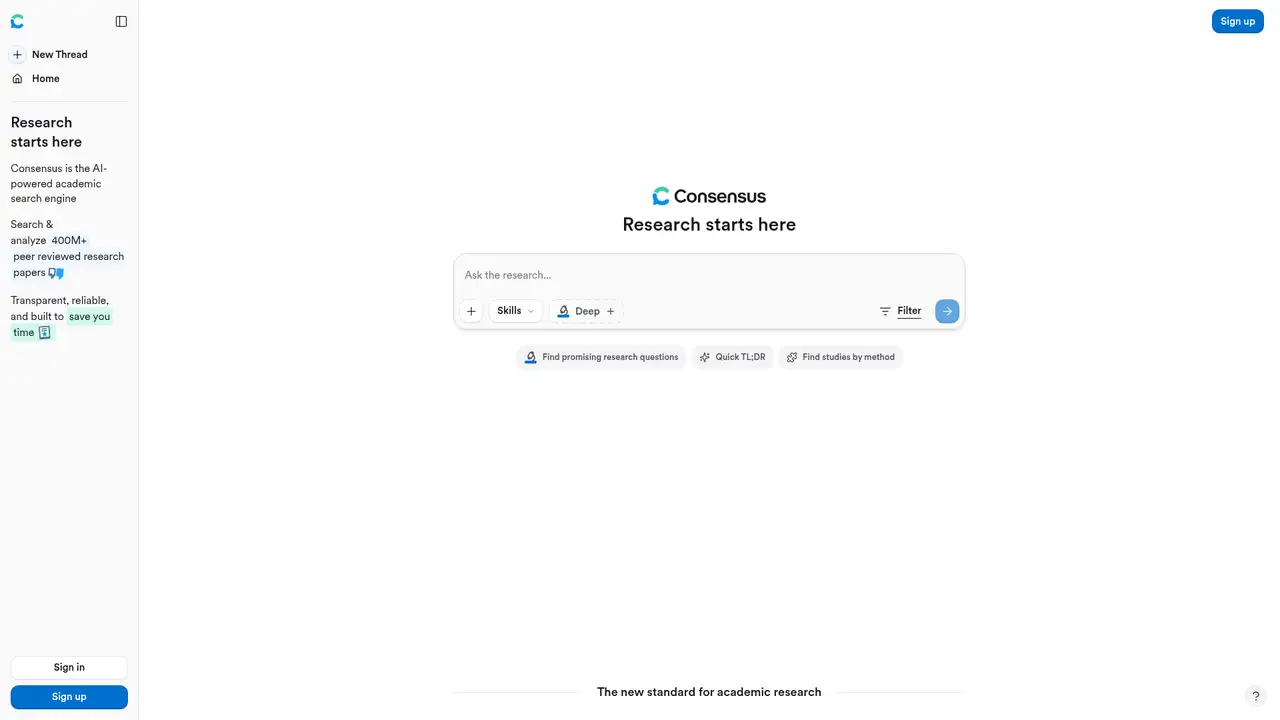
Consensus is made by Consensus NLP, Inc. and presents itself as an AI search engine for research. Its documentation says it searches more than 400 million scholarly articles, including 350 million peer-reviewed papers, while an earlier company primer cited more than 200 million papers. The company says more than five million researchers, students, and clinicians use it across more than 10,000 universities. It is best understood as a retrieval and explanation layer over scholarly literature, rather than a general chatbot. Its defining feature is traceability: answer sentences link to papers, and users can inspect supporting quotations. The company does not publish a founding year or funding total in the material described here, so its identity rests mainly on product scope, audience, and scholarly-search positioning.
A typical workflow begins with a natural-language research question. Consensus searches its paper database, retrieves relevant results, and generates a response from those results rather than relying only on general model knowledge. Users can inspect citations, run Pro searches, and open Study Snapshot entries covering details such as methodology, sample size, and study duration. Pro analysis summarizes up to 20 papers, while Deep Review searches across up to 50 papers for broader literature work. The service also flags retracted papers and supports API and MCP connections. This workflow helps users form reading lists, compare findings, screen evidence, or gain orientation in an unfamiliar field. It is most useful before close reading, because important claims still require checking the full papers, methods, limitations, and surrounding evidence.
Consensus does not identify the underlying language models or provide a public model selector in its product documentation. Its main technical distinction is the retrieval sequence and citation checking: search precedes generation, claims connect to papers, and the company says retracted papers are flagged and excluded from answers. Documentation in 2026 added or clarified Deep Review, Pro subscription behavior, API and MCP allowances, and connections with Microsoft 365 Copilot and other assistants. Deep Review is described as an in-depth search across up to 50 papers. These features help with organization and access, but summaries can contain errors and searches can miss relevant studies. Consensus describes itself as a research assistant and advises readers to verify consequential claims against primary papers and methods.
The Free tier costs $0 and includes unlimited paper searches, 10 Pro messages, three Deep Reviews, 10 Study Snapshots, and 30 API or MCP calls per month. Pro costs $20/month or $144/year when billed annually, equivalent to $12/month, with unlimited paper searches and Pro messages, 15 Deep Reviews, unlimited Study Snapshots, and 500 API or MCP calls monthly. Deep costs $65/month or $540/year annually, equivalent to $45/month, and raises Deep Reviews to 200 and calls to 2,000. Teams and Enterprise use custom pricing. Teams includes 50 Deep Reviews and 500 calls per user monthly. Enterprise pricing is quote-based. The tradeoff is straightforward: individual plans provide progressively more review and integration capacity, but frequent users must monitor allowances and choose between predictable cost and higher research volume.
The main limitation is dependence on indexed scholarly metadata and AI summaries. Citation links make checking easier, but they cannot guarantee that a synthesis captures study quality, conflicting findings, publication bias, or methodological nuance. Consensus is less suited to citation-network exploration than ResearchRabbit, Connected Papers, or Litmaps, and less suited to full reference management than Elicit or Scite. Its 2026 privacy policy says it does not sell personal information or use queries, uploads, or personal data to train large language models, while still describing account, cookie, provider, and analytics processing. Choose Consensus for fast, citation-linked answers and evidence comparison; choose ResearchRabbit for visual discovery and iterative paper mapping. It best fits students, clinicians, researchers, and teams seeking orientation before deeper evaluation.
Who is Consensus best for?
- Students who need a quick, cited starting point for a literature search.
- Clinicians comparing findings across a focused set of studies.
- Researchers screening evidence before reading primary papers.
- Teams that need API or MCP access to scholarly search.
Consensus Pricing (2026)
Pricing model: Freemium. All prices in USD.
| Plan | Price | What you get |
|---|---|---|
| Free | $0 | Unlimited paper searches, 10 Pro messages, 3 Deep Reviews, 10 Study Snapshots, and 30 API or MCP calls per month. |
| Pro | $20/month or $144/year | Annual billing equals $12/month; unlimited Pro messages and Study Snapshots, 15 Deep Reviews, and 500 API or MCP calls monthly. |
| Deep | $65/month or $540/year | Annual billing equals $45/month; 200 Deep Reviews and 2,000 API or MCP calls monthly, plus Pro features. |
| Teams | Custom | Pro features, 50 Deep Reviews and 500 API or MCP calls per user monthly, centralized billing, and managed seats. |
| Enterprise | Custom | Quote-based plan for larger organizations, with volume discounts, integrations, training, and account management. |
Pros and Cons
Pros
- Every generated answer is designed to link claims back to scholarly papers.
- The free tier includes unlimited paper searching and meaningful monthly allowances.
- Deep Review and Study Snapshot address different stages of literature work.
- The 2026 policy explicitly rejects selling data and training models on user content.
Cons
- The company does not publicly identify the language models behind generation.
- AI summaries can still omit context or misrepresent a paper's conclusion.
- Deep searches and API calls are capped even on paid individual plans.
Who should look elsewhere?
- Readers seeking a substitute for evaluating study methods and bias.
- Researchers whose main need is a visual citation-network map.
- Users requiring a disclosed, selectable foundation model.
Technical Details
Frequently Asked Questions
How much does Consensus cost?
Consensus has a $0 Free tier. Pro costs $20/month or $144/year billed annually, while Deep costs $65/month or $540/year billed annually. Teams and Enterprise pricing is custom. The annual prices reduce the effective monthly rate to $12 for Pro and $45 for Deep.
Is Consensus free?
Yes. The Free plan includes unlimited paper searches, 10 Pro messages, three Deep Reviews, 10 Study Snapshots, and 30 API or MCP calls per month. Paid plans raise the AI-search, review, snapshot, and integration allowances. Free access does not mean every advanced feature is unlimited.
Consensus or ResearchRabbit: which is better?
Consensus is the stronger fit for asking a question and receiving a citation-linked synthesis. ResearchRabbit is better for visual citation mapping, iterative discovery from seed papers, collections, and author or paper relationships. They overlap in discovery, but their primary workflows differ, so many researchers can use them together.
Does Consensus train AI models on user data?
Consensus's August 2026 privacy policy says it does not use queries, uploads, or personal information to train large language models, including third-party models, and does not sell personal information. It still processes account, service, security, and permitted analytics data, so organizations should review the full policy and contract terms.
Can businesses use Consensus?
Yes. Consensus offers Teams and Enterprise plans for research groups, universities, institutes, and larger organizations. Enterprise includes centralized administration, library integrations, training, and custom commercial terms according to the company. API and MCP access is also available, with monthly call allowances varying by plan.
Best Consensus Alternatives in 2026
These tools do the same job as Consensus, with different pricing, limits and trade-offs.

Visual citation discovery that grows from the papers you know
AI workflows for literature search, review, and research reports

Citation context and evidence checks for scientific research

Visual maps for discovering related academic papers