Semantic Scholar Review, Pricing & Alternatives (2026)
AI-assisted search and discovery for scientific literature
Last updated: October 22, 2026
What is Semantic Scholar?
Semantic Scholar is a free, AI-assisted scholarly search and discovery service developed by Ai2 for researchers, students, and developers working with scientific literature. It searches more than 214 million papers and offers summaries, citation analysis, libraries, recommendations, and a public API. The entry price is $0.
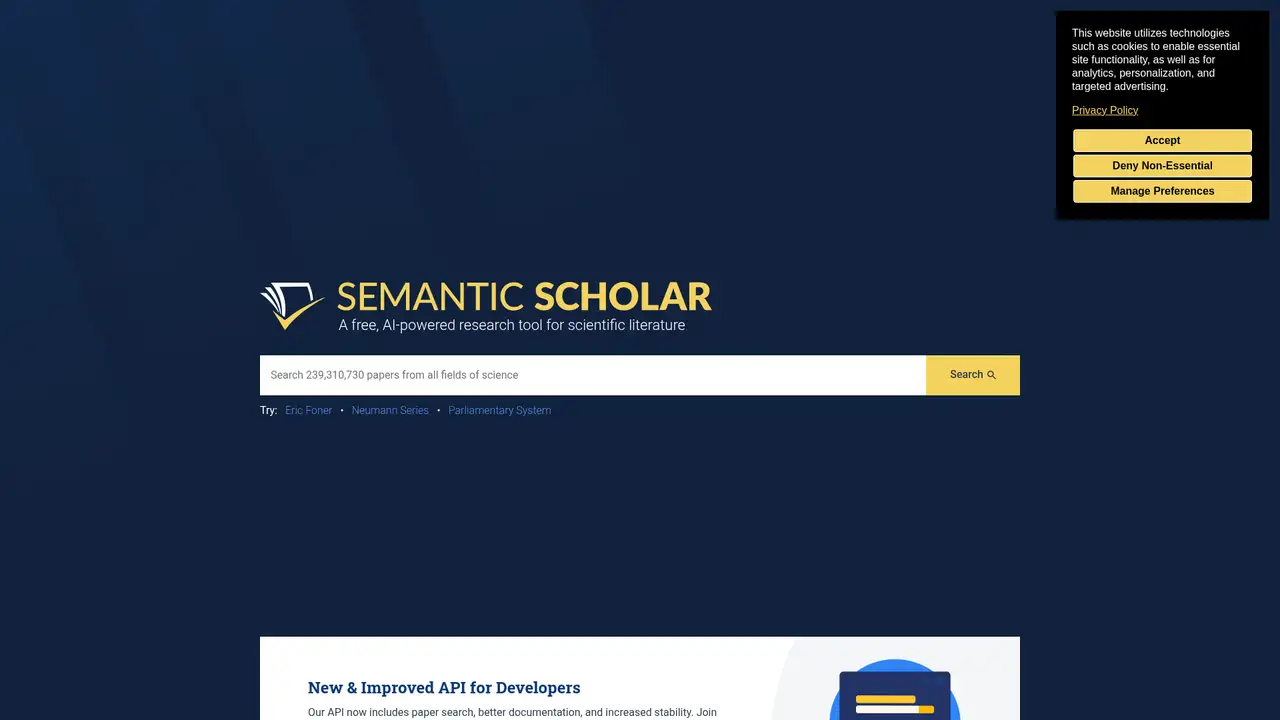
Semantic Scholar is a free scholarly search and discovery service developed by the Allen Institute for Artificial Intelligence, or Ai2, a nonprofit research institute founded in 2014. The service launched in 2015 and indexes more than 200 million academic papers, while its product page reports a searchable corpus exceeding 214 million papers. Ai2 describes the service as a research and product development team using machine learning to process and classify papers. The organization also publishes open code and datasets. Its public resources include the Semantic Scholar Academic Graph and the Semantic Scholar Open Research Corpus, giving researchers and developers access to structured scholarly data alongside the hosted search experience.
A typical workflow starts with a keyword search across papers from all scientific fields, then narrows results by journal, conference, author, publication type, or date. TLDR summaries provide short descriptions for nearly 60 million papers in computer science, biology, and medicine. Users can inspect highly influential citations, export BibTeX, MLA, APA, or Chicago references, and save papers into library folders. Research Feeds learn from saved papers and relevance ratings to recommend additional work and send email alerts. Ask This Paper can answer questions with supporting statements on a limited set of English-language papers. Semantic Reader adds citation cards, tables of contents, definitions, and highlighted goals, methods, and results for many arXiv papers.
The service combines machine learning, natural language processing, computer vision, and document representations informed by citations. Research Feeds use a paper embedding model trained with contrastive learning to find similar papers. The API exposes SPECTER2 embeddings, paper and author records, citations, venues, recommendations, and downloadable datasets. Ask This Paper uses OpenAI's gpt3.5-turbo-16k with the current paper and the user's question, then displays nearby supporting text. The documented release history includes Ask This Paper in December 2023, while current product documentation describes its limited availability and English-language testing. The product warns that generative answers can contain factual errors, awkward phrasing, or irrelevant information, so readers should verify important claims.
The hosted product is free, and the public API has no listed subscription price. Most API endpoints work without authentication, with a shared unauthenticated limit of 1,000 requests per second, although heavy demand can cause additional throttling. An API key is required for certain endpoints, and its introductory limit is 1 request per second across endpoints. Batch requests can process up to 500 paper IDs, return up to 10 MB, and return up to 9,999 citations at a time. API users must provide attribution, follow the licenses attached to S2 Data, and review separate terms for underlying third-party content. Ai2 may use licensee data to provide and improve its services and may publish aggregated, anonymized usage statistics.
Semantic Scholar is strongest as a broad, free discovery layer and metadata service, but it does not grant permission to reuse papers and does not endorse claims made in indexed publications. Its FAQ says it has no smartphone app, and some AI features remain limited by language, corpus, or beta status. Google Scholar offers another broad search index, while OpenAlex provides an alternative open scholarly data service and Scopus targets paid bibliometric workflows. Semantic Scholar is the better pick for researchers who want AI-assisted discovery without a subscription and developers who need accessible scholarly metadata, provided they can work within API limits and licensing terms.
Who is Semantic Scholar best for?
- Researchers conducting broad literature discovery across scientific fields.
- Students who need citation exports and quick paper summaries.
- Developers building scholarly search or metadata applications.
- Teams seeking a free alternative to paid bibliometric databases.
Semantic Scholar Pricing (2026)
Pricing model: Free. All prices in USD.
| Plan | Price | What you get |
|---|---|---|
| Web search | $0 | Free access to Semantic Scholar search, paper pages, summaries, citations, libraries, recommendations, and related discovery features. |
| Academic Graph API | $0 | Most endpoints are publicly accessible. Unauthenticated traffic shares 1,000 requests per second, while introductory API keys allow 1 request per second. |
Pros and Cons
Pros
- It searches more than 214 million scientific papers across fields.
- TLDR summaries cover nearly 60 million papers in three major areas.
- The public API exposes papers, authors, citations, venues, and embeddings.
- Research Feeds turn library folders and relevance ratings into recommendations.
Cons
- Generative answers can contain factual errors and require verification.
- Ask This Paper is limited to some English-language papers.
- API data carries attribution and separate underlying content license requirements.
Who should look elsewhere?
- Readers needing guaranteed full-text access to every indexed paper.
- Organizations requiring a fully self-hosted scholarly search system.
- Users who need unrestricted answers from generative paper features.
Technical Details
Frequently Asked Questions
How much does Semantic Scholar cost?
Semantic Scholar's hosted search and discovery service is free. The Academic Graph API also has no listed subscription price. Most endpoints are publicly accessible, although unauthenticated traffic shares a 1,000 requests per second limit, certain endpoints require an API key, and introductory authenticated access is limited to 1 request per second.
Is Semantic Scholar free to use?
Yes. Users can search its scholarly index, open paper pages, inspect citations, export references, save papers to libraries, and use Research Feeds without a paid plan. Availability of full text depends on publisher and access conditions. Semantic Scholar says it cannot grant permission to reuse content, so readers must contact authors or publishers for those rights.
How does Semantic Scholar compare with Google Scholar?
Both services support broad scholarly search, but Semantic Scholar adds machine-generated TLDR summaries, highly influential citation labels, Research Feeds, paper question answering, and a documented Academic Graph API. Google Scholar is a direct alternative for general discovery. Semantic Scholar is a better fit when structured metadata and programmatic access matter, while neither service guarantees access to every paper's full text.
Does Semantic Scholar train on user data?
The API license says Ai2 may use data that a licensee provides and transmits to call or use the API to provide and improve the API, S2 Data, and Semantic Scholar. It also permits aggregated, anonymized usage statistics. The Ai2 privacy policy describes personal-data processing for its sites and services. Organizations should review the current license and privacy terms before sending sensitive information.
Can I use Semantic Scholar data commercially?
Commercial use is governed by the API license, not by a blanket permission. API users must provide attribution, follow documentation, and comply with licenses attached to S2 Data, such as CC BY-NC or ODC-BY, plus terms for underlying third-party content. The license also restricts repackaging, selling, renting, leasing, distributing, or sublicensing the API unless separately permitted.
Best Semantic Scholar Alternatives in 2026
These tools do the same job as Semantic Scholar, with different pricing, limits and trade-offs.