
ResearchRabbit Review, Pricing & Alternatives (2026)
Visual citation discovery that grows from the papers you know
acquired: Litmaps acquired ResearchRabbit in May 2025. ResearchRabbit remains an active product and brand on its own domain, with RR+ pricing published in 2026.
Last updated: October 22, 2026
What is ResearchRabbit?
ResearchRabbit is a visual literature discovery and citation mapping tool for researchers, students, and teams. Its free tier supports searching, collections, collaboration, and library uploads, while RR+ adds larger seed limits, advanced controls, projects, Signals, and faster support. Litmaps acquired the product in May 2025, but it remains a separate active brand.
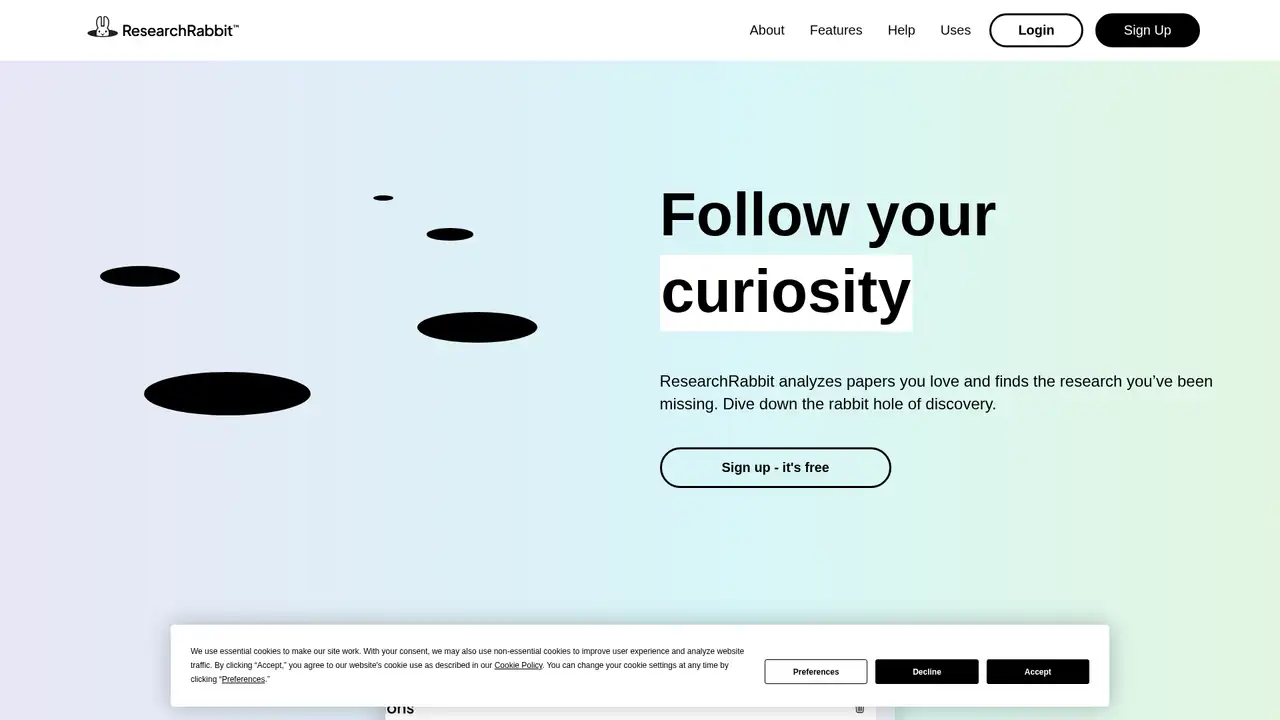
ResearchRabbit is a literature discovery service organized around papers, authors, collections, and citation relationships. Its central identity is a visual recommendation and mapping tool: users begin with work they know, then examine related papers, earlier and later studies, authors, and emerging themes. Litmaps, a New Zealand company, acquired ResearchRabbit in May 2025 during its first-close $1 million funding round. ResearchRabbit remains active under its own name and domain rather than being folded into the Litmaps brand. A 2025 release described a database containing more than 280 million academic sources from Semantic Scholar, Crossref, and OpenAlex. That history gives the product a distinct position between academic search, citation mapping, and collaborative literature organization for individuals and teams.
The supported workflow begins with seed papers or a keyword search. ResearchRabbit displays connected literature visually, enabling inspection of similar, earlier, and later work, along with authors and citation paths. Users can save discoveries into collections, write notes, share collections, and collaborate. A reading list holds articles for later review without requiring collection membership, while users can upload or connect reference libraries. The 2025 redesign added iterative searching, searches from arbitrary article sets, built-in notes, and a larger database. This workflow is valuable when a credible starting paper exists and the goal is to expand outward through relationships. It is less direct for a single factual question, because users must interpret maps, judge relevance, and often open papers themselves rather than receive one synthesized response.
ResearchRabbit’s technology centers on citation metadata and network relationships, using data described as coming from Semantic Scholar, Crossref, and OpenAlex. The company does not identify a selectable foundation model or claim that a general-purpose chatbot writes literature summaries. The October 2025 redesign added advanced search, iterative exploration, notes, and access to more than 280 million academic sources. A July 2026 release added a reading list, adjustable map result counts of 10, 20, or 40, and Signals risk indicators for RR+ users. Signals examines citation behavior and citation networks to flag potentially high-risk papers. These indicators can prioritize checking, but they cannot replace retraction searches, full-text evaluation, methodological scrutiny, or expert judgment about study quality and relevance.
Free Forever costs $0 and includes unlimited search, collections, collaboration, and library uploads, with up to 50 seed articles for a search. RR+ pricing is inconsistent across published pages as of October 22, 2026. The current guide lists $12.50/month or $120/year, while public pricing copy still shows $10/month in places. Annual billing is described as saving 20 percent, and country parity discounts cover more than 100 countries. RR+ raises the seed allowance to 300 and adds advanced filters, multiple projects, Signals badges, and faster support. The tradeoff is straightforward: the free tier covers substantial discovery and sharing, while paid access matters mainly for larger starting sets, richer organization, risk indicators, and support. Prospective subscribers should verify the checkout amount before paying because the displayed prices conflict.
The visual approach can reveal relationships that keyword lists miss, but recommendations inherit the limits of citation coverage, metadata quality, and network structure. ResearchRabbit does not provide Consensus-style sentence-level evidence synthesis, and many users may still need a reference manager, full-text reader, or systematic-review screening and extraction system. The acquisition adds uncertainty because Litmaps owns the product and future boundaries or pricing may change. Privacy materials state that saved articles and notes are not sold or used to train AI models, while the DPA identifies Litmap Limited as processor and names AWS, Stripe, Mixpanel, CloudWatch, SES, Brevo, and Intercom as subprocessors or service providers. Choose ResearchRabbit for visual, iterative discovery and shared citation trails; choose Consensus for direct cited answer synthesis, and consider Connected Papers, Litmaps, Elicit, or Scite for different discovery and evidence needs.
Who is ResearchRabbit best for?
- Researchers expanding a review from known seed papers.
- Students who prefer visual maps to long result lists.
- Teams sharing collections and discovery trails.
- Reviewers screening related work across authors and citations.
ResearchRabbit Pricing (2026)
Pricing model: Freemium. All prices in USD.
| Plan | Price | What you get |
|---|---|---|
| Free Forever | $0 | Unlimited search, collections, collaboration, and library uploads; up to 50 seed articles in a search. |
| RR+ monthly | $12.50/month | Up to 300 seed articles, advanced search controls, multiple projects, Signals risk badges, and faster support; country discounts may apply. |
| RR+ annual | $120/year | The April 2026 guide describes annual billing as 20 percent below monthly pricing, with the same premium features; country discounts may apply. |
Pros and Cons
Pros
- Citation maps make paper and author relationships easy to inspect.
- The free plan supports unlimited collections and collaboration.
- RR+ raises seed limits and adds advanced filters and multiple projects.
- Country parity pricing extends discounts to more than 100 countries.
Cons
- Published pricing conflicts between $10 and $12.50 monthly copy.
- Network recommendations still require manual quality and retraction checks.
- Litmaps ownership may bring future product and pricing changes.
Who should look elsewhere?
- Users wanting a direct, sentence-cited answer to a research question.
- Researchers needing full systematic-review screening and extraction controls.
- Organizations requiring stable pricing unaffected by acquisition changes.
Technical Details
Frequently Asked Questions
How much does ResearchRabbit cost?
ResearchRabbit has a $0 Free Forever plan. The April 2026 RR+ guide lists $12.50/month or $120/year, with annual billing saving 20 percent. The public pricing page still displays $10/month in places, so prospective subscribers should verify the checkout price. More than 100 countries can receive parity discounts.
Is ResearchRabbit free?
Yes. The Free Forever tier includes unlimited searching, collections, collaboration, and library uploads, with up to 50 seed articles in a search. RR+ is optional and raises the seed limit to 300 while adding advanced search controls, multiple projects, Signals risk badges, and faster support responses.
ResearchRabbit or Consensus: which should I choose?
Choose ResearchRabbit when your task is discovering connected papers, authors, and citation paths from seed literature. Choose Consensus when you want an answer synthesized from retrieved papers with sentence-level citation links. ResearchRabbit is a map and recommendation workflow; Consensus is a search and evidence-summary workflow.
Does ResearchRabbit use my papers and notes to train AI?
ResearchRabbit's November 2025 data-responsibility guide says it does not sell or expose users' articles and notes and does not use them to train AI models. Its DPA describes processing account data, saved papers, annotations, integrations, and usage data to provide the service. Review the formal privacy policy for organizational use.
Can ResearchRabbit be used commercially?
ResearchRabbit publishes individual Free Forever and RR+ plans rather than a separate commercial license on the pricing pages reviewed. The DPA supports customer-entity processing and identifies Litmap Limited as processor, but organizations should contact the company about seats, procurement, data terms, and any commercial restrictions before deployment.
Best ResearchRabbit Alternatives in 2026
These tools do the same job as ResearchRabbit, with different pricing, limits and trade-offs.

Evidence-linked search and synthesis for academic literature

Visual maps for discovering related academic papers
AI workflows for literature search, review, and research reports

Citation context and evidence checks for scientific research