
scite Review, Pricing & Alternatives (2026)
Citation context and evidence checks for scientific research
Last updated: October 22, 2026
What is scite?
scite is a scientific literature search and evaluation platform built around Smart Citations, which show how later papers support, contrast with, or mention earlier findings. It serves researchers, students, librarians, and R&D teams that need citation context. A free plan is available, while Basic costs $20 monthly or $144 annually.
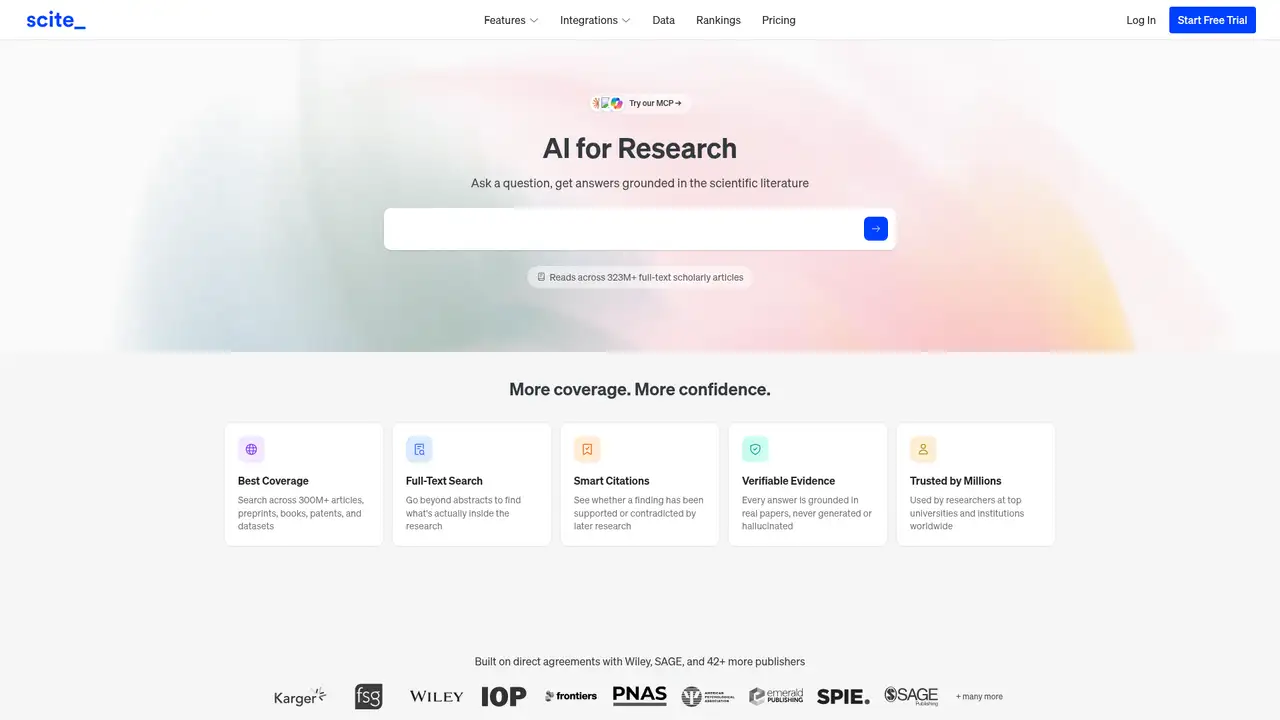
scite is a scientific research platform founded in 2018 and acquired by Research Solutions in December 2023. Research Solutions announced the acquisition on November 27, 2023, and reported about 21,000 active subscribers and $3.6 million in annualized subscription value at the time. The company describes scite as a search and discovery product for evaluating research. Its defining feature is Smart Citations, which display citation statements and surrounding text, then classify later use of a paper as supporting, contrasting, or mentioning. That makes scite more useful than a citation count when a researcher wants to assess how a finding has been received. The product remains available under the scite name.
A typical workflow begins with a keyword or natural language search. Users open a result, inspect the statements that cite it, and review the surrounding passages before deciding which papers deserve closer reading. Collections organize saved papers for later monitoring, while Assistant answers questions against indexed literature and uploaded documents. Search can generate Boolean queries from plain language. Alerts track new papers and citation activity, and Zotero import supports personal, group, and lab libraries. Scite also exposes datasets covering patents, grants, clinical trials, drugs, devices, and safety records. Browser and workflow integrations extend citation context beyond the main web app, although the classifications remain a screening aid rather than a substitute for reading methods and results.
Scite analyzes full text from citing articles to identify citation statements and classify their relationship to cited work. Its documented current technology includes Smart Citations, Assistant, document uploads, Collections, Boolean query generation, and MCP connections for AI tools. In February 2026, Research Solutions launched Scite MCP for clients including ChatGPT, Claude, Microsoft Copilot, Cursor, and Claude Code, with access to more than 250 million indexed articles, chapters, preprints, and datasets. May 2026 updates added Pro, Assistant uploads, expanded regulatory data, and Collections improvements. August updates added one-click connections for ChatGPT and Claude, stronger Zotero imports, and feed improvements. The company does not document a named foundation model for these features.
The public individual plans are Free at $0, Basic at $20 monthly or $144 annually, Pro at $50 monthly or $480 annually, and Team at $50 per user monthly or $480 per user annually. Basic includes 250 MCP credits monthly, Smart Citation reports, and Collections for up to 1,000 papers. Pro and Team include 2,500 MCP credits monthly, API access, and Collections for up to 10,000 papers. Organization and Enterprise pricing is custom. A seven day trial is available. In October 2026, free accounts stopped receiving MCP credits. A Pro API key is for evaluation, while commercial Search use and evidence datasets require separate scopes or agreements. Rate limits vary by endpoint and account.
scite is strongest when a literature review needs citation context, support or contrast signals, and retraction awareness. Elicit focuses more on structured extraction and systematic review tables, Consensus on evidence summaries, and Semantic Scholar on broad discovery and citation graphs. Scite can be less useful for new, lightly cited, or poorly covered work, and automated classifications need human checking. The self serve REST API also does not grant unrestricted production or commercial rights. Choose Basic for individual citation analysis and MCP, Pro for API evaluation and higher usage, or Team and Enterprise for pooled access, SSO, confidentiality, and licensed datasets. Researchers who want citation relationships rather than general web answers should pick scite.
Who is scite best for?
- Researchers checking how important findings were used by later papers.
- Students and writers who need linked evidence while drafting literature reviews.
- Libraries and institutions monitoring citations, retractions, and research impact.
- Developers evaluating evidence backed workflows through MCP or the REST API.
scite Pricing (2026)
Pricing model: Freemium. All prices in USD.
| Plan | Price | What you get |
|---|---|---|
| Free | $0 | Public Papers and Tallies endpoints are available without an API key. Free accounts have no MCP credits as of October 2026. |
| Basic | $20/month or $144/year | Includes 250 MCP credits monthly, Smart Citation reports, and Collections for up to 1,000 papers. It has no self service REST API key. |
| Pro | $50/month or $480/year | Includes 2,500 MCP credits monthly, a self service API key, Collections for up to 10,000 papers, and additional datasets subject to scope. |
| Team | $50/user/month or $480/user/year | Includes Pro access and 2,500 MCP credits per user monthly under one subscription. |
| Organization and Enterprise | Custom | May include pooled usage, SSO, managed credentials, higher limits, additional scopes, and organization wide access. |
Pros and Cons
Pros
- Smart Citations expose support, contrast, and mention context instead of counts alone.
- MCP connects research evidence to several major AI clients.
- Alerts and integrations support recurring literature monitoring.
- Enterprise plans can add pooled access, SSO, and licensed datasets.
Cons
- Automated citation classifications require human checking.
- Free access no longer includes MCP credits.
- Commercial API and dataset rights require separate licensing.
Who should look elsewhere?
- Readers seeking fast answers across general web content.
- Teams needing unrestricted production API rights at a self serve price.
- Researchers working mainly in poorly covered or non English literature.
Technical Details
Frequently Asked Questions
How much does scite cost?
Scite has a free plan. Basic costs $20 monthly or $144 annually. Pro costs $50 monthly or $480 annually, and Team costs the same per user. Organization and Enterprise plans use custom pricing. Annual prices are billed once per year and exclude taxes, discounts, and promotions.
Does scite have a free plan?
Yes. Free accounts can use public Papers and Tallies endpoints without an API key. As of October 2026, free accounts do not receive MCP credits. A seven day trial is available, while Basic adds 250 monthly MCP credits and Pro and Team add 2,500 monthly credits.
How does scite compare with Elicit?
scite specializes in citation context and labels later statements as supporting, contrasting, or mentioning a finding. Elicit focuses more on extracting structured information across papers and organizing systematic review work. Researchers validating a claim may prefer scite, while researchers building comparison tables may prefer Elicit. The products address different review tasks.
Does scite train on user data?
The documented plan and API terms distinguish ordinary subscriptions from enterprise confidentiality and licensing arrangements, but they do not provide a blanket statement that answers every training question. Users handling confidential documents should review current privacy terms and negotiate organization or enterprise provisions rather than assume a personal plan provides enterprise data controls.
Can I use scite commercially?
A Pro subscription provides a self service API key for evaluation, but it does not grant unrestricted commercial, production, or research use of every endpoint. Commercial or research Search use requires a separate license agreement, and evidence datasets require corresponding scopes. Contact Research Solutions for production integrations, higher limits, data feeds, or broader licensing.
Best scite Alternatives in 2026
These tools do the same job as scite, with different pricing, limits and trade-offs.
AI workflows for literature search, review, and research reports

Evidence-linked search and synthesis for academic literature

AI-assisted search and discovery for scientific literature

Visual citation discovery that grows from the papers you know