
NotebookLM Review, Pricing & Alternatives (2026)
Source-grounded research, study aids, and multimedia summaries
rebranded: Google renamed NotebookLM to Gemini Notebook on July 16, 2026. It remains the same standalone product, and existing notebooks remain accessible.
Last updated: October 22, 2026
What is NotebookLM?
Gemini Notebook, formerly NotebookLM, is Google’s source-grounded research and study workspace. It turns documents and links into cited answers, audio and video overviews, reports, and study aids for students, researchers, and teams. A free Standard tier is available, while Google AI Plus starts at $4.99/month in the United States.
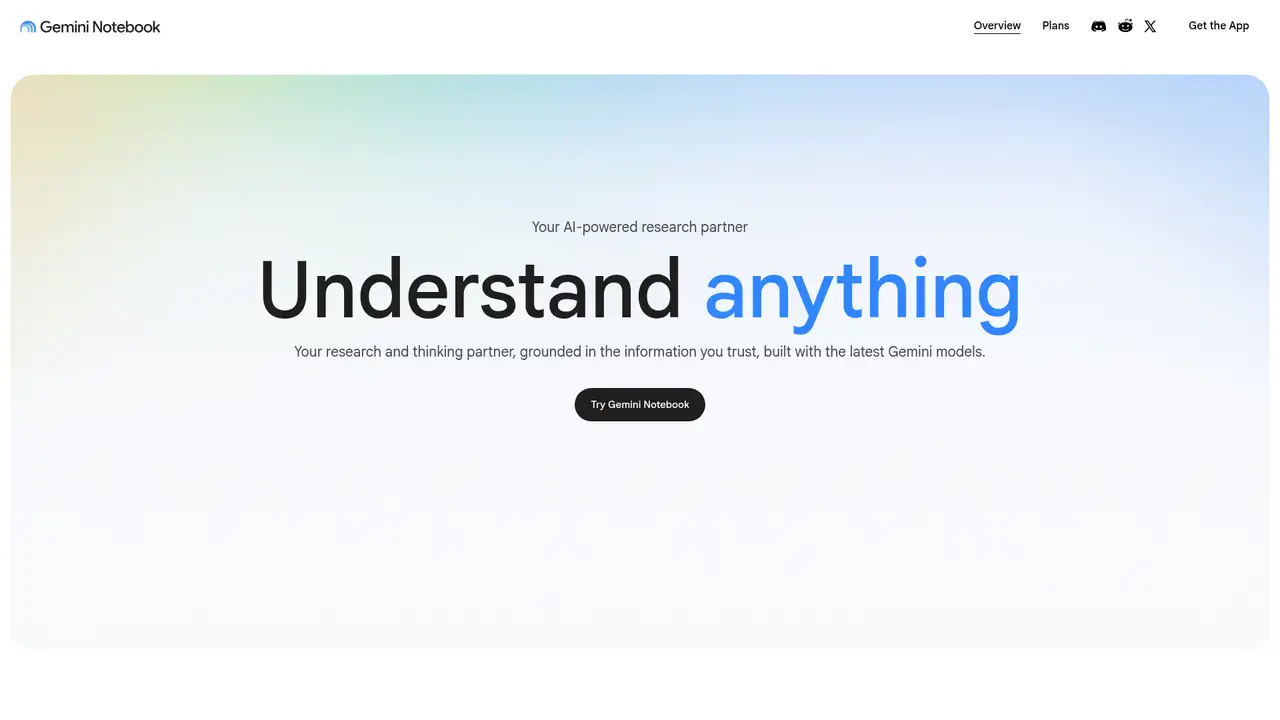
Gemini Notebook is Google’s source-grounded research and study workspace, formerly called NotebookLM. Google introduced it as Project Tailwind at Google I/O 2023, then renamed it on July 16, 2026. The company says more than 30 million people and over 600,000 organizations use it. It remains a standalone product, while notebooks also connect with the Gemini app and are planned for Google Search. The name change matters for directory searches, but the product identity is continuous: Google says existing notebooks remain accessible. Its strongest distinction is a workflow built around user-provided material rather than an open-ended chat window. That makes it a practical fit for study, document review, internal knowledge, and source-based research.
A typical notebook starts with source collection. Users can add PDFs, web pages, Google Docs, handwritten notes, worksheets, photos, and recordings, then ask questions about the material. Gemini Notebook returns answers grounded in those sources and can provide citations. From the same workspace, users can create reports, flashcards, quizzes, mind maps, infographics, slide decks, Audio Overviews, and Video Overviews. Notes sit alongside sources, allowing users to edit, cite, and reuse them. The September 2026 study update adds real-time spoken conversations with notebooks in nearly 100 languages through the mobile app, mobile audio recording, interactive learning overviews, and additional quiz formats. Public notebook sharing is available for consumer accounts, while paid users receive advanced sharing.
Google does not identify one public model name as the product’s sole engine. Its plan pages describe access to Google’s Gemini models, with higher access on Pro and the highest access on Ultra. The documented technology is source grounding, generated citations, multimedia creation, and, for the newer update, a secure cloud computer that can write and execute code for source-grounded data analysis. Google announced that cloud-computer capability on July 16, 2026, first for Google AI Ultra and qualifying Workspace users, with Pro web access rolling out afterward. The September 15, 2026 release added the spoken notebook conversations, recorder, interactive learning overviews, and new quiz formats. These additions make the product more capable, although Google’s published limits still matter for frequent generation.
The free Standard tier includes access to Google’s Gemini models, standard artifact generations, and up to 50 sources per notebook. Google’s Help page lists 100 notebooks per user, 50 chats per day, 3 Audio Overviews per day, 3 Video Overviews per day, and 10 Deep Research runs per month for Standard. Plus costs $4.99/month in the United States and raises the notebook limit to 200 and source limit to 100. Pro costs $19.99/month, with 500 notebooks and 300 sources per notebook. Ultra has 500 notebooks and up to 600 sources per notebook, depending on the storage plan. Google says daily and monthly quotas reset after their respective periods, and limits can change. Regional availability also varies.
Gemini Notebook is less suitable when you need a public developer API, local hosting, or a fully independent research index. Google identifies the consumer product as hosted, and its plan pages describe access through Google AI, Workspace, or Cloud rather than an open-source distribution. SciSpace is stronger for paper discovery and academic reading, while scite emphasizes citation context and Elicit focuses on structured literature review. ChatGPT is broader for general conversation, but it lacks Gemini Notebook’s narrow source-grounded notebook workflow. Individual data is not used to train Gemini Notebook unless feedback is submitted, while Workspace uploads, queries, and responses are not used to train AI models. Pick Gemini Notebook for source-based study and document work with multimedia outputs.
Who is NotebookLM best for?
- Students turning notes and recordings into study aids.
- Researchers reviewing a defined collection of documents.
- Teams building answers from internal reference material.
- Users who want source-based audio, video, and visual summaries.
NotebookLM Pricing (2026)
Pricing model: Freemium. All prices in USD.
| Plan | Price | What you get |
|---|---|---|
| Standard | $0/month | 100 notebooks per user and 50 sources per notebook. Google lists daily and monthly generation quotas. |
| Plus | $4.99/month | Google AI Plus includes Gemini Notebook access, 200 notebooks per user, and 100 sources per notebook in the United States. |
| Pro | $19.99/month | Google AI Pro includes 500 notebooks per user and 300 sources per notebook, with higher model access and priority access. |
| Ultra 5x (20 TB) | $99.99/month | Includes 500 notebooks, 500 sources per notebook and 2,500 daily chats. Audio and Video Overviews each have a 100-per-day limit. |
| Ultra 20x (30 TB) | $199.99/month | Includes 500 notebooks, 600 sources per notebook and 5,000 daily chats. Audio and Video Overviews each have a 200-per-day limit. |
Pros and Cons
Pros
- Answers are grounded in user-selected sources and include citations.
- One notebook can produce reports, quizzes, flashcards, audio, and video.
- The free tier supports 50 sources per notebook.
- Workspace users receive stronger training-data protections.
Cons
- Daily and monthly quotas can restrict frequent artifact generation.
- Plan availability and pricing vary by region.
- The consumer product does not offer self-hosting or a public developer API.
Who should look elsewhere?
- Developers seeking a public consumer API.
- Organizations requiring self-hosted deployment.
- Researchers needing a dedicated scholarly citation database.
Technical Details
Frequently Asked Questions
How much does Gemini Notebook cost?
Gemini Notebook has a free Standard tier. In the United States, Google AI Plus costs $4.99 per month and Google AI Pro costs $19.99 per month. Ultra pricing is presented through Google AI plans and varies by the selected storage plan and region. Google says Plus, Pro, and Ultra availability is limited to supported regions.
Is Gemini Notebook free?
Yes. The Standard tier is free with a Gmail account or qualifying Workspace access. Google lists 100 notebooks per user and up to 50 sources per notebook for Standard users. It also applies daily and monthly quotas to chats, Audio Overviews, Video Overviews, and Deep Research. Paid plans increase limits and add higher model or priority access.
How does Gemini Notebook compare with SciSpace?
Gemini Notebook is centered on sources that a user adds to a notebook, then produces cited answers, notes, study aids, reports, audio, and video. SciSpace is more focused on discovering and analyzing academic literature, including paper search, PDF questions, comparison tables, and literature workflows. Choose Gemini Notebook for source-based multimedia study, and SciSpace for scholarly paper discovery.
Does Gemini Notebook train on my data?
Google says individual data is not used to train Gemini Notebook unless the user submits feedback. If feedback is submitted, Google may review the full interaction context, including queries, uploads, and responses. For Google Workspace and Workspace for Education users, uploads, queries, and responses are not reviewed by human reviewers or used to train AI models.
Can I use Gemini Notebook outputs commercially?
Google’s product pages describe business, education, and enterprise access, but they do not grant a blanket commercial license for every generated output. Commercial use depends on Google’s applicable terms, plan, copyright rules, and the rights you hold in uploaded material. Review those terms before publishing generated text, images, audio, video, or slides, and check third-party source rights.
Sources
Best NotebookLM Alternatives in 2026
These tools do the same job as NotebookLM, with different pricing, limits and trade-offs.

A research workspace for finding, reading, comparing, and writing scientific literature

Citation context and evidence checks for scientific research
AI workflows for literature search, review, and research reports

AI-assisted search and discovery for scientific literature
General-purpose AI assistance for writing, research, coding, and work