
Scholarcy Review, Pricing & Alternatives (2026)
Turn dense academic papers into structured summaries and study notes
Last updated: October 26, 2026
What is Scholarcy?
Scholarcy is a hosted research reading tool for students, researchers, and accessibility focused learners. It converts papers and other documents into interactive summary flashcards, highlights, notes, and exports. The free Article Summarizer allows one summary per day, while Scholarcy Plus is directory listed at $9.99 per month, with the official paid price shown at checkout.
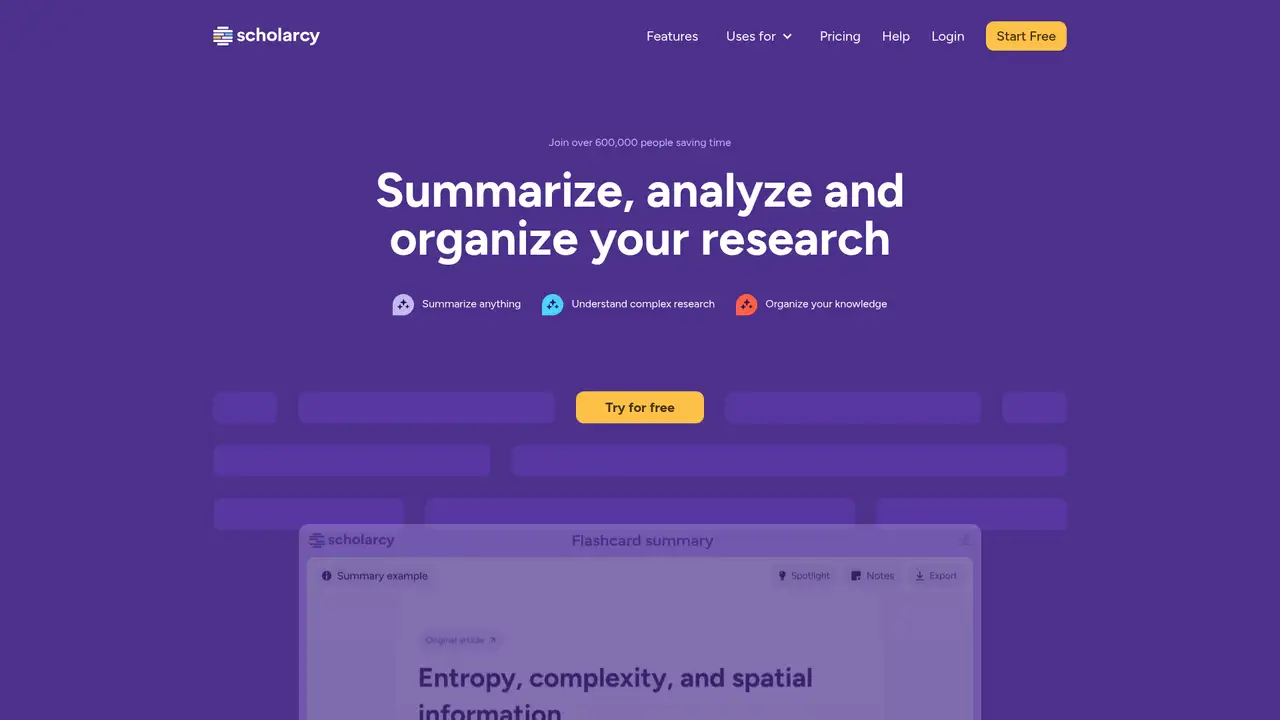
Scholarcy converts academic papers and other documents into structured, interactive summary flashcards. Founder Phil Gooch and Emma Warren Jones began developing it in 2018, incorporated the company in January 2019, and secured investment in September 2019. Digital Catapult records a £200,000 seed investment and Scholarcy’s participation in the 2019 Machine Intelligence Garage. The company says nearly 500,000 students and researchers rely on the service, while its 2024 acquisition announcement says more than half a million people have used it. Texthelp acquired Scholarcy in October 2024. Everway now houses Texthelp and n2y, but Scholarcy remains a distinct research product for higher education and individual users. Its origins trace to Gooch’s PhD reading problem, which shaped the product’s focus on extracting useful information from dense academic documents.
A typical workflow starts with importing a paper, article, web page, video, spreadsheet, document, or plain text file. Scholarcy identifies titles, abstracts, headings, references, claims, key findings, figures, and tables, then presents the material as flashcards. Users can save summaries to a library, organise collections, highlight passages, add notes, and create a Literature Matrix. Integrations include Google Scholar, OpenAlex, PubMed, Zotero, RIS, BibTeX, Mendeley, EndNote, Scite, LibKey, Notion, and Obsidian. Exports cover Word, Excel, PowerPoint, Markdown, RIS, BibTeX, Notion, and Obsidian. Its API can return structured JSON with highlights, key terms, references, and synopsis data. Scholarcy therefore suits reading, annotation, and review more than broad discovery or citation-network analysis.
Scholarcy’s early technical description combined machine learning with traditional natural language processing, including spaCy and UnPaywall. Its current product uses document structure and semantic classification to produce summaries, highlights, comparisons, and related article information. The company does not publish a current model name or context window. Product work continued after the Texthelp acquisition. A refreshed Spaces interface arrived in August 2025, following changes to navigation, autosaving, summaries, imports, and loading speed. A May 2026 update added full screen Dig Deeper chat with conversation context, export of highlights with summaries and notes, planned MindView export, an extra small font option, and clearer handling of highlights after enhanced summaries. These changes mainly improve organisation and follow-up reading rather than expanding Scholarcy into a citation mapping platform.
Scholarcy offers a free Article Summarizer with one summary per day. Its pricing page also lists a free account limited to 10 summaries, with multiple import formats, flashcard collections, enhanced summaries, Literature Matrix creation, and exports of up to 100 flashcards at once. Scholarcy Plus is listed by directories at $9.99 per month or $89.99 per year, adding unlimited summarization, saved libraries, enhanced summaries, collections, batch export, and Literature Matrix access. Scholarcy’s published page text does not display the paid amount, so checkout shows the applicable figure. Institutional and team plans use custom quotes. Prices may exclude taxes, and subscriptions renew automatically, with monthly or annual prepayment and no refunds for unused periods.
Scholarcy’s main limitation is scope: its strongest experience is turning reading into structured notes, rather than building a visual citation map or answering broad questions across a large corpus. Elicit is better for question-led literature review tables, while Consensus suits quick claim checking across research. Scite is stronger when citation context and supporting or contrasting evidence matter most. Scholarcy remains useful for students who need readable summaries, exportable notes, accessibility controls, Literature Matrix creation, and a personal research library. Its free tier permits one summary per day, while Scholarcy Plus adds unlimited summarization and saved libraries. Pick Scholarcy if document digestion and study organisation matter more than discovery graphs or citation debate.
Who is Scholarcy best for?
- Students who need fast structured summaries of assigned academic reading.
- Researchers organising papers, highlights, notes, and literature matrices.
- Users who need exports to reference and knowledge management tools.
- Learners who benefit from adjustable reading and accessibility settings.
Scholarcy Pricing (2026)
Pricing model: Freemium. All prices in USD.
| Plan | Price | What you get |
|---|---|---|
| Article Summarizer | $0 | One summary per day. The free account also lists a 10 summary limit, collections, multiple file formats, Literature Matrix creation, and exports up to 100 flashcards. |
| Scholarcy Plus | See checkout | Directory listed at $9.99 monthly or $89.99 yearly. Includes unlimited summarization, saved libraries, enhanced summaries, collections, batch export, and Literature Matrix access. |
| Institutional and team | Custom | Institutional and team pricing is quoted individually. |
Pros and Cons
Pros
- Scholarcy summarises papers into structured flashcards with key findings and references.
- It imports common research formats and connects with major reference tools.
- It exports summaries, notes, and citations to several academic workflows.
- It adds accessibility controls and text to speech through Everway products.
Cons
- The free Article Summarizer allows only one summary per day.
- The current paid price is not exposed in the official published page text.
- The company does not explicitly state how uploaded documents affect model training.
Who should look elsewhere?
- Researchers seeking a dedicated citation network visualisation tool.
- Teams requiring documented self hosting or an open source core.
- Buyers needing a publicly confirmed paid subscription amount.
Technical Details
Frequently Asked Questions
How much does Scholarcy cost?
Scholarcy offers a free Article Summarizer with one summary per day. Scholarcy Plus is directory listed at $9.99 per month or $89.99 per year, but the official published pricing page does not expose the paid amount in its page text. The paid price is shown at checkout. Institutional and team plans use custom quotes, and taxes may be excluded.
Does Scholarcy have a free plan?
Yes. The free Article Summarizer allows one summary per day. The pricing page also describes a free account with a 10 summary limit, multiple file formats, flashcard collections, enhanced summaries, Literature Matrix creation, and exports of up to 100 flashcards at once. Unlimited summarization and additional library features require a subscription.
How does Scholarcy compare with Elicit?
Scholarcy is the better fit for converting papers into readable flashcards, highlights, notes, and exports. Elicit is the better fit for question led literature review work that organises findings across papers. Choose Scholarcy when the main task is understanding and revising individual documents. Choose Elicit when comparing research results across a defined question matters more.
Does Scholarcy train AI models on uploaded documents?
Scholarcy’s privacy and terms pages say it does not sell personal data or Processed Documents, and that authorised employees can access them. The company does not publish an explicit statement confirming whether uploaded documents are used to train generative AI models. Its privacy policy says account data is deleted after cancellation or deletion, while invoices are retained for seven years.
Can Scholarcy be used commercially?
Scholarcy supports individual subscriptions and institutional or team arrangements, and its API terms cover customer data ownership and processing roles. The published material does not provide a broad commercial reuse licence for generated summaries or extracted content. Commercial users should review the current subscription, API, copyright, and institutional terms before distributing outputs externally.
Best Scholarcy Alternatives in 2026
These tools do the same job as Scholarcy, with different pricing, limits and trade-offs.
AI workflows for literature search, review, and research reports

A research workspace for finding, reading, comparing, and writing scientific literature

Evidence-linked search and synthesis for academic literature

Citation context and evidence checks for scientific research

Visual citation discovery that grows from the papers you know

Visual citation mapping for finding and monitoring research