
Litmaps Review, Pricing & Alternatives (2026)
Visual citation mapping for finding and monitoring research
Last updated: October 26, 2026
What is Litmaps?
Litmaps is a hosted literature discovery service for researchers, students and teams that maps citation relationships across more than 270 million papers. Its free plan supports up to 20 inputs and 100 articles per map, while Pro starts at $10 per month. It suits researchers who prefer visual exploration and alerts over conventional keyword search.
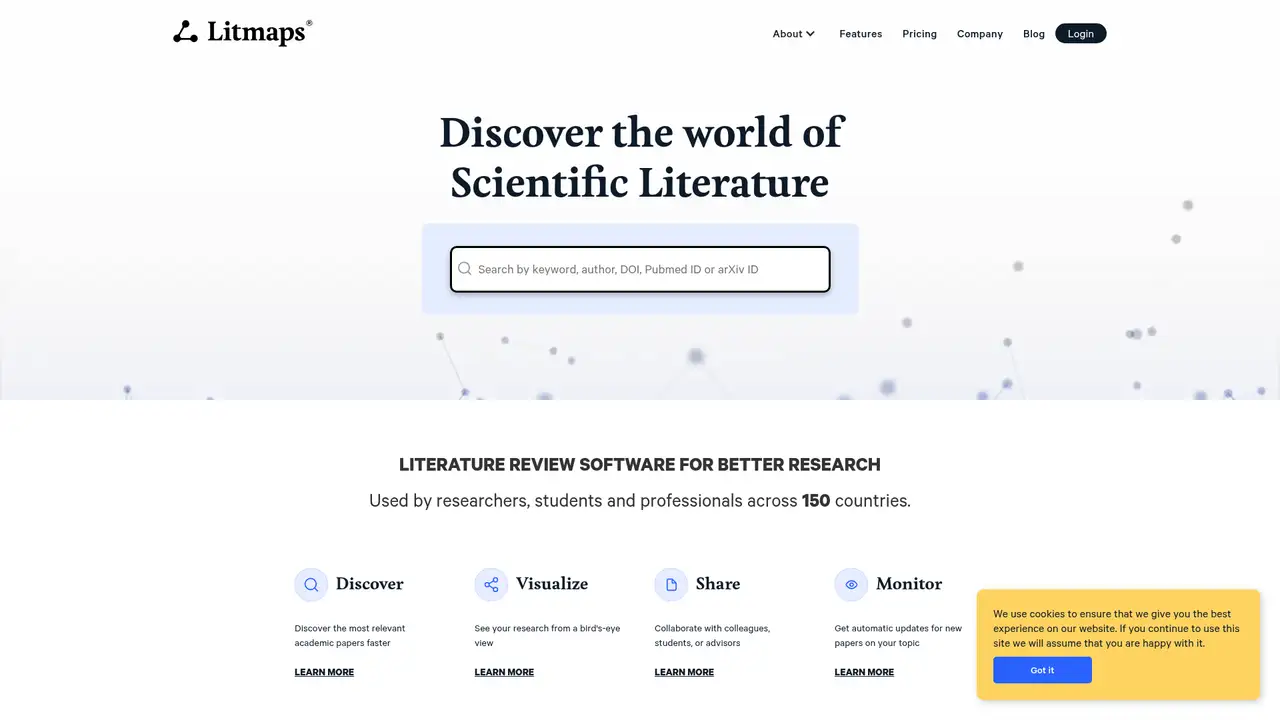
Litmaps is a New Zealand research discovery company founded by Litmap Limited. Its service maps connections among more than 270 million papers, using citation and reference relationships to help researchers find relevant work. In May 2025, the company closed a $1 million Series A first close led by Scholarly Angels and used the funding to acquire ResearchRabbit. Company coverage said the combined community exceeded 2 million users and annual recurring revenue had reached $1 million. Litmaps remains the product identity after the acquisition. The service is aimed at students, academics and research teams rather than general document management users. Its strongest distinction is a visual map that shows how papers connect over time.
A typical Litmaps workflow starts with a seed paper, a search or an uploaded set of references. Users can explore related articles, expand a map with similar papers, and organize results with tags. Imports support Zotero, Mendeley and EndNote, while searches can use academic metadata from sources including Google Scholar, OpenAlex and PubMed. Citation, semantic and co-author views present different ways to inspect a topic. Users can share maps and monitor them for newly published relevant papers. Free accounts receive monthly summaries, while Pro accounts can configure monitoring frequency, algorithms and filters. Zotero Sync, advanced filters and unlimited maps are reserved for Pro. An OpenAPI specification also exposes authenticated article and search endpoints.
Litmaps says its recommendations are based on citation and reference connections, with semantic and co-author networks available as additional views. The service is hosted rather than offered as an open source package or self-hosted installation. Documented changes include a revised map creation workflow in January 2025, monitoring updates in February 2025, and tagging and workspace functionality. The company also acquired ResearchRabbit in May 2025, adding its user community and product assets to Litmaps. Litmaps does not publish a separately verified 2026 release note in the cited material. Its privacy policy, modified in June 2026, describes aggregate and de-identified data use for research and statistical product improvement, but does not expressly state whether identifiable content trains generative AI models.
The free plan costs $0 and allows up to 20 inputs and 100 articles per map. It includes basic search and a monthly summary or monitoring cadence, but no collaboration. Pro is listed at $10 per month, with unlimited inputs, articles, maps, searches and features, plus advanced filters, Zotero Sync, semantic and co-author maps, and configurable alerts. Litmaps says education users receive 75% off commercial pricing, while team, institutional, government and nonprofit arrangements can use custom rates. A third-party pricing capture reports $120 annually, but the official page does not clearly publish that annual amount. Team plans provide unlimited team collaboration and use custom pricing. Paid prices may vary by billing or license type.
Litmaps is less suitable for summarizing individual documents, maintaining a personal reference library, or running a self-hosted service. Elicit is stronger for structured, question-led reviews, while Consensus suits answer-oriented searches. Connected Papers is a closer visual alternative for focused relationship graphs, although Litmaps adds monitoring, tagging, imports and team collaboration. ResearchRabbit is no longer an independent alternative because Litmaps acquired it in 2025. Litmaps does not clearly publish a generative AI training policy or claim public SOC 2 or ISO certification. Its free plan permits 20 inputs and 100 articles per map, while Pro is listed at $10 per month. Choose Litmaps if you are a researcher who values visual citation discovery, expanding maps and ongoing alerts more than document summarization.
Who is Litmaps best for?
- Researchers tracing citation relationships across a broad topic.
- Students building literature reviews from a few seed papers.
- Teams sharing maps, tags and ongoing research alerts.
- Users who want configurable monitoring for new publications.
Litmaps Pricing (2026)
Pricing model: Freemium. All prices in USD.
| Plan | Price | What you get |
|---|---|---|
| Free | $0 | Up to 20 inputs and 100 articles per map. Includes basic search, monthly summaries and no collaboration. |
| Pro | $10/month | Unlimited inputs, articles, maps, searches and features, plus advanced filters, Zotero Sync and configurable alerts. |
| Team | Custom | Unlimited articles and maps with team-wide unlimited collaboration. |
Pros and Cons
Pros
- Maps citation, semantic and co-author relationships visually.
- Searches and organizes a catalogue stated at over 270 million papers.
- Pro supports unlimited maps, inputs, articles and configurable alerts.
- Imports work with Zotero, Mendeley and EndNote.
Cons
- The free plan limits inputs, articles and collaboration.
- Annual commercial pricing is not clearly published on the official page.
- AI training practices are not expressly defined in the privacy policy.
Who should look elsewhere?
- Readers seeking detailed summaries of individual uploaded documents.
- Organizations requiring a documented self-hosted deployment.
- Users who need a clearly stated generative AI training policy.
Technical Details
Frequently Asked Questions
How much does Litmaps cost?
Litmaps has a free plan and a Pro plan listed at $10 per month. The free plan supports up to 20 inputs and 100 articles per map. Education users receive 75% off commercial pricing. Team, institutional, government and nonprofit plans use custom pricing. The official page does not clearly publish the annual commercial amount.
Does Litmaps have a free plan?
Yes. The free plan costs $0 and includes basic search, up to 20 inputs and 100 articles per map. It provides monthly summaries or monitoring, but excludes collaboration. Advanced search, unlimited maps and articles, configurable alerts, Zotero Sync and other Pro features require a paid license.
How does Litmaps compare with Connected Papers?
Both tools help researchers inspect relationships among academic papers visually. Litmaps is the better choice when you need ongoing monitoring, tags, sharing, reference manager imports and configurable alerts. Connected Papers is a more focused option for creating a relationship graph around a topic or seed paper. The recommendation depends on whether follow-up discovery or a single visual graph matters more.
Does Litmaps train AI models on user data?
Litmaps does not expressly state whether identifiable user content trains generative AI models. Its privacy policy says aggregate and de-identified data may be used for research and statistical product improvement. The company says it does not sell personal data, and its data processing addendum describes Litmaps as a processor for customer data.
Can I use Litmaps for commercial research?
Yes. Litmaps lists commercial Pro pricing and offers team and institutional licensing. The service supports research discovery, citation mapping, monitoring, imports and collaboration. Commercial users should review the applicable subscription terms and license because team, institutional, government and nonprofit arrangements may have different pricing or conditions.
Best Litmaps Alternatives in 2026
These tools do the same job as Litmaps, with different pricing, limits and trade-offs.

Visual maps for discovering related academic papers
AI workflows for literature search, review, and research reports

Evidence-linked search and synthesis for academic literature

Citation context and evidence checks for scientific research

Citation networks for discovering and connecting academic literature