
Salesloft Review, Pricing & Alternatives (2026)
Revenue orchestration connecting buyer signals with seller action
Last updated: October 26, 2026
What is Salesloft?
Salesloft is a revenue orchestration platform for mid-market and enterprise revenue teams. It combines sales engagement, conversation intelligence, deal management, forecasting, seller prioritization and AI agents under the Salesloft brand after its merger with Clari. Current pricing is quote-led, with Advanced and Elite as the named packages and no public entry price.
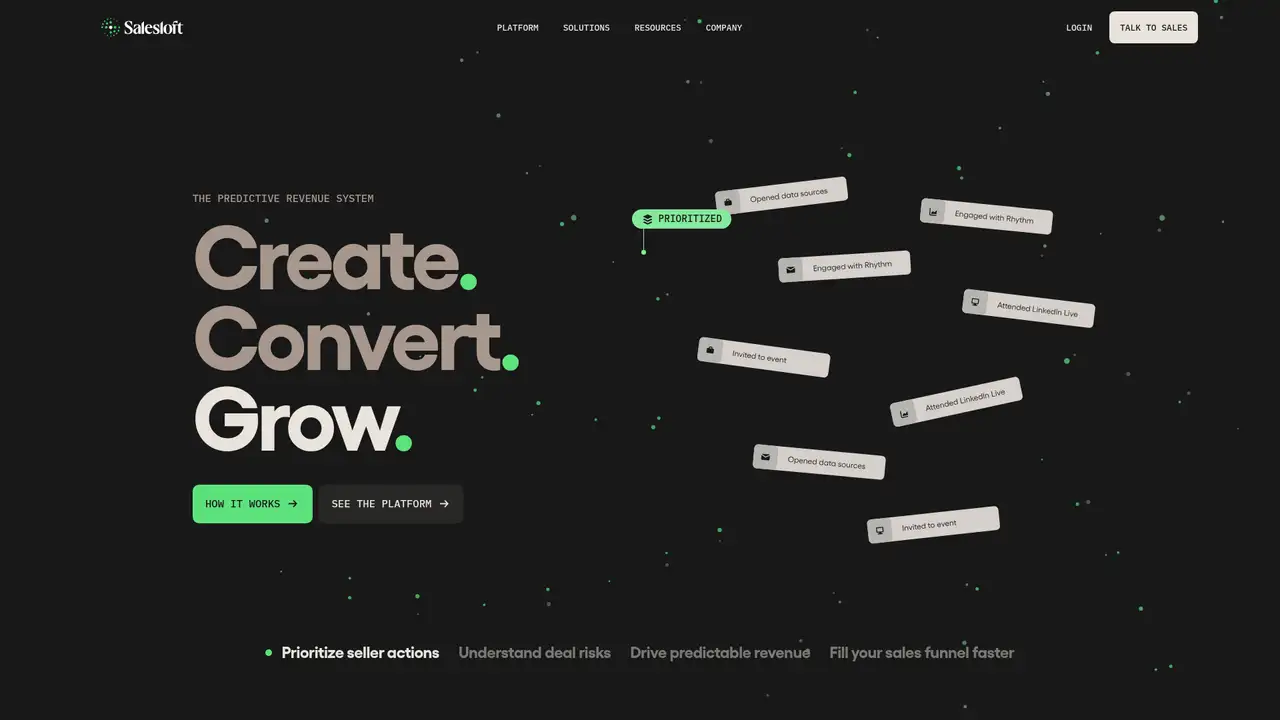
Salesloft is a revenue orchestration platform for mid-market and enterprise teams. Its suite covers Cadence for sales engagement, Conversations for recording and intelligence, Deals for deal execution, Forecast for forecasting, Rhythm for seller prioritization, and AI agents for account research and coaching. The company says its Predictive Revenue System connects buyer engagement, conversation, deal, and forecast signals to seller actions. Salesloft reports more than 4,000 customers, including Adobe, 3M, IBM, and Zoom. Its merger with Clari completed in December 2025, establishing Salesloft as the go-forward company and platform brand. Clari Forecast retains its name, while broader Clari capabilities continue under Salesloft. Current packaging includes Advanced and Elite, with some features offered as add-ons or package-dependent modules.
Salesloft brings outbound execution and revenue intelligence into one connected workflow. A team can use Cadence to organize multichannel outreach, Conversations to capture buyer interactions, Deals to inspect opportunities, Forecast to evaluate expected revenue, and Rhythm to prioritize seller actions. AI agents support account research and coaching workflows. The company says its system connects buyer engagement, conversation, deal and forecast signals so revenue teams can turn them into prioritized work. Exact workflows depend on purchased modules and CRM configuration. Deals documentation identifies a Salesforce CRM dependency, making CRM fit an important procurement question. The platform is therefore broader than a sequencing tool, but its value depends on which modules a customer buys and how those modules connect to existing systems.
The platform combines Salesloft’s sales engagement, revenue intelligence and forecasting within its Predictive Revenue System. Salesloft says its combined dataset with Clari contains more than 10 billion revenue interactions and 1 trillion data signals. After the merger, the company says it connected forecasting intelligence with seller execution, made revenue data available through its MCP Server, and launched Salesloft Conversation Intelligence. It also describes agentic AI for account research and coaching. These are company descriptions of capabilities, not independently tested performance results. Salesloft does not publish named underlying model IDs, model providers, or a dated technical model release in the cited material.
Salesloft does not publish a complete public checkout price for its current packages. Its help documentation identifies Advanced and Elite, while noting that package contents can vary and directing buyers to an account representative. Elite adds capabilities for complex enterprise use, including multi-team administration, sandbox support and CRM signals for custom objects. Forecasting, Account Agent, Coaching Agent and Dialer may be add-ons or package-dependent features. A transition article lists Advanced at $180 and Premier at $220, but those names belong to earlier packaging and are not current universal rates. Legacy Essentials, Prospect, Sell, Engage and Enterprise packages are no longer sold. Buyers should therefore treat the historical prices as context, not as current standard rates, and request a quote based on required modules.
Salesloft suits revenue organizations that want engagement, conversations, deals and forecasting connected in one commercial platform, although quote-led packaging makes comparisons harder. Outreach is a close alternative for enterprise sequencing and seller workflows, while Gong focuses on conversation intelligence and revenue analysis. ZoomInfo Sales combines prospect data, engagement and intent. HubSpot Sales Hub and Salesforce Sales Engagement are more natural choices for teams prioritizing CRM-native execution. Salesloft is a poor fit for buyers seeking transparent self-serve pricing or a documented self-hosted edition. Choose it when a mid-market or enterprise revenue team wants coordinated engagement and forecasting under one brand, with exact module availability and costs determined during procurement rather than through a complete public rate card.
Who is Salesloft best for?
- Enterprise revenue teams needing engagement and forecasting in one platform.
- Sales leaders coordinating Cadence, Conversations, Deals and Forecast workflows.
- Teams using Salesforce that need connected seller execution and deal inspection.
- Organizations evaluating AI agents for account research and coaching workflows.
Salesloft Pricing (2026)
Pricing model: Paid. All prices in USD.
| Plan | Price | What you get |
|---|---|---|
| Advanced | Custom | Quote-based package for sales engagement. Exact seat minimums, included features, add-ons, and contract terms are set in the sales proposal. |
| Elite | Custom | Designed for complex enterprise requirements with multi-team administration, sandbox support and CRM signals for custom objects. |
Pros and Cons
Pros
- It connects sales engagement with conversations, deals and forecasting.
- Its Advanced and Elite packages address different enterprise administration needs.
- REST APIs support OAuth 2.0, private applications and customer API keys.
- The combined platform covers seller execution and revenue intelligence.
Cons
- Current pricing is quote-led and package entitlements can vary.
- Deals documentation identifies a Salesforce CRM dependency.
- Several capabilities are add-ons or package-dependent.
Who should look elsewhere?
- Small teams requiring transparent self-serve pricing.
- Buyers seeking a documented self-hosted deployment.
- Teams wanting a standalone prospect database as their primary tool.
Technical Details
Frequently Asked Questions
How much does Salesloft cost?
Salesloft does not publish a complete current public rate card. Current help materials identify Advanced and Elite packages, with exact pricing and entitlements handled through an account representative. A transition article lists historical Advanced pricing at $180 and Premier pricing at $220, but those packages belong to earlier packaging and should not be treated as current universal prices.
Does Salesloft have a free plan?
Salesloft does not list a current free plan in its package documentation. Its current named packages are Advanced and Elite, both quote-led. Forecasting, Account Agent, Coaching Agent and Dialer may be add-ons or package-dependent. Buyers should request a current package breakdown because contents can vary by agreement.
How does Salesloft compare with Outreach?
Salesloft and Outreach both address sales engagement and enterprise seller workflows. Salesloft extends its platform across Conversations, Deals, Forecast and Rhythm after combining with Clari. Outreach is a direct alternative for sequencing and revenue workflows. The choice depends on CRM fit, forecasting requirements, dialer needs, pricing and the modules included in each proposal.
Does Salesloft train AI on customer data?
Salesloft describes a combined revenue dataset of more than 10 billion interactions and 1 trillion data signals, and says Revenue Context supports its models and AI agents. The cited pages do not state a complete policy explaining whether customer data is used to train general-purpose models. Buyers should review the applicable contractual privacy and data-processing terms.
Can companies use Salesloft commercially?
Salesloft is sold as business software for revenue teams, including more than 4,000 organizations such as Adobe, 3M, IBM and Zoom. Commercial use is part of its customer offering. Specific licensing, user rights, data permissions, API terms and add-on entitlements depend on the customer agreement and should be confirmed in the purchase contract.
Best Salesloft Alternatives in 2026
These tools do the same job as Salesloft, with different pricing, limits and trade-offs.

AI-assisted workflows for prospecting, deals, forecasting, coaching, and expansion

Revenue intelligence that turns customer interactions into guided sales action.

Sales intelligence, outreach, enrichment, and AI workflows together

Account research and prioritization folded into ZoomInfo's GTM Workspace
CRM-grounded AI assistants, agents, and workflows for go-to-market teams