
Apollo.io Review, Pricing & Alternatives (2026)
Sales intelligence, outreach, enrichment, and AI workflows together
Last updated: October 22, 2026
What is Apollo.io?
Apollo.io is a sales intelligence and go-to-market platform for founders, sales teams, marketers, and revenue operations groups that need prospect data, enrichment, sequencing, calling, and AI-assisted workflows. A free plan costs $0, while paid plans start at $49 per seat monthly with annual billing, according to October 2026 coverage from ZoomInfo.
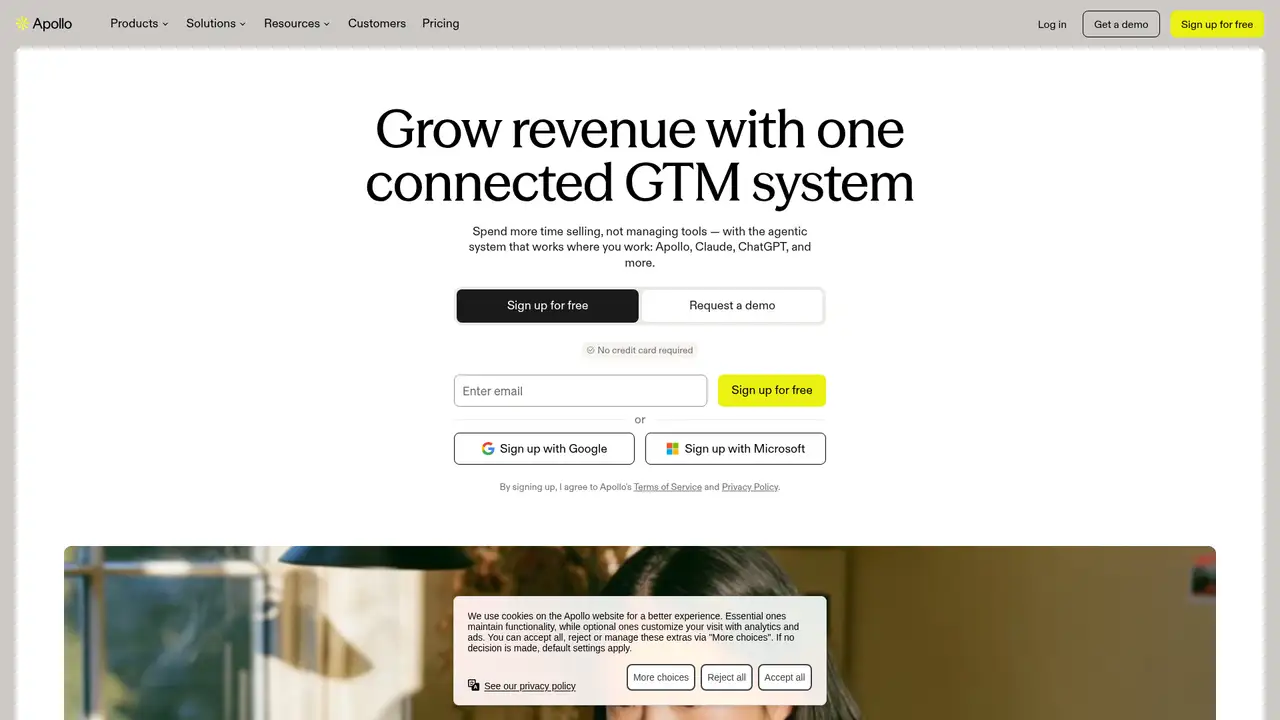
Apollo.io is a sales intelligence and go-to-market platform made by ZenLeads, Inc., doing business as Apollo.io. Founded in 2015, it released its first product in 2016 and says it reached $150 million in annual recurring revenue in May 2025. Apollo also reports more than 500,000 companies using the platform and more than 50,000 weekly active users in 2025. Its 2023 Series D raised $100 million at a reported $1.6 billion valuation. The product combines a business contact database with prospect search, enrichment, sequencing, calling, pipeline support, analytics, and AI features. That combination places Apollo closer to a sales operating system than a standalone lead database, serving founders, sales teams, marketers, and revenue operations groups.
Apollo’s workflow usually begins with finding people or companies through filters, then selecting records for enrichment, lists, sequences, or exports. Email campaigns are available on every account. Free users can connect Gmail, while paid users can connect Microsoft Office and other providers. Teams can create sequences, manage pipeline activity, record calls, prepare for conversations, and review AI-generated insights. The AI Assistant accepts natural-language requests, uses Apollo data and saved messaging context, and can find decision-makers, research accounts, build sequences, export lists, and report on performance. Scheduled agents can run some outbound tasks in the background. Permissions still govern available actions, and Apollo advises reviewing generated messages, matches, and credit estimates before execution.
Apollo says it uses proprietary machine-learning models, third-party AI providers, and an integration layer for customer-selected tools. Its August 2026 AI policy names OpenAI, Anthropic, Gemini, Perplexity, Assembly AI, and Exa among providers used for selected features. Apollo says internal models run on its infrastructure and may use Customer Data and proprietary data as training inputs. Its October 2025 agentic platform announcement introduced AI Assistant, AI Projects, agentic outbound, inbound, deals, and data enrichment. Apollo said more than 10,000 users joined the AI Assistant beta within five days. Documentation updated October 14, 2026 adds personal memory, scheduled agents, and support for connecting a customer’s own large language model key.
Apollo uses per-seat plans plus credits for consumption-based actions. Free costs $0 per month and remains available without a time limit, with five AI Assistant chats per billing cycle and ten messages per chat. Basic costs $49 per seat monthly when billed annually, Professional costs $79, and Organization costs $119 with a three-seat minimum, according to its October 2026 pricing page. Apollo’s official plan naming uses Custom rather than Organization for teams needing custom volumes, single sign-on, advanced security, dedicated support, or complex integrations. Paid credits are pooled, granted at the billing-cycle start, and do not roll over. Add-on credits are recurring until removed, and monthly billing costs more than annual billing.
Apollo’s main limitation is pricing and usage complexity: the final amount depends on seats, billing frequency, credits, add-ons, and selected features. Basic includes one mailbox, 250 daily emails, five team workflows, and 1,000 records per selection, while Professional raises several limits and adds AI and call features. Standard plans are for internal business use, so powering external products, sharing data with customers, or reselling it requires a separate agreement. Apollo competes with ZoomInfo, Cognism, Outreach, Salesloft, and HubSpot Sales Hub. It combines data and enrichment more closely than Outreach or Salesloft, and adds execution tools beyond ZoomInfo or Cognism. Choose Apollo if one team needs prospect intelligence, outbound execution, enrichment, and AI actions together.
Who is Apollo.io best for?
- Small teams building outbound prospecting programs.
- Sales teams combining contact data with sequencing.
- Revenue operations teams managing shared credits.
- Teams wanting AI actions inside sales workflows.
Apollo.io Pricing (2026)
Pricing model: Freemium. All prices in USD.
| Plan | Price | What you get |
|---|---|---|
| Free | $0/month | Free access remains available without a time limit. It includes five AI Assistant chats per billing cycle, ten messages per chat, Gmail connections, and one seat after downgrade. |
| Basic | $49/seat/month, billed annually | October 2026 ZoomInfo coverage lists 30,000 credits per seat yearly, one mailbox, 250 daily emails, five team workflows, and 1,000 records per selection. |
| Professional | $79/seat/month, billed annually | October 2026 ZoomInfo coverage lists 48,000 credits per seat yearly, unlimited daily sends, AI features, call recording, 50 team workflows, and 2,500 records per selection. |
| Organization | $119/seat/month, billed annually | October 2026 ZoomInfo coverage lists 72,000 credits per seat yearly and a three-seat minimum. Apollo’s official plan page names Custom rather than Organization. |
| Custom | Custom | Apollo describes Custom for teams needing custom volumes, SSO, advanced security, dedicated support, or complex integration requirements. |
Pros and Cons
Pros
- Apollo combines prospect data, enrichment, sequences, and pipeline tools.
- The AI Assistant can turn natural-language requests into sales actions.
- Free accounts remain available without a short trial deadline.
- The API supports enrichment, organization search, and AI insight workflows.
Cons
- Paid costs vary by seats, billing frequency, add-ons, and credit usage.
- Credits expire at the end of each billing cycle.
- Standard plans restrict external resale and customer-facing data products.
Who should look elsewhere?
- Teams needing fixed paid pricing without a calculator or checkout.
- Organizations selling Apollo data through customer products.
- Teams wanting an open-source or self-hosted database.
Technical Details
Frequently Asked Questions
How much does Apollo.io cost?
Apollo’s Free plan costs $0 per month. October 2026 coverage from ZoomInfo lists Basic at $49, Professional at $79, and Organization at $119 per seat monthly when billed annually, with three seats required for Organization. Apollo’s official page names Free, Basic, Professional, and Custom, while its calculator says final costs depend on seats, usage, add-ons, and billing frequency.
Does Apollo.io have a free plan?
Yes. Apollo offers a Free plan without a time limit after a trial. Free accounts include five AI Assistant chats per billing cycle, with ten messages per chat, and Gmail connections for campaigns. Apollo says downgrading limits the account to one seat. Credits are granted according to the account and expire at the end of each billing cycle.
Apollo.io versus ZoomInfo: which is better?
Apollo and ZoomInfo both provide business contact intelligence, but Apollo combines prospect data with sequencing, enrichment, pipeline tools, and AI actions. ZoomInfo is a direct competitor for contact and company intelligence. Choose Apollo when outbound execution belongs in the same workspace. Choose ZoomInfo when the buying decision focuses more narrowly on its data platform and sales intelligence capabilities.
Does Apollo train AI models on customer data?
Apollo says it may use Customer Data and proprietary data as inputs to train internally developed models running on Apollo infrastructure. It says third-party AI providers cannot use Customer Data for algorithm training or model enhancement without disclosure and consent. Apollo also says Customer Data sent to those providers is deleted within 30 days, subject to its AI policy.
Can I use Apollo data commercially?
Apollo’s standard plans support internal business use. Its pricing page says customers cannot use Apollo data to power external products, share data with customers, or resell it under standard terms. Those uses require a separate agreement with custom pricing. Teams should review Apollo’s terms and API restrictions before routing data through external products or AI tools.
Best Apollo.io Alternatives in 2026
These tools do the same job as Apollo.io, with different pricing, limits and trade-offs.