Gong Review, Pricing & Alternatives (2026)
Revenue intelligence that turns customer interactions into guided sales action.
Last updated: October 22, 2026
What is Gong?
Gong records and analyzes customer interactions for revenue teams that need coaching, deal inspection, forecasting, and sales engagement. Paid access requires a custom quote covering per-user licenses and a platform fee, with optional applications and AI usage credits adding further costs. Free Collaborator seats offer limited access within an existing customer account.
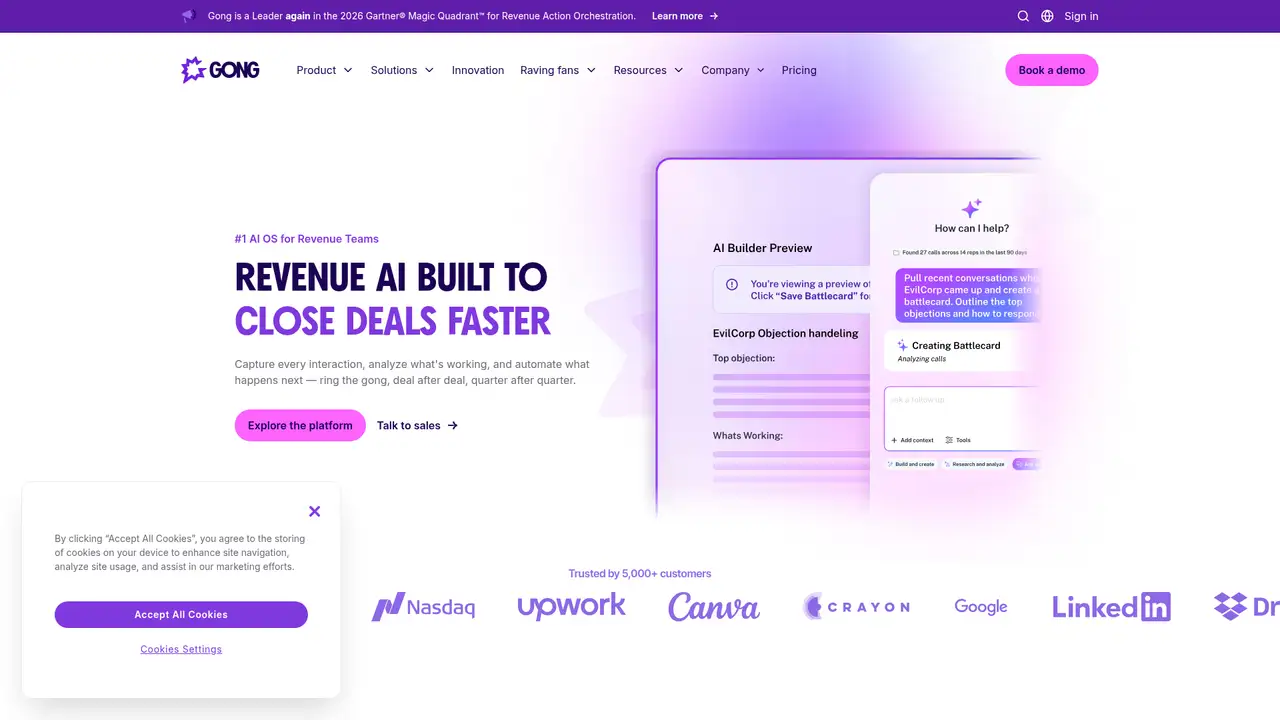
Gong is a revenue technology company founded in 2015. It began with conversation recording and analysis and now presents its product as a Revenue AI OS for revenue teams. The platform captures customer interactions, connects them with revenue data, and supports workflows for sales, customer success, enablement, forecasting, engagement, and account management. Gong describes its architecture through the Revenue Graph, AI agents, applications, and operating surfaces. Current product areas include Gong Engage, Gong Forecast, Gong Enable, Gong Agents, Account Boards, Account Console, and related revenue applications. Gong announced more than 4,800 customer companies in October 2025. The company continues to publish product announcements, documentation, and security updates.
Gong connects recorded calls, emails, meetings, CRM information, and other digital interactions into searchable revenue context. Its API can accept calls recorded by other systems and CRM data, then return transcripts, participants, topics, trackers, comments, scorecards, analyzed call information, team activity, and interaction statistics. Teams can use this information for call review, coaching, deal inspection, pipeline risk analysis, forecasting, account management, customer handoffs, custom reporting, and custom workflows. Gong Engage supports sales outreach, while Gong Forecast supports pipeline visibility and forecasting. Gong Enable uses customer conversations for coaching, guided practice, and measurement. AI agents support transcription, briefings, question answering, task suggestions, email composition, deal review, deal prediction, revenue prediction, tracking, and theme detection.
Gong announced more than a dozen purpose-built AI agents in April 2025, including AI Activity Mapper, AI Transcriber, AI Briefer, AI Ask Anything, AI Call Reviewer, AI Tasker, AI Composer, AI Deal Monitor, AI Deal Reviewer, AI Deal Predictor, AI Revenue Predictor, AI Tracker, and AI Theme Spotter. In October 2025, the company announced Gong Orchestrate, expanded AI Ask Anything, AI Deep Researcher, AI Data Extractor, configurable Forecast Boards, and broader Account Boards. Mission Andromeda, announced in February 2026, introduced Gong Enable, Gong Assistant, Account Console, Account Boards, and support for Model Context Protocol. Gong describes its AI as developed through an in-house framework, but the available material does not name a proprietary large language model.
Gong does not publish standard public prices. Its pricing page says licenses are priced per user, the platform fee depends on supported users, and existing technology integrations can be connected without an integration charge. Current packaging includes a required Gong Foundation core license and optional applications including Enable Essentials, Forecast Essentials, Gong Forecast, Gong Engage, and Data Cloud. A team member without an assigned seat is a Collaborator and receives limited access without a paid seat. Additional seats may be purchased, and newly purchased seats are charged on a prorated basis through the subscription term. Exact application prices, platform fees, seat prices, billing cadence, and additional credit prices require a customer proposal.
Gong credits are usage units for selected AI processing. Each paid core seat includes 2,000 annual credits in a company-wide pool that resets at the start of each contract year. Ten emails consume one credit, calls longer than ten minutes consume one credit, and calls up to ten minutes consume 0.3 credits. Selected trackers, API and MCP requests, deep mode, Gong Enrich, and automated briefs can consume credits. When the pool is exhausted, credit-based processing stops while existing data remains available; API requests can fail, automated briefs can stop updating, and trackers must be resumed after credits are added. Purchased credits expire at the end of the contract term.
Who is Gong best for?
- Revenue teams that need interaction intelligence connected to coaching and deal workflows.
- Organizations managing sales forecasting from customer interaction data.
- Large teams requiring permissions, integrations, seat administration, and data controls.
- Companies wanting governed AI agents for revenue operations.
Gong Pricing (2026)
Pricing model: Paid. All prices in USD.
| Plan | Price | What you get |
|---|---|---|
| Gong Foundation | Custom | Required core license; per-user pricing plus a platform fee. Billing terms and included capabilities depend on the contract. |
| Enable Essentials | Custom | Optional application for AI-based coaching and sales performance capabilities. Requires Gong Foundation. |
| Forecast Essentials | Custom | Optional application for pipeline visibility, deal intelligence, and forecasting essentials. Requires Gong Foundation. |
| Gong Forecast | Custom | Optional application providing the full Gong Forecast capability set. Requires Gong Foundation. |
| Gong Engage | Custom | Optional application for prioritizing, personalizing, and automating sales outreach. Requires Gong Foundation. |
| Data Cloud | Custom | Optional application for exporting Gong-enriched data to external data platforms, BI tools, and other data sources. |
| Collaborator | $0 | Limited access without an assigned paid seat; capabilities depend on the organization’s plan. |
| Gong credits | Custom | Each paid core seat includes 2,000 annual shared credits. Additional credits expire at the contract term’s end. |
Pros and Cons
Pros
- Gong combines interaction capture, analysis, coaching, forecasting, and revenue workflows.
- Its API supports importing calls and CRM data and retrieving analyzed interaction records.
- The platform provides permissions, retention, recording, and credit controls.
- Collaborator seats provide limited access without paid seat assignment.
Cons
- Gong does not publish standard seat or application prices.
- Selected AI workflows consume shared credits and can pause when credits run out.
- Recorded customer interactions require consent, privacy, and retention governance.
Who should look elsewhere?
- Small teams seeking transparent self-serve pricing.
- Teams needing an open-source or self-hosted conversation platform.
- Organizations unwilling to manage recorded interaction consent and retention policies.
Technical Details
Frequently Asked Questions
How much does Gong cost?
Gong does not publish standard public prices. Its pricing page states that licenses are priced per user and that a platform fee depends on supported users. The current model combines Gong Foundation with optional applications, seats, and selected AI usage controls. Exact prices, billing terms, and credit purchases require a customized proposal.
Does Gong have a free plan?
Gong does not present a free standalone product plan. Its documentation describes free Collaborator access for team members without assigned paid seats. Collaborators receive limited capabilities inside an organization’s Gong account, so this access is not equivalent to a free version of the complete platform.
What is Gong’s closest competitor?
The closest competitor depends on the workflow. Clari is a direct alternative for forecasting and revenue operations, while Salesloft and Outreach overlap more with sales engagement and conversation intelligence. Gong combines interaction analysis, coaching, forecasting, applications, and AI agents, so competing products overlap with different parts of its offering.
Does Gong train AI models on customer data?
Gong’s trust materials state that customer data is not used to train generative AI models and is not shared with or exposed to the public domain. Gong describes a secure in-house AI framework with isolated customer data. Its privacy policy also describes customer-data processing under customer instructions and applicable contractual data-processing terms.
Can companies use Gong commercially?
Gong is sold as a commercial subscription for organizations through per-user licenses, a platform fee, applications, seats, and selected credit-based processing. Commercial use is governed by the customer contract, order form, privacy terms, data-processing addendum, and applicable recording and data-protection obligations. Gong materials reference GDPR, UK GDPR, CCPA, and security controls.
Best Gong Alternatives in 2026
These tools do the same job as Gong, with different pricing, limits and trade-offs.