
People.ai Review, Pricing & Alternatives (2026)
Revenue answers from CRM, communication, and engagement signals
rebranded: People.ai rebranded as Backstory on April 21, 2026. Legacy People.ai documentation remains available.
Last updated: October 26, 2026
What is People.ai?
People.ai, now branded Backstory, is an enterprise revenue intelligence platform for Salesforce-centered teams. It connects CRM, email, calendar, call, meeting, and engagement signals to support deal risk, pipeline health, account strategy, qualification, forecasting, and activity capture. It suits revenue leaders and operations teams, with quote-based pricing and no published entry price.
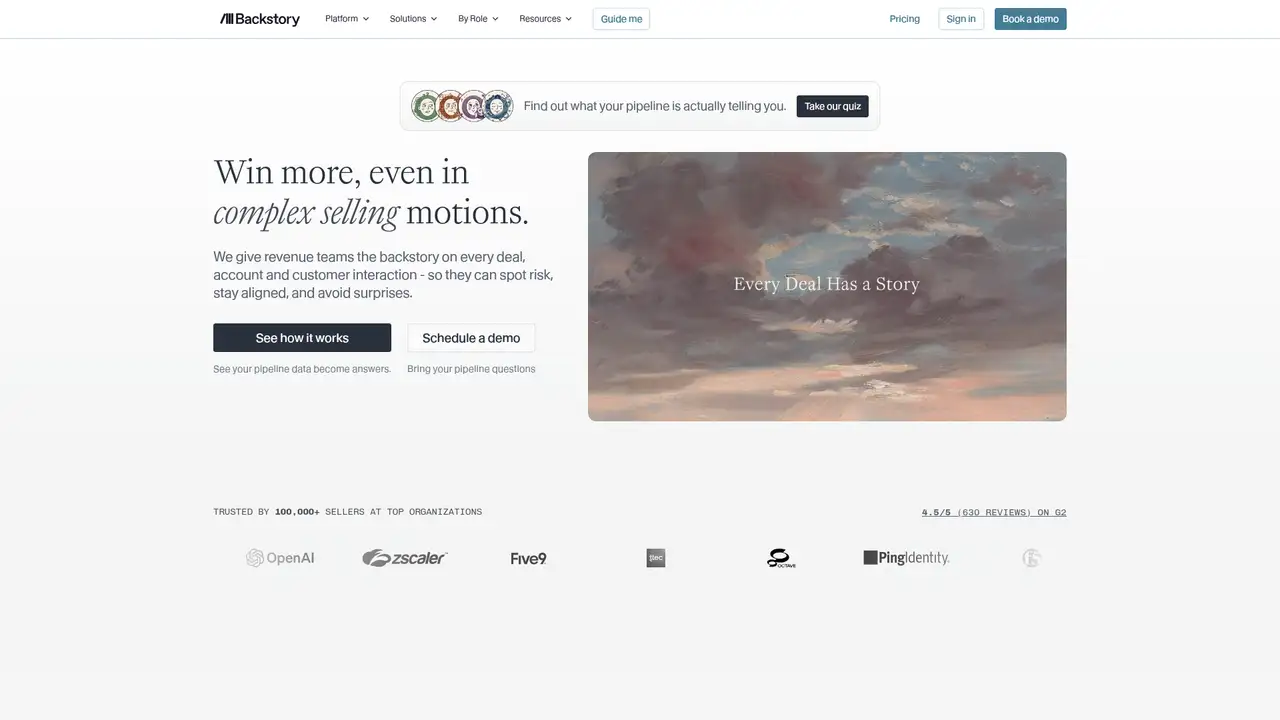
People.ai, founded in 2016, is now branded Backstory, an enterprise sales and revenue operations software company. On April 21, 2026, the company announced the new name and described a Revenue Answers Platform focused on questions about deals, accounts, and pipeline. Backstory says it began by helping revenue teams avoid searching emails, call recordings, and CRM notes to understand deal status. Its careers page says the platform processes billions of signals and supports trillions in customer revenue. Buyers should search both names during procurement, security review, and renewal because current branding uses Backstory while legacy documentation still uses People.ai. The company remains active, with product and support material published under both names.
Backstory ingests CRM records, email, calendars, calls, meetings, intent data, news, and related engagement information, then associates those signals with accounts and opportunities. The company describes automatic activity capture, relationship and stakeholder visibility, pipeline health, deal risk monitoring, opportunity qualification, account strategy, and forecasting as core outcomes. A typical workflow begins with connected revenue systems, maps activity to the relevant account or opportunity, and presents context about momentum, risk, or missing engagement. Recommended actions can appear in Salesforce, Slack, Microsoft Copilot, ChatGPT, and Claude. Backstory targets revenue execution and intelligence rather than contact-data prospecting, outbound sequencing, or standalone dialing. Its workflow helps revenue teams inspect scattered activity within deal and account contexts instead of relying on manually updated CRM records or separate communication systems.
The platform applies revenue-specific reasoning to execution data and engagement patterns. Backstory says it combines activity data, relationship intelligence, and AI-driven insights to reconstruct activity inside deals and accounts. Its platform material describes an MCP offering that provides deal context where teams work, with integrations for Salesforce, Slack, Microsoft Copilot, ChatGPT, and Claude. Backstory does not publish named foundation models, model versions, context windows, or latency figures. The notable recent release is the 2026 rebrand from People.ai to Backstory. The company describes that change as a move from data and analytics toward answers and decisions for revenue teams. This positioning distinguishes the product from general-purpose AI tools and supports its focus on revenue execution and account intelligence.
Backstory uses quote-based enterprise pricing instead of a public self-serve seat price. Its pricing material says costs reflect what a team uses, while current public material does not provide a dependable dollar figure, usage allowance, or complete plan catalog. Historical People.ai documentation mentions Forensics, Forecasting, and Premium or Enterprise Opportunity and Account Management, but those labels should not be treated as current packages without a quote or order form. Older documentation also describes a free PeopleGlass version and a paid PeopleGlass+ enterprise edition. Integration scope, permissions, implementation, and data volume may affect the commercial discussion. Backstory does not publish a fixed entry price, so buyers need a quote or order form to establish current packaging and cost.
The main limitation is purchase and deployment complexity. Teams should evaluate data association, explanation quality, permissions, recording consent, retention, regional hosting, deletion, subprocessors, and model-training terms before connecting communication systems. Salesforce setup documents a managed package, connected app, SSO, permissions, and sandbox compatibility. Customer API connectivity and an MCP surface are also documented, although public developer limits are not clear. Gong emphasizes conversation intelligence, Clari emphasizes forecasting and revenue execution, and Outreach emphasizes outbound execution. Salesforce Revenue Intelligence is the closer native analytics option. Backstory is now the stronger choice for revenue teams that need answers assembled from scattered CRM, communication, and engagement signals, provided they can support enterprise procurement, integration work, and the related governance review before deployment.
Who is People.ai best for?
- Enterprise revenue teams using Salesforce as a central system.
- Sales leaders who need deal-risk and pipeline context.
- Revenue operations teams automating activity capture.
- Organizations combining CRM, email, calendar, and call signals.
People.ai Pricing (2026)
Pricing model: Paid. All prices in USD.
| Plan | Price | What you get |
|---|---|---|
| Enterprise | Custom | Quote-based pricing applies. The company does not publish a fixed seat price or usage allowance. |
Pros and Cons
Pros
- Connects CRM, communication, and engagement signals around accounts.
- Supports deal risk, pipeline health, qualification, and forecasting workflows.
- Delivers answers through Salesforce and other workplace tools.
- Documents Salesforce setup, permissions, SSO, and sandbox compatibility.
Cons
- Current public pricing does not include a dependable dollar figure.
- The company does not disclose its foundation models or performance metrics.
- Enterprise deployment requires careful privacy and integration review.
Who should look elsewhere?
- Small teams seeking a transparent self-serve price.
- Prospecting teams needing a contact database.
- Sales teams wanting a dedicated outbound sequencer.
Technical Details
Frequently Asked Questions
How much does People.ai cost?
People.ai, now branded Backstory, uses quote-based enterprise pricing. Current public pricing material does not show a fixed dollar amount, seat price, usage allowance, or complete plan catalog. The company says pricing is built around what a team uses. Buyers should request a quote covering integrations, licensed capabilities, implementation services, permissions, and data requirements.
Does People.ai have a free plan?
Current Backstory pricing material does not advertise a free plan. Older People.ai documentation mentions a free PeopleGlass version and a paid PeopleGlass+ enterprise edition, but those references describe historical packaging rather than a confirmed current offer. Teams evaluating the product should ask Backstory which modules and trial options are available under the current brand.
How does People.ai compare with Gong?
People.ai, now Backstory, centers on connecting CRM, email, calendar, call, meeting, and engagement signals to answer questions about deals, accounts, pipeline, and forecasts. Gong emphasizes conversation intelligence. Backstory fits teams seeking broader revenue context across systems, while Gong fits teams prioritizing analysis of sales conversations and related coaching workflows.
Does People.ai train models on customer data?
Published material describes AI-driven insights, revenue reasoning, connected signals, security controls, and permissions, but it does not provide a definitive current statement about training models on customer data. Before connecting mailboxes, calendars, calls, or CRM records, ask Backstory about training use, retention, subprocessors, regional hosting, deletion, and customer data isolation.
Can People.ai data be used commercially?
People.ai and Backstory are enterprise revenue software products intended for business use, including deal intelligence, pipeline health, account strategy, qualification, forecasting, and activity capture. Commercial rights depend on the applicable quote, order form, and contract. Confirm permitted users, connected data, generated outputs, retention, and restrictions on internal or customer-facing use before purchase.
Best People.ai Alternatives in 2026
These tools do the same job as People.ai, with different pricing, limits and trade-offs.

Revenue intelligence that turns customer interactions into guided sales action.

AI-assisted workflows for prospecting, deals, forecasting, coaching, and expansion

Revenue forecasting and intelligence for complex B2B sales teams

Revenue orchestration connecting buyer signals with seller action