
Common Room Review, Pricing & Alternatives (2026)
Buyer intelligence that connects signals to sales workflows
acquired: Zoom's acquisition of Common Room was announced on July 17, 2026, for $266.8 million in cash.
Last updated: October 26, 2026
What is Common Room?
Common Room is a buyer-intelligence platform for revenue teams that combine CRM, product, web, social, and community signals. It is designed for sales and revenue-operations groups that need person-level context, research, enrichment, and workflow automation. Essential costs $2,500 per month, billed annually, with five seats included.
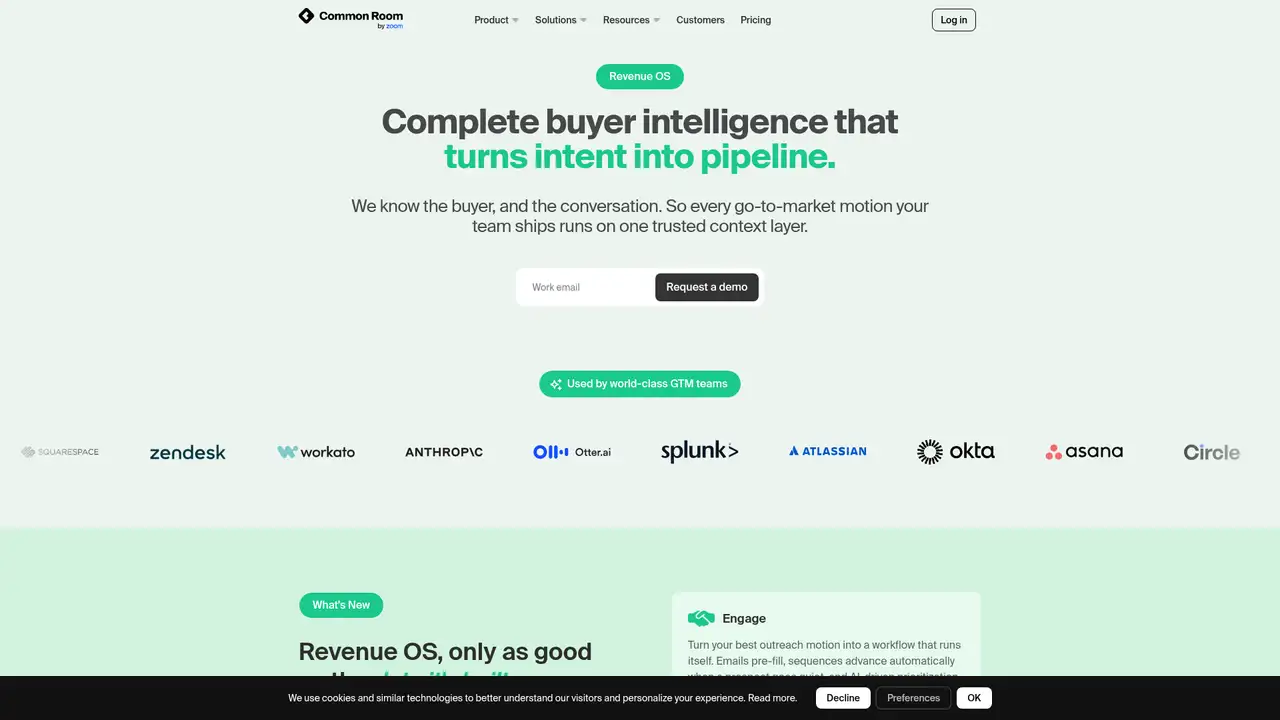
Founded in 2020 by Linda Lian, Francis Luu, Viraj Mody, and Tom Kleinpeter, Common Room sells buyer intelligence software for sales and revenue operations teams. It began as community software, then shifted toward signal-based selling. Forbes reported a $4.3 million seed round and a $16.3 million Series A in 2020. The platform combines first-party customer data with second-party and third-party signals, identity resolution, enrichment, and workflow automation. Its aim is to give sales teams more context than a conventional contact database. The company was acquired by Zoom in July 2026 for $266.8 million in cash, according to the acquisition announcement. That ownership change matters for buyers assessing product direction, integration plans, and long-term support under Zoom’s broader communications business.
A Common Room workflow begins by connecting CRM, sales-engagement, Slack, email, product, web, social, or community data. Person360 resolves multiple digital identities into person and account records, allowing teams to inspect job changes, website visits, intent topics, social engagement, and other activity. Users can rank accounts, create segments, send alerts, export records, or trigger workflows. RoomieAI Capture researches accounts and contacts, while Orchestrate and Spark Brief prioritize activity. Activate drafts outbound messages from that context. Ask CR Anything answers questions inside account and contact views. Teams can also connect the MCP server or CLI to assistants, scheduled jobs, automation pipelines, and custom agents. Every listed plan includes unlimited alerts, workflows, and segments.
RoomieAI is Common Room’s agent suite for go-to-market work, built on unified buyer intelligence rather than isolated public records. Capture researches accounts using internal information and public material such as earnings calls and 10-K filings. Orchestrate and Spark Brief rank accounts and people showing intent, while Activate drafts outbound messages. Ask CR Anything returns answers inside account and contact views. A February 2025 launch post claimed Capture reduced account research from 60 minutes to 60 seconds. The product page lists MCP Server access and a CLI for automation pipelines, scheduled jobs, and custom agents. Enterprise materials list zero data retention for AI, plus SOC 2, GDPR, CCPA, SSO, SAML, and SCIM support.
Essential costs $2,500 per month with annual billing, creating a $30,000 yearly commitment. It includes five seats, 100,000 contacts, 5,000 RoomieAI research credits, 2,500 Prospector credits, six Bombora Company Surge topics, 240,000 annual website-activity credits, and 1,000 monthly website-deanonymization credits. Advanced is Custom with 15 seats, 250,000 contacts, 7,500 RoomieAI credits, 7,500 Prospector credits, and 480,000 annual website-activity credits. Enterprise is Custom with 30 seats, 750,000 contacts, 10,000 RoomieAI credits, 15,000 Prospector credits, and 960,000 annual website-activity credits. DataAgent, extra Prospector credits, and Product Signals can add cost. All plans include CRM, sales-engagement, Slack, and MCP connections. Extra capacity needs budgeting.
Common Room is expensive for small teams, and its annual contract makes casual evaluation difficult. Credit allocations and contact ceilings also require forecasting when research, enrichment, or website activity grows. ZoomInfo centers on business-contact and company data, while Common Room adds first-party signals, identity resolution, and workflow execution. 6sense focuses on account intent and account-based orchestration, while Common Room puts person-level signals and buyer views at the center. Clay gives technical teams more control over multi-provider workflows, while Common Room packages identity resolution, research, prioritization, and activation for revenue teams. Its Prospector comparison claims pricing can reach about 20 percent of ZoomInfo in some cases. Choose Common Room if your team has meaningful first-party signals and wants them connected to sales action.
Who is Common Room best for?
- Revenue teams combining CRM, product, web, and community signals.
- RevOps leaders automating research and signal-triggered workflows.
- Sales organizations needing person and account identity resolution.
- Teams connecting buyer intelligence to MCP-enabled assistants.
Common Room Pricing (2026)
Pricing model: Paid. All prices in USD.
| Plan | Price | What you get |
|---|---|---|
| Essential | $2,500/month | Billed annually. Five seats, 100,000 contacts, 5,000 RoomieAI research credits, 2,500 Prospector credits, and 240,000 annual website-activity credits. |
| Advanced | Custom | Fifteen seats, 250,000 contacts, 7,500 RoomieAI research credits, 7,500 Prospector credits, and 480,000 annual website-activity credits. |
| Enterprise | Custom | Thirty seats, 750,000 contacts, 10,000 RoomieAI research credits, 15,000 Prospector credits, and 960,000 annual website-activity credits. |
Pros and Cons
Pros
- Person360 connects signals to people and buying committees.
- RoomieAI combines research, prioritization, and outbound support.
- Every listed plan includes unlimited alerts, workflows, and segments.
- Enterprise materials list SSO, SAML, SCIM, SOC 2, GDPR, and CCPA support.
Cons
- Essential requires a $30,000 annual commitment.
- Advanced and Enterprise pricing is not published.
- Credits and add-ons make cost forecasting more complex.
Who should look elsewhere?
- Small teams seeking low-cost self-serve prospecting.
- Buyers wanting a contact database as the primary product.
- Teams unwilling to sign an annual contract.
Technical Details
Frequently Asked Questions
How much does Common Room cost?
Essential costs $2,500 per month with annual billing, or $30,000 for a year, and includes five seats. Advanced and Enterprise use Custom pricing. Essential lists 100,000 contacts, 5,000 RoomieAI research credits, 2,500 Prospector credits, and 240,000 annual website-activity credits. The pricing page also lists DataAgent, additional Prospector credits, and Product Signals as add-ons or add-on-only features.
Does Common Room have a free plan?
The pricing page lists Essential, Advanced, and Enterprise, and does not list a free tier. Essential is the published entry plan at $2,500 per month with annual billing. Advanced and Enterprise use Custom pricing. The listed plans include sales, CRM, and Slack connections, while broader integrations and some capabilities vary by tier.
How does Common Room compare with ZoomInfo?
ZoomInfo is centered on business-contact and company information. Common Room combines enrichment with first-party signals, identity resolution, AI research, prioritization, and workflow execution. Common Room's pricing page claims Prospector can cost around 20 percent of ZoomInfo in some comparisons. Buyers should compare coverage, credit consumption, data rights, and contract terms for their target market.
Does Common Room train AI on customer data?
The enterprise page says Common Room offers zero data retention for AI. Its RoomieAI page says agents use a company's unified buyer intelligence for prioritization, research, and outbound support. Common Room's privacy notice says customer data is governed by customer contracts rather than that notice. Buyers should review contractual processing, retention, subprocessors, and training terms.
Can teams use Common Room commercially?
Yes. Common Room is sold as a commercial SaaS platform for sales and revenue teams, with CRM, sales-engagement, Slack, webhooks, exports, MCP, and CLI features listed across its materials. Commercial use remains subject to the order form, plan limits, privacy obligations, and marketing laws. The product is not open source or self-hosted.
Best Common Room Alternatives in 2026
These tools do the same job as Common Room, with different pricing, limits and trade-offs.

Data enrichment and AI workflows for outbound teams

Sales intelligence, outreach, enrichment, and AI workflows together

Account research and prioritization folded into ZoomInfo's GTM Workspace
Account intent data, predictive buying stages and RevvyAI agents for B2B revenue teams
Account-based marketing suite with intent data, B2B ads and Mojo campaign agents