Clay Review, Pricing & Alternatives (2026)
Data enrichment and AI workflows for outbound teams
Last updated: October 22, 2026
What is Clay?
Clay is a GTM data enrichment and workflow platform for sales, marketing, growth, and RevOps teams. It combines 150+ data providers, provider waterfalls, AI research, signals, audiences, CRM workflows, and outbound actions. A Free plan is available, while Launch starts at $185 per month, Growth at $495 per month, and Enterprise uses custom pricing.
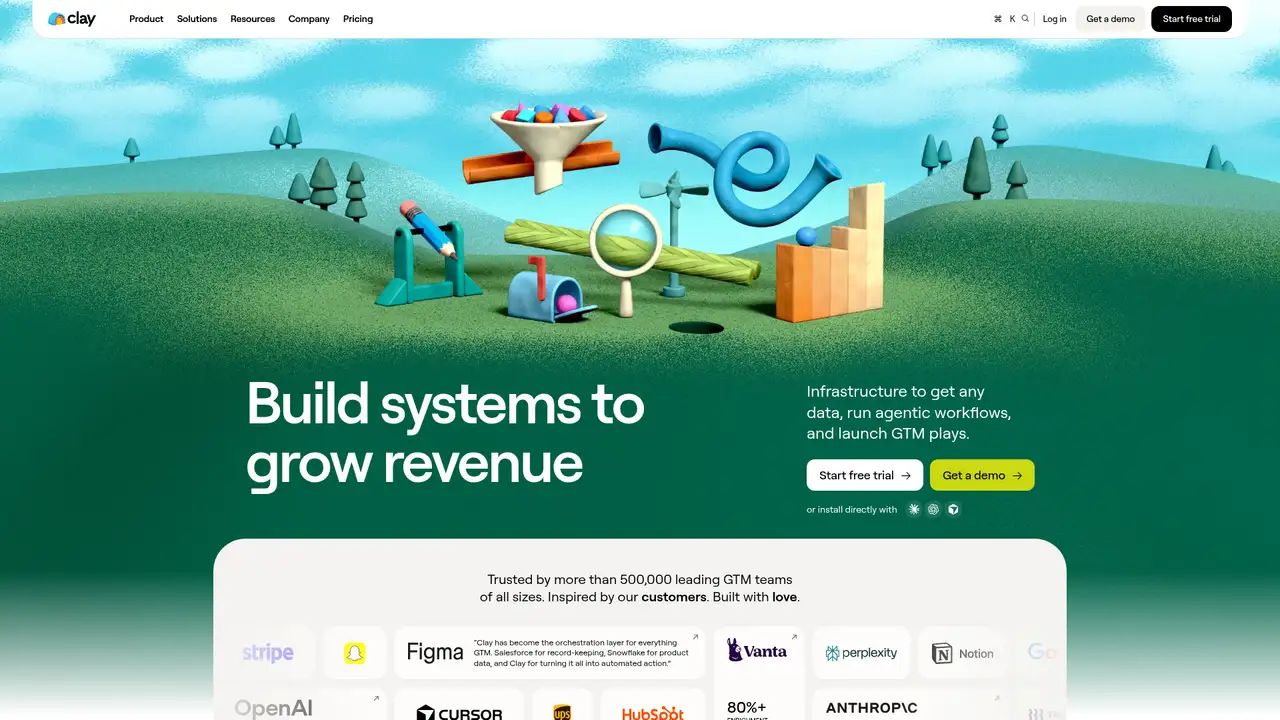
Clay is a GTM data enrichment and workflow platform for sales, marketing, growth, and RevOps teams. Its table-based workspace supports prospect lists, company and contact enrichment, provider waterfalls, AI research, signals, audiences, scoring, and outbound actions. Clay says it began as a data marketplace for researching prospects, with early use focused on enriching and exporting company and contact lists. The current product is positioned as infrastructure for acquiring data, running agentic workflows, and launching GTM plays. Clay says users can combine more than 150 marketplace partners, while Claygent supports web research for custom data points. The platform suits teams that need configurable processes for prospecting, enrichment, research, qualification, and activation instead of a single packaged database.
A typical Clay workflow begins with a table of companies or people, then applies search, enrichment, AI research, scoring, filtering, and an outbound or destination action. Provider waterfalls can use several marketplace sources, and users can bring their own provider or AI API keys. Claygent supports custom web research fields, while Clay Sequencer supports email workflows. Launch adds phone enrichment, job-change and other signal tracking, reusable functions, email campaign integrations, and larger table capacity. Growth adds CRM synchronization, data-warehouse synchronization, HTTP API connections, webhooks, web-intent signals, ad audiences, and priority support. Enterprise adds larger-scale administration, SSO, SCIM, RBAC, connection controls, custom agreements, and a dedicated growth strategist.
Clay separates platform activity from purchased data and AI usage. Actions measure work such as running enrichments, conducting AI research, sending information to other tools, and exporting information. Data Credits pay for marketplace data and selected AI usage, including email addresses, phone numbers, company information, and model consumption. Clay says 80 percent of its AI models use fixed Data Credit pricing, while token-intensive models use variable pricing based on consumption. Users may bring their own provider or AI API keys, avoiding Data Credit charges for that provider while still using Actions. The March 2026 pricing update introduced this two-meter structure for modern plans and reduced the top-up premium to 30 percent.
Clay's current modern plans include Free at $0 with 100 Data Credits and 500 Actions per month, unlimited seats and tables, provider waterfalls, Claygent, Clay Sequencer, bring-your-own-key support, and up to 200 rows per table. Launch starts at $185 per month with 2,500 Data Credits and 15,000 Actions per month, phone enrichment, signals, campaign features, and up to 50,000 rows per table. Growth starts at $495 per month with 6,000 Data Credits and 40,000 Actions per month, CRM and warehouse synchronization, HTTP API, webhooks, web intent, ad audiences, and priority support. Enterprise uses custom pricing with at least 100,000 Data Credits and 200,000 Actions monthly, plus additional security and support controls.
Clay requires careful workflow and usage management because teams must understand tables, provider waterfalls, Actions, Data Credits, AI pricing, and reruns before forecasting spend. Actions reset each billing cycle, while unused Data Credits on monthly plans can accumulate up to twice the monthly allowance. Annual plans can roll over up to 15 percent of annual credits under stated renewal conditions. G2 reviewers praise centralized prospect research, enrichment, AI capabilities, and automation, while reported drawbacks include cost, a steep learning curve, and credit consumption. Apollo is a closer fit for packaged prospecting and sequencing, ZoomInfo for a proprietary intelligence database, and Outreach for sales engagement. Clay is more focused on configurable data operations and orchestration.
Who is Clay best for?
- Growth teams building custom enrichment workflows.
- RevOps teams combining multiple data providers.
- Technical users monitoring Actions and Data Credits.
- Organizations automating CRM and warehouse workflows.
Clay Pricing (2026)
Pricing model: Freemium. All prices in USD.
| Plan | Price | What you get |
|---|---|---|
| Free | $0/month | 100 Data Credits and 500 Actions monthly; unlimited seats and tables; provider waterfalls, Claygent, Clay Sequencer, own API keys, and up to 200 rows per table. |
| Launch | $185/month | Starting monthly price. Includes 2,500 Data Credits, 15,000 Actions, phone enrichment, signals, campaign features, reusable functions, and up to 50,000 rows per table. |
| Growth | $495/month | Starting monthly price. Includes 6,000 Data Credits, 40,000 Actions, CRM and warehouse synchronization, HTTP API, webhooks, web intent, ad audiences, and priority support. |
| Enterprise | Custom | Annual commitment with 100,000+ Data Credits and 200,000+ Actions monthly, plus SSO, SCIM, RBAC, connection controls, custom agreements, credit budgeting, and a dedicated growth strategist. |
Pros and Cons
Pros
- Provider waterfalls reduce reliance on one enrichment vendor.
- Claygent supports custom web research fields.
- Growth connects CRM, warehouses, APIs, webhooks, and audiences.
- Unlimited seats are included in published plan descriptions.
Cons
- Actions and Data Credits complicate cost forecasting.
- G2 reviewers report a learning curve and high cost.
- Advanced administration requires Enterprise.
Who should look elsewhere?
- Small teams wanting predictable per-seat pricing.
- Users avoiding table workflows and usage meters.
- Buyers needing advanced controls on Free.
Technical Details
Frequently Asked Questions
How much does Clay cost?
Clay has a $0 Free plan. Launch starts at $185 per month and Growth starts at $495 per month. Enterprise uses custom pricing with an annual commitment. Actions and Data Credits are separate usage meters. Monthly and annual billing structures differ, and additional Data Credits can be purchased at a 30 percent premium.
Is Clay free?
Yes. Free includes 100 Data Credits and 500 Actions monthly, unlimited seats and tables, provider waterfalls, Claygent, Clay Sequencer, bring-your-own API keys, and up to 200 rows per table. Phone enrichment, larger tables, signals, and email campaign features begin with Launch.
What is Clay's closest competitor?
Apollo is a close alternative for teams comparing prospecting, enrichment, and outbound workflows. Clay emphasizes provider waterfalls, custom web research, CRM workflows, and data operations. Apollo packages prospect discovery and sequencing more directly. Clay is a stronger fit for technical growth and RevOps users assembling configurable processes.
Does Clay train AI models on customer data?
Clay's CLI privacy documentation says customer data is not used to train or fine-tune AI models, except when processing is solely for the customer's benefit within its own workspace. It also describes contractual restrictions with AI providers, workspace isolation, encryption in transit and at rest, and deletion of workspace data after 30 days.
Can Clay be used commercially?
Clay's plans support business workflows involving enrichment, campaigns, CRM synchronization, API calls, webhooks, audiences, and warehouses. Use is subject to the selected plan, Clay's terms, provider terms, privacy obligations, and restrictions attached to purchased data. Enterprise adds custom agreements and administrative controls.
Best Clay Alternatives in 2026
These tools do the same job as Clay, with different pricing, limits and trade-offs.