
Unify Review, Pricing & Alternatives (2026)
AI prospecting, research, signals, and outbound in one seller workspace
Last updated: October 26, 2026
What is Unify?
Unify is an AI outbound platform for SDRs, account executives, sales leaders, marketing teams, and RevOps. It combines prospecting data, research, enrichment, intent signals, sequencing, calling, and CRM connections in one workspace. The Free plan costs $0, while paid access starts at $20 per seat monthly for 800 credits.
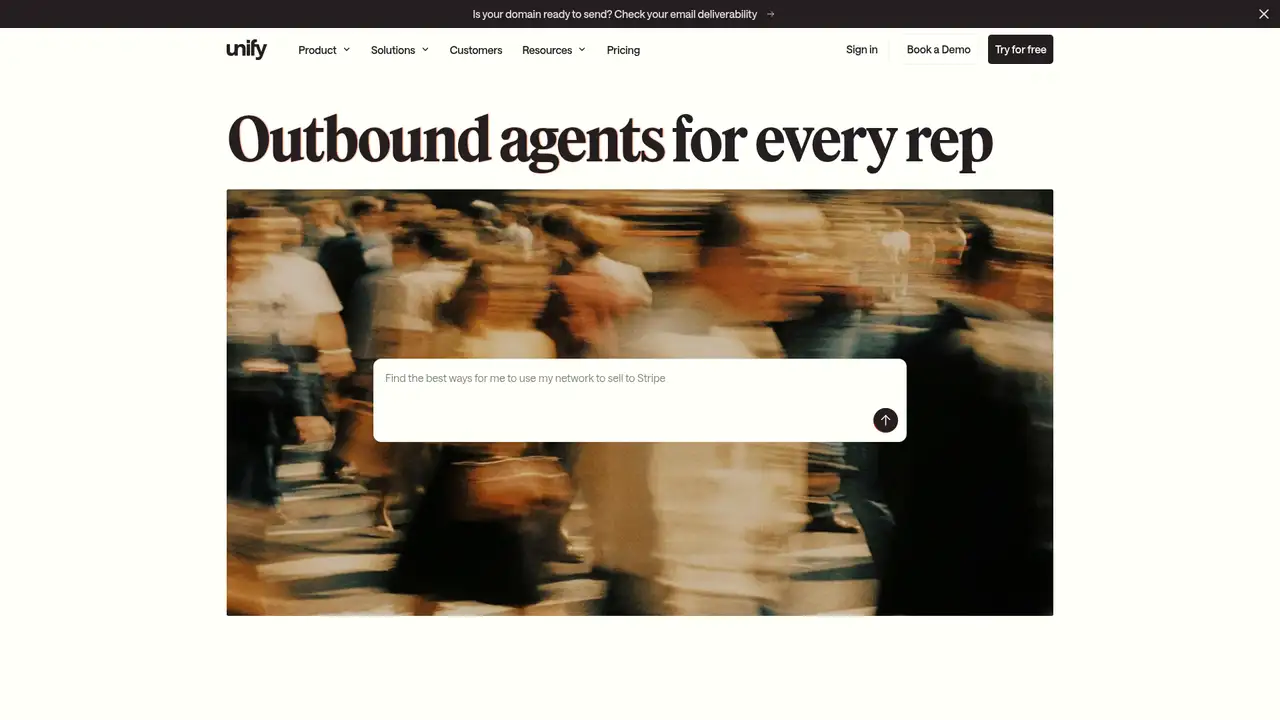
Unify is an AI outbound platform from Unify AI Business Corporation, founded by Austin Hughes and Connor in January 2023. The founders joined OpenAI’s Converge Accelerator two months after ChatGPT’s release. In July 2025, Unify announced a $40 million Series B led by Battery Ventures, following a $12 million Series A nine months earlier. The company said revenue had grown eightfold year over year and that hundreds of teams used the product, including Perplexity, Cursor, and Together AI. Its June 2026 announcement introduced self-service plans starting at $20 per month. The product is aimed at individual sellers, small sales teams, marketing groups, RevOps teams, and larger go-to-market organizations. It combines prospecting, research, signals, enrichment, sequencing, calling, and CRM connections in one web workspace.
A typical Unify workflow begins with a prompt or database search. Users can search more than 1.1 billion people and 65 million companies, build lists from more than 40 data sources, and filter for funding, hiring, job changes, website visits, technology usage, and other signals. Contact records can then be enriched through multiple email and phone providers. Unify places results into multichannel sequences with email, social, and call tasks. AI agents research accounts, qualify prospects, write personalized messages, and trigger outbound plays from selected signals. The product also includes a browser extension, click-to-call, managed Gmail and Outlook mailboxes, sequence analytics, Salesforce and HubSpot connections, and bulk export APIs. Feature access differs by plan, and credit use can pause when an allocation is exhausted.
Unify meters prospecting, enrichment, research, chat, intent signals, and calling through credits. The pricing page lists GPT 5.4 among its standard models, while the terms describe Unify as proprietary hosted software. In December 2025, the company released an updated AI Agents product at 0.1 credits per execution, which it described as a tenfold improvement over the previous rate. Its June 2026 product announcement added a chat-led workflow, more than 40 data and signal sources, seven or more contact-data waterfalls, and lookalike functionality powered by Ocean.io. The company also announced OpenAI’s Computer Use model in Unify for complex seller questions. Unify does not publish a complete foundation-model roster or one fixed price for every credit-consuming action, making workload estimates dependent on activity and configuration.
Unify’s Free plan costs $0 and includes limited credits, up to three seats, AI outbound, more than 40 data sources, multichannel sequencing, click-to-call, and standard models. Base costs $20 per seat monthly and includes 800 credits per seat, AI email copywriting, and phone and email enrichment. Pro costs $60 per seat monthly and includes 2,400 credits per seat, read-only HubSpot and Salesforce sync, Slack notifications, and a 14-day trial. Business is custom and billed annually. Email enrichment averages one credit per record, with rare cases reaching 10, while phone enrichment averages four, with rare cases reaching 20. Paid customers can buy one-time top-ups, and unused top-up credits carry over for up to 12 months. Managed mailboxes cost $25 per mailbox monthly.
Credit economics are Unify’s clearest constraint. Rates vary by activity, provider, destination, call duration, and workflow complexity, while Business pricing and some add-on rates require a quote or workspace review. Apollo offers a database-led prospecting and sequencing workflow, making it a closer fit for teams centered on contact search and sales engagement. Clay is better suited to operators who need detailed enrichment orchestration across data providers. Instantly focuses more narrowly on email campaigns and mailbox operations than Unify’s research and signal workflow. Unify is proprietary SaaS, not open source or self-hosted, and its data can depend on third-party providers. Sellers and small revenue teams should pick Unify when they want AI research, prospecting, signals, and sequencing in one self-serve workspace.
Who is Unify best for?
- Individual sellers who want AI-assisted prospecting at a low entry price.
- Small sales teams running multichannel sequences from shared research.
- RevOps teams creating signal-triggered outbound plays.
- Revenue teams combining enrichment, calling, and CRM workflows.
Unify Pricing (2026)
Pricing model: Freemium. All prices in USD.
| Plan | Price | What you get |
|---|---|---|
| Free | $0 | Free forever with limited credits, up to 3 seats, AI outbound, 40+ data sources, multichannel sequencing, click-to-call, and standard models. |
| Base | $20/seat/month | Billed monthly with 800 credits per seat monthly, AI email copywriting, and phone and email enrichment. |
| Pro | $60/seat/month | Billed monthly with 2,400 credits per seat monthly, read-only HubSpot and Salesforce sync, Slack notifications, and a 14-day trial. |
| Business | Custom | Billed annually with custom workspace credits, website intent, product signals, automations, managed mailboxes, Power Dialer, read-write CRM sync, and all integrations. |
Pros and Cons
Pros
- The Free plan supports up to three seats.
- Base includes 800 credits per seat for $20 monthly.
- More than 40 data sources support list building and signals.
- AI usage is charged through credits rather than a separate AI subscription.
Cons
- Credit rates vary across activities, providers, destinations, and workflows.
- Business pricing and several capacity options require a quote or workspace review.
- Data quality depends partly on third-party providers and waterfall results.
Who should look elsewhere?
- Teams that require unlimited activity instead of credit-based usage.
- Buyers seeking a product dedicated mainly to email delivery.
- Organizations that require self-hosted deployment or source access.
Technical Details
Frequently Asked Questions
How much does Unify cost?
Unify has four listed tiers. Free costs $0. Base costs $20 per seat monthly and includes 800 credits per seat. Pro costs $60 per seat monthly and includes 2,400 credits per seat. Business is custom and billed annually. Paid plans support one-time credit top-ups, and unused top-up credits carry over for up to 12 months. Mailbox capacity and other usage may add separate charges.
Does Unify have a free plan?
Yes. Unify’s Free plan is available indefinitely with limited credits and up to three seats. It includes AI outbound, more than 40 data sources, multichannel sequencing, click-to-call, and standard models. The plan does not include the larger credit allocations, read-only CRM sync, Slack notifications, or the advanced Business features listed on the pricing page.
How does Unify compare with Apollo?
Apollo centers its workflow on contact and company search, prospecting, and sales engagement. Unify combines those functions with prompt-led AI research, signal-based plays, third-party enrichment waterfalls, and credit-metered actions. Apollo fits teams prioritizing a conventional database and sequencing workflow. Unify fits teams that want research and signal-triggered actions in the same workspace. Actual coverage and costs depend on the target market and workflow.
Does Unify train AI on customer data?
Unify’s privacy policy says Google Workspace API data may not be used to develop, improve, or train generalized artificial intelligence or machine-learning models. The policy also describes collection and processing of customer, service, and third-party data, including aggregated or de-identified data for business purposes. Customers should review the current privacy policy and agreement for data handling, retention, and connected-service terms.
Can Unify be used commercially?
Yes. Unify’s terms allow customers to use the hosted platform for internal business purposes under an applicable order and usage limits. Commercial outbound remains subject to the customer’s responsibilities under laws and rules named in the agreement, including CAN-SPAM, TCPA, the Do Not Call Registry, GDPR, and other applicable privacy and marketing requirements. Unify is proprietary SaaS, not open source or self-hosted.
Best Unify Alternatives in 2026
These tools do the same job as Unify, with different pricing, limits and trade-offs.

Sales intelligence, outreach, enrichment, and AI workflows together

Data enrichment and AI workflows for outbound teams

Cold outreach, lead data, deliverability, and sales workflows in one service

AI-assisted workflows for prospecting, deals, forecasting, coaching, and expansion
Account intent data, predictive buying stages and RevvyAI agents for B2B revenue teams