
Sigma Review, Pricing & Alternatives (2026)
Cloud BI with spreadsheet analysis, warehouse writeback, and data apps
Last updated: October 26, 2026
What is Sigma?
Sigma is a cloud BI and data-app platform for teams working directly with cloud warehouses. It combines spreadsheet-style analysis, SQL, Python, dashboards, writeback, workflows, embedding, and AI features. Sigma does not publish dollar prices; organizations use quote-only pricing, with a free trial and free Sigma Public service available.
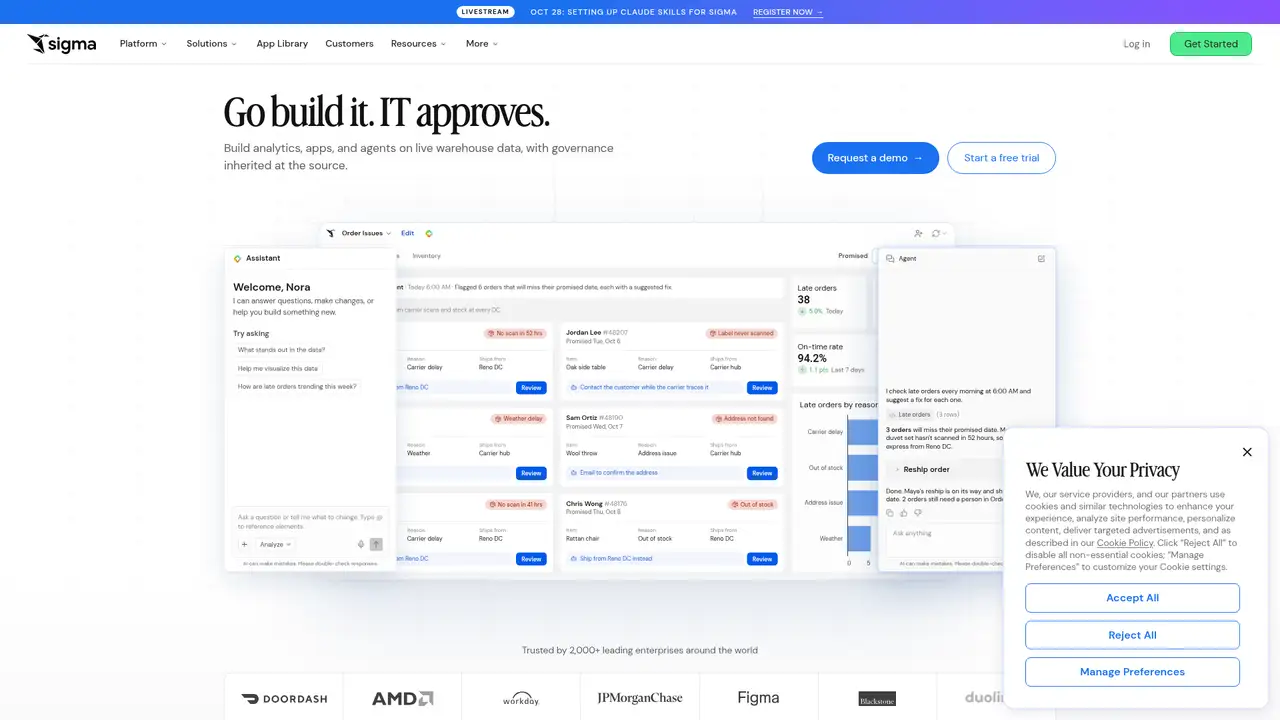
Sigma Computing is an independent private company founded in 2014 by Rob Woollen and Jason Frantz. It sells cloud business intelligence and data application software that connects directly to cloud warehouses. The company reported more than 1,350 customers, over $100 million in annual recurring revenue, 83% fiscal year growth, and more than 250 customers above $100,000 in annual recurring revenue in 2025. On May 2026, Sigma announced an $80 million Series E at a $3 billion valuation, with company reported figures of $200 million ARR, more than 2,000 customers, and growth above 100% year over year. Sigma is proprietary software. Its documented deployment model is cloud only, with no on premises option published.
A normal Sigma workflow begins with a connection to Snowflake, Databricks, BigQuery, Redshift, PostgreSQL, or another supported source. A user selects governed tables or data models, then explores warehouse data in a spreadsheet style grid using formulas, pivots, charts, dashboards, and controls. Builders can add SQL, Python, reusable models, input tables, actions, workflows, and applications. Input Tables allow forecasts, decisions, and other user inputs to be written back to supported warehouses. Sigma also provides embedded analytics, API connectors, warehouse writeback, and administrative controls. Sigma Assistant answers natural language questions and can build AI Apps. Sigma Agents provide no code agents that operate within warehouse security and governance.
Sigma normally runs queries against live warehouse data instead of maintaining a separate extract for analysis. That design keeps warehouse permissions and compute central to the product, while Sigma supplies the workbook and application layer. Documented capabilities include spreadsheet formulas, SQL, Python, materialization, writeback, embedding, APIs, actions, and AI features. An April 2025 company announcement highlighted Ask Sigma, actions, enhanced data models, Redshift Input Tables, and Snowflake and Databricks OAuth write access. In May 2026, Sigma announced AI Apps, Sigma Agents, and additional Sigma Assistant capabilities alongside its Series E. These releases extend the product beyond dashboards into governed operational applications, although they do not remove dependence on the connected warehouse.
Sigma does not publish dollar prices, seat costs, or public usage allowances. Quote only, order form pricing applies, with a free trial and free Sigma Public service also available. Organizations created on or after March 4, 2025 use View, Act, Analyze, and Build tiers. View covers prepared workbook and report consumption, controls, drill paths, aggregated underlying data, PDF and PNG export, comments, Sigma Assistant, and chart explanations. Act adds forms, Input Table editing, advanced actions, broader underlying data access, scheduling, alerts, and exports. Analyze adds ad hoc analysis and AI formula assistance. Build adds creation, modeling, materialization, SQL, Python, integrations, credentials, APIs, and administration. Older organizations may use Lite, Essential, or Pro.
Budgeting is difficult because Sigma publishes no tier prices or public usage allowances, and usage based billing can charge credits for specified billable events or user activity. Warehouse compute also remains a material cost because queries run in the customer’s warehouse. Sigma is a poor standalone choice without a cloud warehouse and offers no on premises deployment. Looker has a stronger code defined semantic layer, while Sigma has the more approachable spreadsheet workflow and native writeback. Tableau offers deeper visualization tooling, and Power BI generally costs less for Microsoft centered organizations. Teams that already operate a cloud warehouse and want spreadsheet analysis, writeback, and governed data applications should pick Sigma.
Who is Sigma best for?
- Warehouse-first teams needing spreadsheet-style BI and live data access.
- Analysts who need SQL, Python, formulas, pivots, and visual controls together.
- Organizations requiring warehouse writeback for forecasts, decisions, or inputs.
- Teams building embedded analytics, workflows, and warehouse-connected data apps.
Sigma Pricing (2026)
Pricing model: Paid. All prices in USD.
| Plan | Price | What you get |
|---|---|---|
| View | Custom | For prepared-workbook and report consumption. Includes controls, drill paths, aggregated underlying data, PDF and PNG export, comments, Sigma Assistant, and chart explanations. |
| Act | Custom | Adds forms, input-table editing, advanced actions, underlying-data access, broader exports, scheduling, and alerts. |
| Analyze | Custom | Adds ad hoc analysis and AI formula assistance. |
| Build | Custom | Adds workbook, report, and app creation, modeling, materialization, SQL, Python, integrations, credentials, APIs, and administration. |
Pros and Cons
Pros
- Sigma combines spreadsheet analysis with SQL, Python, dashboards, and visual controls.
- Input Tables support writeback for forecasts, decisions, and other business inputs.
- Live warehouse queries reduce dependence on extracts in the normal workflow.
- The platform includes embedding, workflows, APIs, actions, and AI features.
Cons
- Sigma does not publish dollar prices, seat costs, or public usage allowances.
- Warehouse compute remains an important cost because queries run against customer warehouses.
- The product has no stated on-premises deployment option.
Who should look elsewhere?
- Organizations without a cloud warehouse to supply the underlying data.
- Teams requiring an on-premises deployment option.
- Buyers needing transparent public seat prices and usage allowances.
Technical Details
Frequently Asked Questions
How much does Sigma cost?
Sigma does not publish dollar prices, seat costs, or public usage allowances. Current organizations use quote-only, order-form pricing. Billing can include credits for specified billable events or user activity, and warehouse compute remains a separate operating consideration because Sigma runs queries against the customer’s warehouse. A free trial and free Sigma Public service are available.
Does Sigma have a free plan?
Sigma offers a free trial and a free Sigma Public service, but it does not publish a continuing general-purpose free commercial tier with stated public quotas. Current paid organizations use View, Act, Analyze, or Build licenses. The capabilities differ by tier, and older organizations may still use Lite, Essential, or Pro. Buyers should request current commercial terms from Sigma.
Is Sigma better than Looker?
Sigma and Looker emphasize different workflows. Sigma provides a spreadsheet-style interface, live warehouse analysis, and native writeback for inputs such as forecasts and decisions. Looker has a stronger code-defined semantic layer. Sigma is a closer fit for analysts and business teams wanting spreadsheet interaction plus data apps, while Looker may suit organizations prioritizing centrally defined modeling logic.
Does Sigma train AI models on customer data?
Sigma’s Feature Terms say customers own AI inputs and outputs. Sigma may process them to operate the service and may use AI inputs and outputs to train or fine-tune AI Features solely to understand and improve the customer’s use. Sigma may share data with AI providers as needed for output. Trial terms warn that trial data may receive broader third-party model processing.
Can companies use Sigma commercially?
Sigma is a commercial proprietary platform with quote-only licensing for paid organizations. Its published licenses cover capabilities such as viewing, acting, analyzing, building, APIs, integrations, administration, and embedding, depending on the tier. The company also offers a free trial and free Sigma Public service. Commercial customers should review the applicable order form and terms for permitted use.
Best Sigma Alternatives in 2026
These tools do the same job as Sigma, with different pricing, limits and trade-offs.

Conversational analytics for governed business decisions
Governed business intelligence built around a shared semantic model

AI assistance for governed dashboards, metrics, and data preparation
Natural language assistance for governed Power BI analysis

Cloud data platform combining BI, ETL, apps, workflows, and AI