
ThoughtSpot Review, Pricing & Alternatives (2026)
Conversational analytics for governed business decisions
Last updated: October 22, 2026
What is ThoughtSpot?
ThoughtSpot is an AI analytics platform made by ThoughtSpot for business teams, analysts, and developers embedding governed data experiences. It combines natural language search, dashboards, semantic modeling, and Spotter agents. Analytics Essentials starts at $25 per user per month with annual billing, while consumption pricing starts at $0.10 per credit.
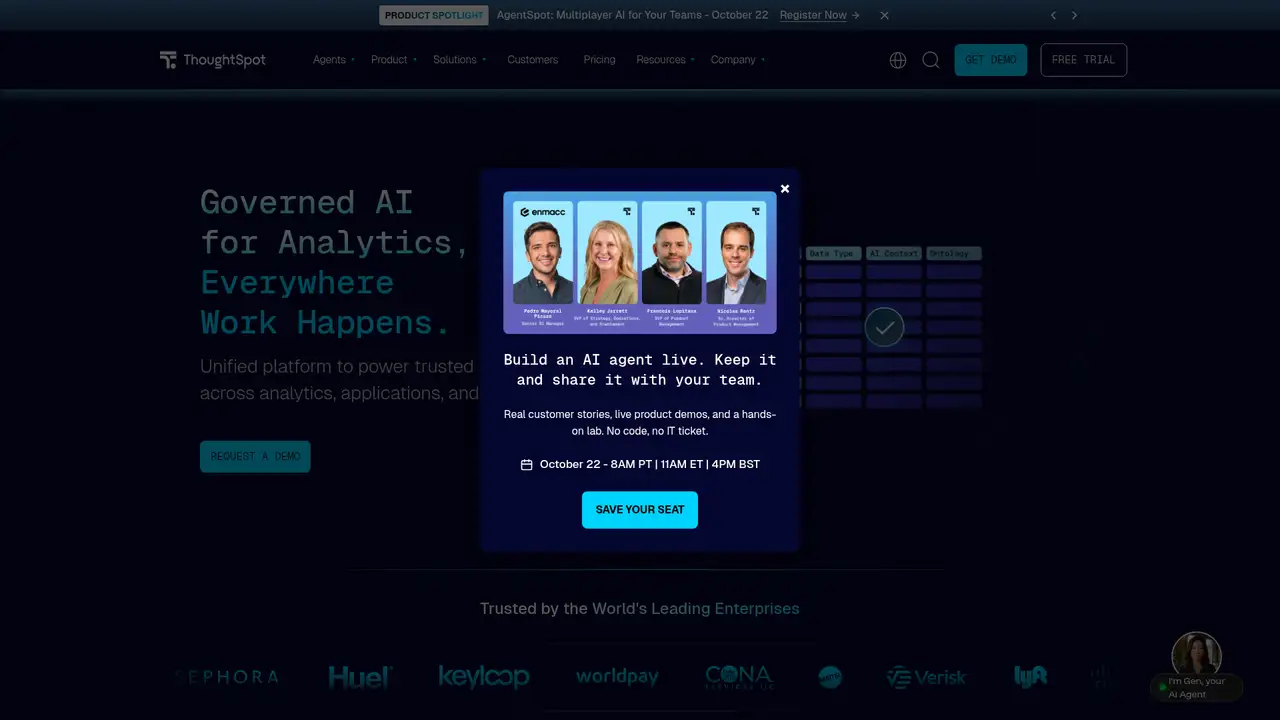
ThoughtSpot is an AI analytics platform made by ThoughtSpot, a Palo Alto company founded in 2012 by Ajeet Singh and other executives with backgrounds at Google, Amazon, and Facebook. The company announced $145 million in Series D funding in May 2018 and said total funding had passed $306 million. Its product serves internal business users and developers embedding analytics into applications. ThoughtSpot connects to warehouses including Snowflake, Databricks, and Redshift, then presents governed answers through search, dashboards, and AI agents. The product is split between ThoughtSpot Analytics for organizational users and ThoughtSpot Embedded for application builders. Its central pitch is practical: ask a question in ordinary language, receive a visual answer, and continue exploring without writing SQL.
A normal workflow begins with warehouse connections, a prepared data model, and access rules. A user types a natural language question, receives a visualization, and continues with follow-up searches, drilldowns, or saved Answers. Teams assemble interactive Liveboards, monitor key performance indicators, and share personalized insights. Spotter adds conversational analysis, suggested questions, multiple-question requests, and explanations for calculated fields. Administrators can apply row-level security, encryption, permission groups, and data isolation. Developers can embed dashboards and visualizations through a REST-based API, add custom styles and actions, and configure SAML, OAuth, or OIDC single sign-on. The setup is less casual than the search box suggests, because useful answers depend on business definitions, permissions, and a well-maintained model.
Spotter sits on ThoughtSpot's relational search model, which adds business context from the underlying data model to natural language requests. The current documentation describes Spotter 3 as querying structured and unstructured data together, selecting data sources across models, reasoning through complex analysis, and connecting with Slack, Confluence, or Jira. ThoughtSpot announced Spotter 3 in September 2025 with generated Python analysis for clustering, regression, anomaly detection, forecasting, and next-step recommendations. Its security documentation names GPT-4.1 through Azure OpenAI Service, plus Gemini, Claude Sonnet 4.5, and Claude Opus 4.5 through Google Vertex AI. ThoughtSpot says it tests and updates the model services as performance changes, while AI features remain disabled by default until administrators enable them.
Pricing has three distinct mechanics. Essentials starts at $25 per user per month with annual billing, supports five to 50 users, and covers up to 25 million rows. Pro's published user-based rate is $50 per user per month annually, with up to 1,000 users, 250 million rows, and 25 Spotter queries per user monthly. Consumption starts at $0.10 per credit, and credits can be consumed by searches, Liveboard activity, modeling, administration, Spotter, Analyst Studio, and data refreshes. Enterprise is custom with unlimited users and data. Embedded Developer is free for one year for up to 10 users and 25 million rows, while Embedded Enterprise is custom. ThoughtSpot says managed LLM tokens are unlimited and unmetered, although customer-selected providers may charge separately.
ThoughtSpot requires data modeling and administrative preparation before conversational answers become dependable, and consumption pricing makes active usage harder to forecast than Essentials. Spotter is included with new Analytics per-user and consumption plans, but legacy row-based, unlimited, and embedded plans may require an add-on. Tableau offers broader visual authoring, while ThoughtSpot puts natural language search closer to the center of analysis. Power BI is often the cheaper Microsoft-centered choice, though Copilot requires qualifying capacity beyond a Pro or Premium Per User seat. Looker offers a strong semantic modeling approach, while ThoughtSpot adds a more direct conversational interface and embedded delivery. Choose ThoughtSpot when governed natural language exploration and embedded AI analytics matter more than the broadest authoring toolkit.
Who is ThoughtSpot best for?
- Business teams asking natural language questions over governed warehouse data.
- Companies embedding AI dashboards and analytics into customer applications.
- Analytics groups managing row-level security and enterprise access controls.
- Organizations wanting Spotter without separately metered managed LLM tokens.
ThoughtSpot Pricing (2026)
Pricing model: Usage-based. All prices in USD.
| Plan | Price | What you get |
|---|---|---|
| Essentials | $25/user/month | Annual billing supports five to 50 users and up to 25 million rows, with dynamic dashboards and actionable insights. |
| Pro | $50/user/month | Annual billing supports up to 1,000 users and 250 million rows, with 25 Spotter queries per user monthly. |
| Pro Consumption | $0.10/credit | Credits cover searches, dashboard activity, Spotter, modeling, administration, Analyst Studio, and data refreshes. |
| Enterprise | Custom | Enterprise supports unlimited users and data, advanced governance, managed AI analytics, and enterprise support. |
| Embedded Developer | Free for 1 year | The developer tier supports up to 10 users and 25 million rows with embedded dashboards, visualizations, API access, and SDK access. |
| Embedded Enterprise | Custom | Embedded enterprise plans provide APIs, SDK capabilities, natural language exploration, configurable experiences, and negotiated terms. |
Pros and Cons
Pros
- Spotter 3 combines structured and unstructured data analysis.
- Essentials publishes clear annual pricing and row limits.
- REST embedding supports dashboards, visualizations, and application workflows.
- ThoughtSpot says managed LLM tokens are unlimited and unmetered.
Cons
- Consumption credits apply to many activities beyond natural language searches.
- Dependable conversational answers require preparation of the semantic model.
- Legacy and embedded customers may need a separate Spotter add-on.
Who should look elsewhere?
- Small teams seeking a permanently free general BI workspace.
- Analysts unwilling to prepare semantic models before conversational use.
- Buyers needing transparent enterprise pricing for unlimited deployments.
Technical Details
Frequently Asked Questions
How much does ThoughtSpot cost?
ThoughtSpot Analytics Essentials starts at $25 per user per month with annual billing. It supports five to 50 users and up to 25 million rows. The published Pro user plan costs $50 per user monthly with annual billing and includes 25 Spotter queries per user monthly. Consumption pricing starts at $0.10 per credit, while Enterprise and Embedded Enterprise pricing is custom.
Does ThoughtSpot have a free plan?
ThoughtSpot publishes Embedded Developer as free for one year, supporting up to 10 users and 25 million rows with embedded dashboards, visualizations, API access, and SDK access. The current pricing page does not present a permanently free general ThoughtSpot Analytics workspace. Analytics Essentials is the lowest published internal-user plan at $25 per user per month billed annually.
How does ThoughtSpot compare with Tableau?
ThoughtSpot centers natural language search, Spotter conversations, and governed answers from a semantic model. Tableau provides a broader visual authoring environment and an established dashboarding practice. ThoughtSpot is the closer fit when business users and embedded application users need conversational exploration, while Tableau suits teams prioritizing extensive visual design and authoring controls.
Does ThoughtSpot train AI models on customer data?
ThoughtSpot's security documentation says customer data is not used for LLM training with its Azure AI Foundry providers. Spotter sends queries, model metadata, sample values, and, for Spotter 3, warehouse query results to supported providers. The company says customer data is not persisted or cached by listed providers, although Spotter 3 results can remain cached for up to one hour.
Can businesses use ThoughtSpot commercially?
Yes. ThoughtSpot sells commercial Analytics and Embedded offerings for business teams, enterprise deployments, and applications. Embedded plans include REST-based APIs, SDK access, custom styles, actions, and single sign-on options. Commercial terms vary by users, rows, credits, deployment needs, and embedding requirements, so enterprise customers receive negotiated pricing rather than one universal list price.