Looker Review, Pricing & Alternatives (2026)
Governed business intelligence built around a shared semantic model
Last updated: October 26, 2026
What is Looker?
Looker is Google Cloud's enterprise business intelligence platform for governed metrics, dashboards, exploration, APIs, embedded analytics, and data applications. It suits organizations that want centralized definitions through LookML and live queries against connected databases. Google publishes quote-only pricing with annual commitments; third-party reporting lists Standard at $5,000 per month, but buyers should verify all prices with Google sales.
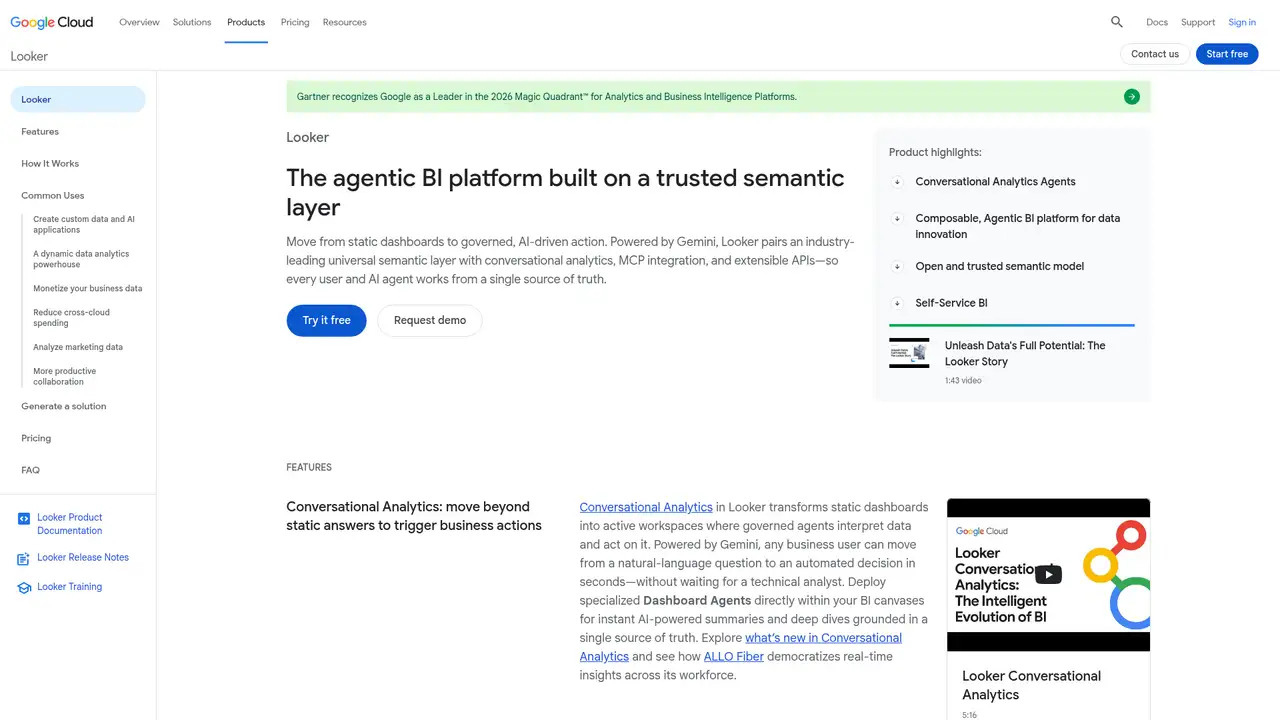
Looker is an enterprise business intelligence product founded in 2012 by Lloyd Tabb and Ben Porterfield. Google announced its acquisition in June 2019, and the transaction closed in February 2020 for approximately $2.6 billion in cash, according to Reuters and the UK Competition and Markets Authority. The product is now offered within Google Cloud as Looker, including Google Cloud core and original Looker deployments. Its audience is organizations that need shared metric definitions across analysts, applications, and operational teams. Looker combines dashboards, reports, ad hoc exploration, APIs, embedded analytics, and data applications around a governed model. It is a proprietary, Google-managed service rather than an open-source project. Google also presents Gemini in Looker and Conversational Analytics as capabilities grounded in the Looker semantic model.
Looker workflows begin with LookML, its code-defined modeling language. Teams define dimensions, measures, and relationships, then Looker compiles user queries to SQL that runs against a connected database. Analysts work through reusable Explores, dashboards, Looks, filters, drills, schedules, and downloads. Developers receive Development Mode, SQL Runner, administration, API access, and support access, while Standard Users can explore, schedule, filter, drill, download, and create dashboards or Looks. Viewer Users can access folders, dashboards, and Looks, then filter, drill, schedule, and download, but cannot create dashboards or use Explore, SQL Runner, APIs, or administration. Signed embedding and cookieless embedding support application-facing analytics. Persistent derived tables and other materializations can improve query workflows while introducing freshness and warehouse-storage tradeoffs.
Looker is primarily a live-query, in-database analytics platform. LookML supplies the semantic layer, and Gemini in Looker plus Conversational Analytics use that model as grounding for natural-language questions. Google documents standard monthly releases and a quarterly Extended Support Release program. The 2025 ESR schedule covered versions 25.0, 25.6, 25.12, and 25.18, while the 2026 schedule includes 26.0, 26.6, 26.12, and planned 26.18. Release documentation lists Looker 26.20 in October 2026. Deployment of 26.22 begins October 26, 2026, with final availability scheduled for November 9, 2026, so it should not be described as fully released on the deployment start date. Google warns that Gemini output can be plausible but incorrect and requires validation.
Google's current pricing page lists Standard, Enterprise, and Embed editions with annual commitments and one-, two-, or three-year terms. All are quote-only. Standard includes one production instance, 10 Standard Users, two Developer Users, a maximum of 50 users, 1,000 query-based API calls per month, and 1,000 administrative API calls per month. Enterprise keeps the included users and instance but removes the user maximum, raising allowances to 100,000 query and 10,000 administrative calls monthly. Embed raises them to 500,000 query and 100,000 administrative calls. Enterprise and Embed add private connections, VPC Service Controls, customer-managed encryption keys, Elite System Activity logs, custom themes, and private labeling. Embed also adds signed and cookieless embedding. A reported $5,000 monthly Standard list price is not displayed on Google's pricing page.
Looker's main limitation is the expertise required for effective SQL and LookML modeling, which can make adoption slower for casual analysts than Sigma, Tableau, or Power BI. Sigma is more spreadsheet-native and offers more direct writeback, while Looker emphasizes centralized semantic consistency and API-first embedded analytics. Tableau generally leads on visual authoring, whereas Looker centers governance and reusable definitions. Power BI generally offers stronger Microsoft integration and more transparent seat pricing. Google says Looker does not permanently store customer data in the Looker instance in its normal architecture, and daily Looker Core configuration backups are retained for 180 days. Conversational Analytics conversations are retained until deletion, then permanently deleted after 30 days. Organizations needing governed metrics and embedded applications should choose Looker.
Who is Looker best for?
- Organizations that need governed, reusable metric definitions across teams.
- Data teams building dashboards and exploration on connected databases.
- Companies embedding analytics into customer-facing applications.
- Enterprises requiring APIs, access controls, and centralized LookML development.
Looker Pricing (2026)
Pricing model: Paid. All prices in USD.
| Plan | Price | What you get |
|---|---|---|
| Standard | Custom | One production instance, 10 Standard Users, two Developer Users, maximum 50 users, 1,000 query API calls monthly, and 1,000 administrative API calls monthly. |
| Enterprise | Custom | One production instance, 10 Standard Users, two Developer Users, no maximum users, 100,000 query API calls monthly, and 10,000 administrative API calls monthly. |
| Embed | Custom | One production instance, 10 Standard Users, two Developer Users, no maximum users, 500,000 query API calls monthly, and 100,000 administrative API calls monthly. |
Pros and Cons
Pros
- LookML centralizes dimensions, measures, relationships, and metric definitions.
- Live querying keeps analysis connected to the underlying database.
- APIs, signed embedding, and cookieless embedding support application analytics.
- Role-specific user capabilities separate development, analysis, and viewing access.
Cons
- Looker requires meaningful SQL or LookML expertise for many deployments.
- Google publishes quote-only platform pricing rather than public dollar amounts.
- Persistent derived tables can introduce freshness and warehouse-storage tradeoffs.
Who should look elsewhere?
- Casual analysts seeking a spreadsheet-first business intelligence workflow.
- Teams without SQL or LookML expertise for semantic model development.
- Buyers requiring transparent public seat pricing before contacting sales.
Technical Details
Frequently Asked Questions
How much does Looker cost?
Google lists Standard, Enterprise, and Embed editions as quote-only products with annual commitments of one, two, or three years. Google does not display dollar prices for platform or user licenses on its public pricing page. A third-party report lists a $5,000 monthly Standard figure and separate user prices, but buyers should treat those as reported list-price information and verify them with Google sales.
Does Looker have a free plan?
Looker does not have a continuing free edition listed on Google's current pricing page. The published editions are Standard, Enterprise, and Embed, and each requires contacting sales for an annual-commitment quote. Looker is therefore a paid product for organizations seeking its governed modeling, dashboards, APIs, or embedded analytics capabilities.
What is Looker's closest rival?
Sigma is a close rival for cloud business intelligence, but the products emphasize different workflows. Sigma is more spreadsheet-native and offers more direct writeback. Looker focuses on LookML, centralized semantic consistency, reusable Explores, APIs, and embedded analytics. Tableau generally leads on visual authoring, while Power BI generally offers stronger Microsoft integration and more transparent seat pricing.
Does Looker train models on customer data?
Google says Looker does not permanently store customer data in the Looker instance in its normal architecture and does not extract underlying data. Gemini documentation says Conversational Analytics conversations are retained until deletion, then permanently deleted after 30 days, while raw prompts and responses are not logged by default. Google also says Gemini processing uses a global service and warns that outputs require validation.
Can companies use Looker commercially?
Looker is an enterprise commercial product offered through Google Cloud, with Standard, Enterprise, and Embed editions sold under annual commitments. Its proprietary licensing is separate from open-source software licensing. The Embed edition is designed for application-facing analytics and includes signed and cookieless embedding. Commercial buyers should obtain contractual licensing, user, support, and security terms directly from Google.
Best Looker Alternatives in 2026
These tools do the same job as Looker, with different pricing, limits and trade-offs.

Conversational analytics for governed business decisions

Cloud BI with spreadsheet analysis, warehouse writeback, and data apps

AI assistance for governed dashboards, metrics, and data preparation
Natural language assistance for governed Power BI analysis
Associative BI dashboards with agentic AI, an MCP server and capacity-based pricing