
Domo Review, Pricing & Alternatives (2026)
Cloud data platform combining BI, ETL, apps, workflows, and AI
Last updated: October 26, 2026
What is Domo?
Domo is a cloud-native data platform for organizations that need data integration, transformation, dashboards, apps, workflows, and AI in one service. It targets business and analytics teams that want self-service data products without managing infrastructure. A 30-day full-platform trial is free, while paid access uses custom credit-based pricing.
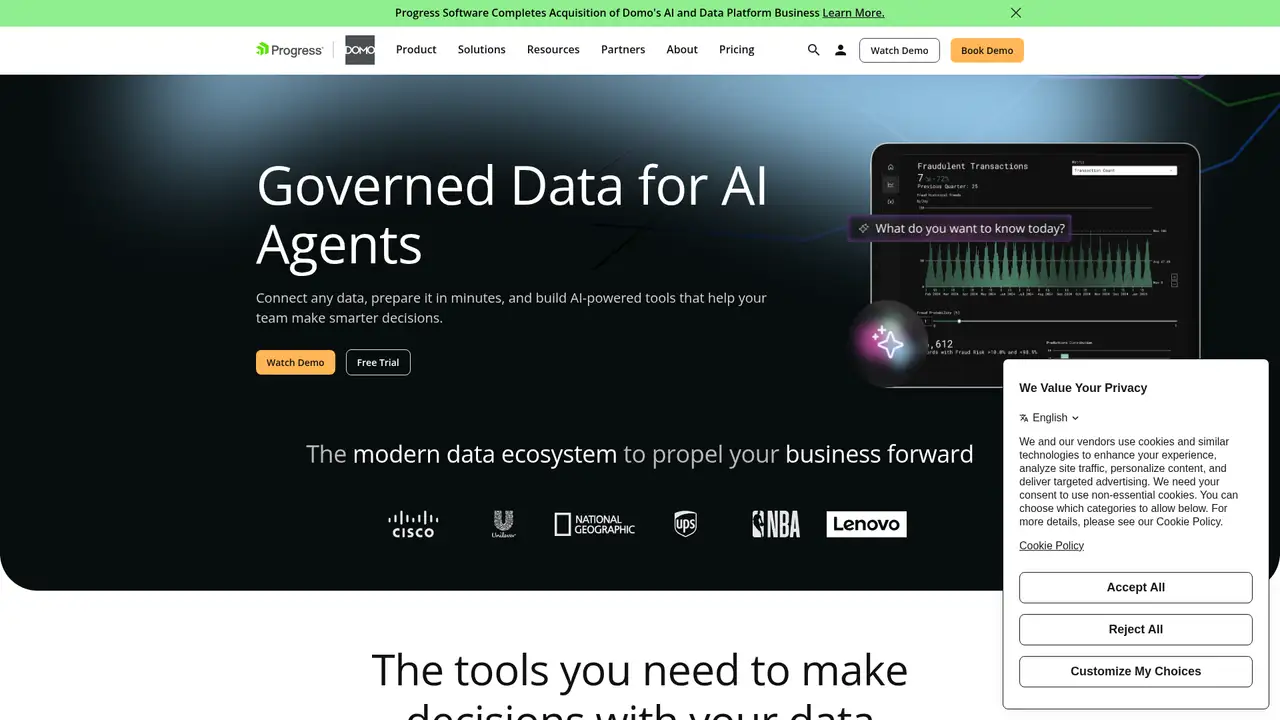
Domo is a cloud-native data platform made by Domo, Inc., a company founded in 2010 by Omniture co-founder Josh James. Domo raised $33 million in a 2011 Series A, bringing reported total funding to $43 million, then went public in 2018 at $21 per share and approximately $202.6 million in net proceeds. The company positions Domo as a platform for putting data to work across an organization, with dashboards and apps intended for business users as well as data teams. Its current product scope spans data integration, transformation, business intelligence, automation, AI, governance, and embedded analytics. That breadth is useful for organizations seeking one cloud service, though it also means buyers must assess which capabilities they will consume.
Domo typically starts with connectors that bring data into the platform, followed by transformation in Magic ETL or SQL-based flows. Teams can build dashboards, visualizations, and apps from those datasets, then distribute reports or trigger workflows from alerts, timers, applications, or APIs. App Studio provides drag-and-drop elements for interactive experiences, while Workspaces organize apps, dashboards, cards, datasets, and dataflows. Domo also supports embedded dashboards and apps, scheduled reports, low-code development, and connections to cloud data warehouses. The workflow is designed to move from ingestion to preparation, analysis, distribution, and action without requiring separate products for every stage. Administrators can apply permissions and PDP policies to data access, including for AI-generated responses.
Domo’s 2025 releases added a Magic ETL SQL action, table elements in App Studio, Workspaces, Report Builder, and additional workflow and AI features. The 2025 Release 2 documentation lists AI Agent tasks in Workflows, an AI Content Builder Agent, Deep Research, Image-to-Text, embedded AI Chat, Jupyter Notebook workflow tasks, and API workflow triggers. Domo AI Pro became generally available in September 2025, with consumption pricing taking effect October 1, 2025. Domo AI remains available for features such as the Beast Mode Assistant, SQL Assistant, and Magic ETL Formula Assistant, while AI Pro covers selected agent tasks, AI Services, text generation, and related analysis. Domo describes flexible use of Domo-hosted models and customer-hosted models, with token-based AI consumption pricing.
Domo publishes a 30-day free trial with the full platform, unlimited users, onboarding support, self-service education, and one training session. No credit card is required, but the trial is time-limited rather than a permanent free plan. Paid access uses custom credit-based pricing, with credits consumed by activities such as storing data, updating tables, running workflows, and using advanced capabilities. The paid offer includes the trial capabilities plus a dedicated account team, volume discounts, custom add-ons, support packages, AWS PrivateLink, and a HIPAA-compliant environment. Domo does not publish a general dollar subscription price or public credit rate on its pricing page. AI Pro adds consumption-based charges, and administrators can view feature and model rates through the platform’s AI Consumption Rate Card.
Domo’s main trade-off is commercial complexity: the platform combines many products, but its public pricing does not reveal a standard paid starting point. It is cloud-native rather than an open-source or self-hosted deployment, and AI use can add consumption charges. Power BI is a clearer fit for teams already invested in Microsoft tools and seeking a lower published per-user price. Tableau is stronger when highly customized visual exploration is the priority, while Looker is a closer choice for governed modeling and embedded analytics. Domo is more cohesive when one service must cover ingestion, ETL, BI, apps, workflows, and AI for business users. Choose Domo if that integrated cloud scope matters more than transparent pricing or self-hosting.
Who is Domo best for?
- Organizations needing BI, ETL, apps, workflows, and AI in one cloud service.
- Business teams building dashboards and data products with low-code tools.
- Companies requiring unlimited users without per-user charges.
- Teams that can manage credit-based and AI consumption billing.
Domo Pricing (2026)
Pricing model: Usage-based. All prices in USD.
| Plan | Price | What you get |
|---|---|---|
| 30-day Free Trial | $0 for 30 days | Full platform, unlimited users, onboarding support, self-service education, and one training session during the 30-day trial. |
| Custom Pricing | Custom | Credit-based billing; credits cover activities such as data storage, table updates, workflows, and advanced capabilities. User counts are unlimited. |
| Domo AI Pro | Usage-based | Token-based consumption billing for selected AI Pro features, including AI Agent workflow tasks, AI Services, text generation, and AI-powered analysis. |
Pros and Cons
Pros
- Domo combines connectors, ETL, dashboards, apps, workflows, and AI.
- The trial includes the full platform and unlimited users for 30 days.
- Magic ETL supports drag-and-drop transformations and freeform SQL.
- AI requests apply user permissions and PDP policies before model access.
Cons
- Domo does not publish a standard paid dollar price or general credit rate.
- AI Pro introduces additional consumption-based charges for selected features.
- Domo is cloud-native and does not offer an open-source self-hosted edition.
Who should look elsewhere?
- Organizations requiring a permanent free plan with published limits.
- Buyers needing self-hosted or on-premises deployment.
- Teams seeking a simple, publicly listed paid subscription price.
Technical Details
Frequently Asked Questions
How much does Domo cost?
Domo does not publish a standard paid dollar price. Its paid platform uses custom credit-based pricing, with credits consumed by activities such as storing data, updating tables, running workflows, and using advanced capabilities. Domo also offers AI Pro features with token-based consumption pricing. The company requires prospective paid customers to contact its account team for a quote.
Does Domo have a free plan?
Domo offers a 30-day free trial rather than a permanent free plan on its public pricing page. The trial includes the full platform, unlimited users, onboarding support, self-service education, and one training session, and it does not require a credit card. After 30 days, continued use requires a custom paid agreement.
How does Domo compare with Power BI?
Domo and Power BI both provide dashboards, data preparation, analytics, and natural-language or AI-assisted features. Domo also packages apps, workflows, embedded experiences, and credit-based consumption in its platform. Power BI has a lower published per-user entry price and fits organizations already using Microsoft products. Domo is a stronger candidate when broad cloud data-product capabilities and unlimited paid users matter.
Does Domo use customer data to train AI models?
Domo says customer prompts and outputs are not used for model training, fine-tuning, or performance improvement. Its AI FAQ says permissions and PDP policies apply before data reaches the model. Domo stores agent requests and responses for session history, while third-party providers do not store that data. Domo’s privacy notice identifies Domo as a processor for subscriber data under customer agreements.
Can I use Domo commercially, and what about licensing?
Domo is a commercial subscription service, not an open-source product. The public pricing page offers a 30-day trial and custom paid agreements, but it does not publish a general commercial-use license or standard contract terms. Organizations should review the applicable customer agreement for data rights, AI terms, support, deployment, and any restrictions before using Domo in production.
Best Domo Alternatives in 2026
These tools do the same job as Domo, with different pricing, limits and trade-offs.

Conversational analytics for governed business decisions

Natural language assistance for governed Power BI analysis

AI assistance for governed dashboards, metrics, and data preparation

Governed business intelligence built around a shared semantic model
Associative BI dashboards with agentic AI, an MCP server and capacity-based pricing