
Reply.io Review, Pricing & Alternatives (2026)
Multichannel sales engagement with sequences, deliverability tools, and AI SDR
Last updated: October 26, 2026
What is Reply.io?
Reply.io is a hosted sales engagement platform for outbound teams using email, LinkedIn, calls, SMS, and WhatsApp. It combines sequences, mailbox management, deliverability tools, CRM synchronization, live B2B data, and Jason AI SDR features. Email Volume starts at $49 per user monthly with annual billing, while Multichannel starts at $89.
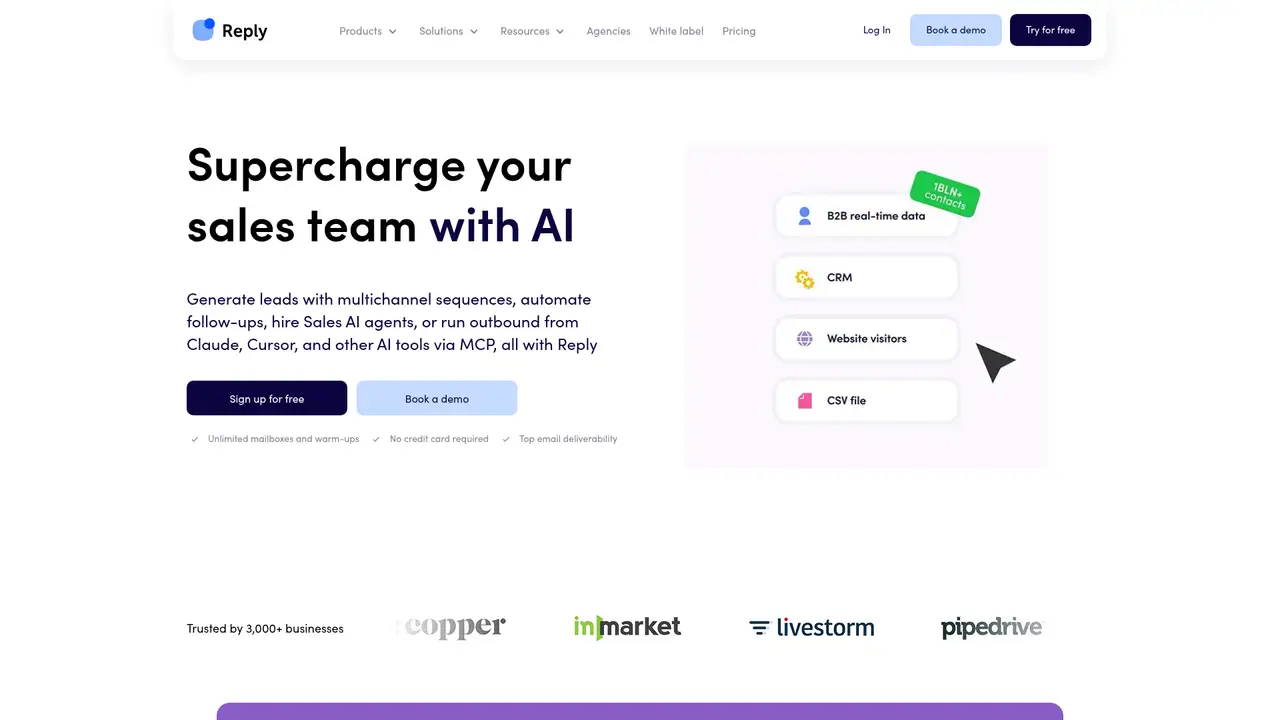
Reply.io is a hosted sales engagement platform founded in 2014 by Oleg Campbell. The company says it operates with offices in the United States, Canada, and Ukraine, alongside distributed staff. Its history places the first code in August 2014, beta customers in December 2014, and the first public release in August 2015. Reply had raised a $400,000 seed round by 2016. It serves outbound sales teams rather than organizations seeking a general CRM. The product combines contact sequencing, mailbox management, deliverability controls, prospect data, analytics, CRM synchronization, and AI-assisted outreach in one web application. There is no public open-source or self-hosted edition. Reply remains a private company under the Reply.io brand.
A typical Reply workflow starts with importing prospects or finding contacts through live B2B data and website visitor reveals. Users assign contacts to lists, then place them in sequences that combine email with LinkedIn actions, calls, SMS, and semi-automated WhatsApp steps. Templates, scheduling, inbox handling, reports, mailbox warmup, anti-spam controls, and task management support campaign operations. Native two-way CRM integrations cover HubSpot, Salesforce, Pipedrive, and Copper. Zapier, n8n, webhooks, and a REST API extend automation. Email Volume focuses on email outreach, while Multichannel adds LinkedIn, calls, SMS, WhatsApp, reporting, and channel controls. The platform also exposes API, MCP, CLI, and Skills access layers for teams that need programmatic workflows.
Reply does not name an underlying model or model version for Jason AI or its other AI features. The company describes Jason AI as an AI SDR with real-time contact search, intent signals, personalization, and AI-generated responses. The AI SDR plans also list autopilot and copilot modes, multichannel automation, website visitor reveals, and deliverability support. Reply's API v3 uses REST, JSON, and Bearer authentication at its documented v3 endpoint. It covers contacts, lists, custom fields, blacklists, sequences, accounts, templates, inboxes, schedules, tasks, reports, webhooks, and background jobs. Published API limits are 100 requests per minute, 3,000 per hour, and 150,000 per week per user. These product descriptions explain available functions without identifying a model architecture or model provider.
Email Volume starts at $49 per user monthly with annual billing for 1,000 active contacts, or $59 with monthly billing. Annual pricing reaches $899 for 100,000 active contacts, while monthly pricing reaches $999. At 10,000 contacts, the annual price is $159 and the page shows unlimited users. Multichannel starts at $89 annually or $99 monthly, with 10 mailboxes per user annually and five monthly. Both versions list unlimited active contacts and emails, 50 live-data credits monthly, and up to 200 website visitor reveals. Jason AI SDR starts at $500 monthly with annual billing, while monthly Starter pricing begins at $800. LinkedIn Automation costs $69 per account monthly, Calls and SMS Automation costs $29, and extra live-data or email-validation credits have separate prices. A 14-day Multichannel trial is advertised.
Reply's main limitation is the number of operational variables involved: active-contact bands, mailbox counts, warmup seats, fair-usage rules, channel add-ons, and billing cadence all affect the final setup. Higher Email Volume tiers require contact sales at 200,000, 300,000, and 500,000 contacts. Outreach and Salesloft are closer enterprise sales engagement alternatives, with stronger emphasis on larger sales organizations and structured engagement operations. Apollo is a closer choice when prospect database access is the primary requirement, while Reply emphasizes execution across connected mailboxes and channels. Reply also carries more configuration work than a basic email sequencer because teams must manage deliverability, mailbox allocation, channel permissions, and CRM synchronization. Choose Reply when multichannel outbound automation, mailbox controls, CRM connections, and AI SDR features matter more than a general CRM.
Who is Reply.io best for?
- Outbound teams coordinating email, LinkedIn, calls, SMS, and WhatsApp sequences.
- Agencies managing several prospecting programs with mailbox controls.
- Sales operations teams needing CRM synchronization, webhooks, and API access.
- Companies evaluating AI-assisted prospecting through Jason AI SDR.
Reply.io Pricing (2026)
Pricing model: Paid. All prices in USD.
| Plan | Price | What you get |
|---|---|---|
| Email Volume, annual | From $49/month | 1,000 contacts costs $49 monthly, rising to $899 at 100,000. The 200,000, 300,000, and 500,000 contact tiers require contact sales; 10,000 contacts and above show unlimited users. |
| Email Volume, monthly | From $59/month | 1,000 contacts costs $59 monthly, rising to $999 at 100,000. The 200,000, 300,000, and 500,000 contact tiers require contact sales; 10,000 contacts and above show unlimited users. |
| Multichannel, annual | From $89/month | Includes 10 mailboxes per user, unlimited active contacts and emails, 50 live-data credits monthly, 200 website visitor reveals monthly, warmup, reports, and multichannel automation. |
| Multichannel, monthly | From $99/month | Includes five mailboxes per user, unlimited active contacts and emails, 50 live-data credits monthly, 200 website visitor reveals monthly, warmup, reports, and multichannel automation. |
| AI SDR Starter, annual | From $500/month | Covers 1,000 contacts at $500, 2,000 at $800, and 3,000 at $1,000 monthly. The displayed tiers include one to three LinkedIn accounts and unlimited users. |
| AI SDR Growth, annual | From $1,500/month | Covers 5,000 contacts at $1,500 and 10,000 at $3,000 monthly. The displayed tiers include five LinkedIn accounts, unlimited users, multichannel automation, and onboarding. |
| AI SDR Enterprise, annual | Custom | The displayed contact options are 25,000 and 50,000. Enterprise adds custom playbooks, prompt engineering, executive strategy calls, and white-glove onboarding. |
| AI SDR Starter, monthly | From $800/month | Covers 1,000 contacts at $800, 2,000 at $1,200, and 3,000 at $1,500 monthly. The displayed tiers include one LinkedIn account and unlimited users. |
| AI SDR Growth, monthly | From $2,500/month | Covers 5,000 contacts at $2,500 and 10,000 at $5,000 monthly. The displayed tiers include one LinkedIn account, multichannel automation, and unlimited mailboxes subject to fair usage. |
| AI SDR Enterprise, monthly | Custom | The displayed contact options are 25,000 and 50,000. Enterprise includes custom playbooks, prompt engineering, executive strategy calls, and white-glove onboarding. |
| Agency Core, annual | From $210/month | Agency pricing is displayed as a starting rate. Reply also lists Agency AI SDR and Hybrid plan options; detailed limits require contacting Reply. |
| Agency AI SDR, annual | From $500/month per client | Designed for agency-managed AI SDR programs. Reply does not display full public limits for this plan. |
| Hybrid plan, annual | Custom | Listed under agency plans. Reply does not display a public starting price or detailed limits. |
| LinkedIn Automation | $69/month per account | Adds connection requests, messages, InMails, attachments, voice messages, profile actions, and other LinkedIn outreach features to a Reply subscription. |
| Calls & SMS Automation | $29/month per account | Adds a dialer, automated SMS, call analytics, call resolution, transcripts, and AI-generated voice messages. |
| AI and Live Data Credits | From $39/month | Monthly options include 200 credits for $39, 500 for $69, 1,000 for $119, 2,500 for $219, 6,000 for $399, and 10,000 for $599. |
| Email Validation | From $20/month | Monthly options include 5,000 validations for $20, 25,000 for $75, 50,000 for $125, 100,000 for $200, and 300,000 for $600. |
Pros and Cons
Pros
- Supports sequences across email, LinkedIn, calls, SMS, and semi-automated WhatsApp.
- Offers native two-way integrations with HubSpot, Salesforce, Pipedrive, and Copper.
- Publishes API limits and supports REST, webhooks, MCP, CLI, and Skills.
- Combines mailbox warmup, live data, visitor reveals, and AI SDR options.
Cons
- Pricing changes with billing cadence, contact volume, mailbox count, and add-ons.
- Higher Email Volume tiers require sales contact beyond 100,000 active contacts.
- Multichannel and Jason AI add operational and budget complexity.
Who should look elsewhere?
- Teams seeking a full CRM with broad opportunity management.
- Small senders needing occasional manual email outreach.
- Organizations unwilling to manage mailbox and deliverability settings.
Technical Details
Frequently Asked Questions
How much does Reply.io cost?
Reply.io Email Volume starts at $49 per user monthly with annual billing for 1,000 active contacts, or $59 with monthly billing. Multichannel starts at $89 annually or $99 monthly. AI SDR Starter starts at $500 annually or $800 monthly. LinkedIn Automation costs $69 per account monthly, and Calls & SMS Automation costs $29.
Does Reply.io have a free plan?
Reply.io does not list a permanent free plan. Its pricing page advertises a 14-day Multichannel trial. Email Volume, Multichannel after trial, AI SDR, agency plans, and add-ons are paid offerings. Trial limits and billing conditions can change, so prospective customers should review the current pricing page before registering.
Reply.io or Apollo, which is better for outbound sales?
Reply.io focuses on sequencing and multichannel execution across connected mailboxes, LinkedIn, calls, SMS, and WhatsApp. Apollo is often a better fit when a large prospect database is central to the workflow. Reply also offers live-data credits and visitor reveals, but its main product emphasis is campaign orchestration, deliverability, and channel automation.
Does Reply.io train AI models on customer data?
Reply says it does not use customer data to train generalized AI or machine-learning models unless the customer provides a written agreement. Its AI policy says inputs may be sent securely to third-party AI providers when needed, with providers instructed or contracted not to use those inputs for training. Reply may use aggregated, anonymized, or deidentified data for analytics, security, benchmarking, and service improvement.
Can businesses use Reply.io for commercial outreach?
Reply.io is designed for commercial sales outreach. Customers remain responsible for lawful processing, consent requirements, email regulations, and reviewing AI-generated outputs. Its published policies do not grant a blanket right to resell generated outputs or bypass anti-spam laws. Commercial users should review Reply's terms, data-processing agreement, and the rules applying to their campaigns.
Best Reply.io Alternatives in 2026
These tools do the same job as Reply.io, with different pricing, limits and trade-offs.

AI-assisted workflows for prospecting, deals, forecasting, coaching, and expansion

Sales intelligence, outreach, enrichment, and AI workflows together

Cold outreach, lead data, deliverability, and sales workflows in one service

Revenue orchestration connecting buyer signals with seller action

Multichannel outbound sales with personalization, data, and AI agents