
RB2B Review, Pricing & Alternatives (2026)
Identify website visitors and route sales signals to sales tools
Last updated: October 26, 2026
What is RB2B?
RB2B identifies B2B website visitors for sales, marketing, and revenue operations teams. It resolves traffic to companies globally and people primarily in the United States, then sends profiles to Slack, Teams, CRMs, Clay, and other tools. A permanent free plan includes 150 monthly resolutions, while paid plans begin at $79 per month.
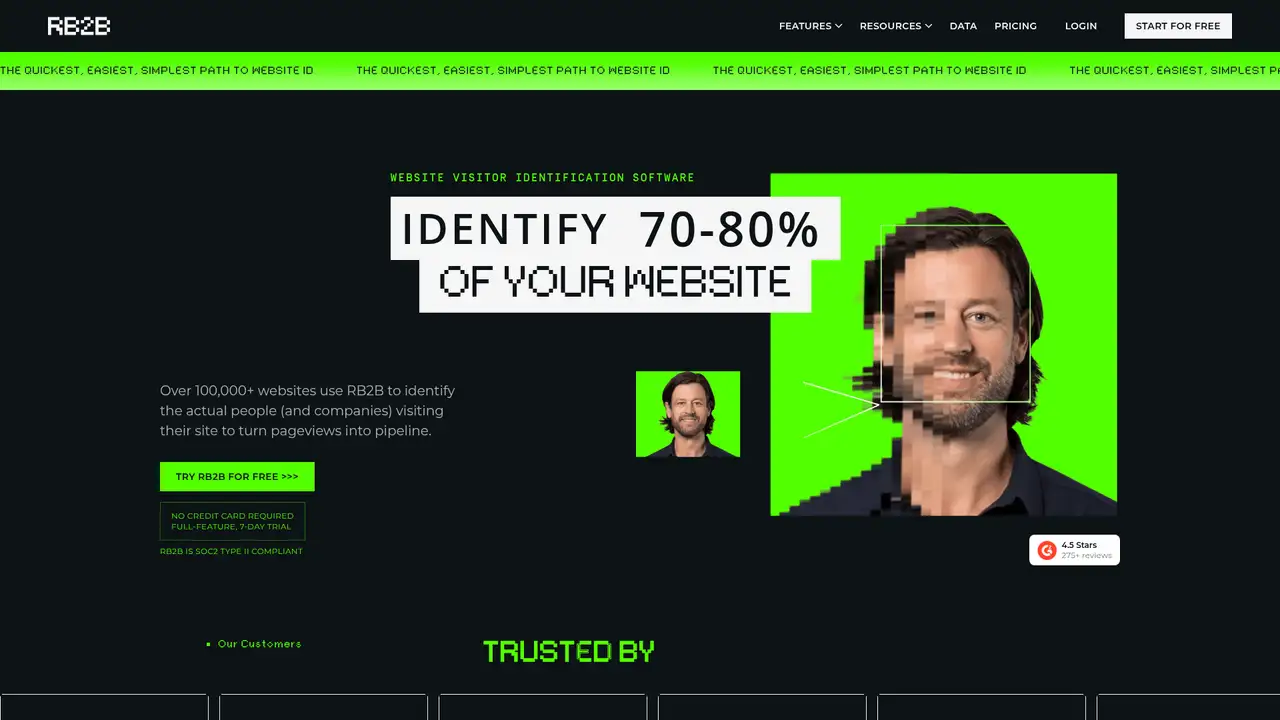
RB2B is a website visitor identification platform operated by GetEmails, LLC, doing business as RB2B and Retention. The company says it launched in 2023. A May 2025 company update reported $5 million in annual recurring revenue 13 months after launch, with a five-person team at that milestone. A separate profile lists the company as bootstrapped and founded in 2023. RB2B identifies companies globally and people primarily in the United States. Because company-level and person-level resolution are separate capabilities, international teams should determine whether they need account identification or individual contact details before selecting a plan. This distinction affects how sales teams qualify traffic and design follow-up workflows. The RB2B FAQ says more than 100,000 websites use the service.
The workflow begins by adding one RB2B script to a website header, allowing visitor activity to feed sales workflows without manually reviewing every session. After identification, the service sends visitor profiles to selected destinations, including Slack, Microsoft Teams, CRMs, Clay, and other connected applications. Profiles can include names, LinkedIn URLs, company information, business email addresses, captured pages, and visit details, depending on plan and match results. Pro and Pro+ add HubSpot, Salesforce, Zapier, webhooks, Apollo, CSV export, and other integrations, supporting enrichment, routing, and follow-up. Hot Pages marks visits to selected high-intent URLs, while Hot Leads filters visitors against defined ideal-customer criteria. Domain, URL, and list exclusions help remove unwanted traffic before alerts reach sales teams.
RB2B describes Basic Resolution as global company identification, with contact-level identification primarily for United States visitors. Pro+ adds Premium Resolution through an identity-graph waterfall that uses additional data sources. Published plan information lists roughly 15 to 20 percent coverage for Basic Resolution and 35 to 45 percent for Premium Resolution across contact-level US and global company identification. These figures help buyers estimate how often website traffic may produce actionable records, although results depend on visitor mix. The May 2025 Demandbase announcement reported combined person and company identification for 70 to 80 percent of website traffic. In January 2026, RB2B introduced revised plans and billing, including Starter and Pro+. Microsoft Teams support arrived in January 2026, and the Profiles API launched in October 2026.
Public monthly pricing lists Free at $0 for 150 resolutions, Starter at $79 for 300 resolutions, Pro from $149 for at least 600 resolutions, and Pro+ from $199 for at least 600 resolutions. Starter includes LinkedIn URLs and charges $0.45 for each additional resolution, making usage growth more expensive at that tier. Pro and Pro+ charge $0.25 per additional resolution. Those plans can add domains for $99 monthly, with coverage for up to five domains, which may suit teams operating multiple websites. Every account receives a seven-day full-featured trial without a credit card, allowing evaluation before payment, but the trial is not an ongoing subscription tier. Pro+ volumes above 12,500 monthly resolutions require contacting RB2B, so larger programs need a separate pricing discussion.
RB2B's principal constraint is coverage: person-level identification is limited to US traffic, while company-level identification is global. Deployments may require privacy-policy disclosures, consent tooling, opt-out handling, and review of RB2B's data terms. Teams must also account for resolution limits and possible overage charges when estimating operating costs. The service depends on other sales tools for sequencing, enrichment, and closing, so it is not a complete prospecting or CRM replacement. Warmly provides adjacent visitor and buying-signal workflows, Apollo combines prospect data with search and sequencing, and Common Room covers web, product, community, and account signals. Leadfeeder and Albacross offer further visitor-identification alternatives. RB2B suits teams wanting a focused website-visitor feed, particularly US-heavy B2B teams using Slack, CRM systems, or Clay.
Who is RB2B best for?
- US-focused B2B teams needing person-level visitor alerts.
- Revenue teams using Slack, HubSpot, Salesforce, or Clay.
- Small teams wanting a permanent free visitor-identification tier.
- Marketers needing company-level identification outside the United States.
RB2B Pricing (2026)
Pricing model: Freemium. All prices in USD.
| Plan | Price | What you get |
|---|---|---|
| Free | $0/month | 150 monthly resolutions; company-level identification, Slack, and Teams. No person-level identification, email addresses, or other integrations. |
| Starter | $79/month | 300 monthly resolutions; LinkedIn URLs to Slack or Teams. Overage is $0.45 per resolution. |
| Pro | From $149/month | Starts at 600 monthly resolutions; business email, integrations, and Basic Resolution. Overage is $0.25 per resolution. |
| Pro+ | From $199/month | Starts at 600 monthly resolutions; Premium Resolution, higher coverage, business email, and integrations. Overage is $0.25 per resolution. |
Pros and Cons
Pros
- The free plan includes 150 monthly resolutions indefinitely.
- Slack and Teams delivery are available on every plan.
- Pro+ adds a published Premium Resolution coverage tier.
- The Profiles API supports visitor profile retrieval.
Cons
- Person-level identification is limited to US traffic.
- Paid plans charge per-resolution overages.
- Advanced prospecting still requires connected sales tools.
Who should look elsewhere?
- Teams requiring person-level identification worldwide.
- Organizations seeking a complete CRM replacement.
- Buyers unwilling to manage consent and visitor-data disclosures.
Technical Details
Frequently Asked Questions
How much does RB2B cost?
RB2B has a $0 Free plan with 150 monthly resolutions. Starter costs $79 per month, Pro starts at $149, and Pro+ at $199. Starter overages cost $0.45 per resolution, while Pro and Pro+ overages cost $0.25. The published pricing page lists monthly prices, and RB2B does not advertise an annual discount.
Does RB2B have a free plan?
Yes. The permanent Free plan includes 150 monthly resolutions, company-level identification, and Slack or Teams delivery. It excludes person-level identification, email addresses, and other integrations. Every account also receives a seven-day full-featured trial without a credit card. After the trial, users can remain on Free or select a paid plan.
How does RB2B compare with Apollo?
RB2B focuses on identifying website visitors and sending those signals into sales workflows. Apollo is broader, combining prospect data, search, contact access, and sequencing. RB2B fits when a website visit is the starting signal. Apollo fits when the main task is creating outbound lists and contacting prospects who may not have visited your site.
Does RB2B train AI models on customer data?
RB2B's privacy policy describes processing information to provide, improve, and develop its services, but it does not state a specific promise that customer data is never used for model training. The company publishes opt-out, access, deletion, data usage, and DPA documents. Legal teams should review those documents and applicable contracts before deployment.
Can businesses use RB2B commercially?
RB2B is designed for business marketing and sales use, and its plans include operational integrations. Commercial use remains subject to service terms, data usage terms, privacy obligations, and applicable consent rules. Person-level identification is US-only, while global company-level identification may require a consent-management setup. Teams should review disclosures and opt-out requirements before launch.
Best RB2B Alternatives in 2026
These tools do the same job as RB2B, with different pricing, limits and trade-offs.