
Warmly Review, Pricing & Alternatives (2026)
Website intent, visitor identification, and AI agents for revenue teams.
acquired: Warmly announced an agreement to be acquired by HubSpot on June 30, 2026. Its announcement says existing contracts, pricing, account teams, product experience, and integrations remain unchanged.
Last updated: October 26, 2026
What is Warmly?
Warmly is a B2B revenue platform for identifying website visitors, combining intent with CRM context, and activating inbound or outbound workflows. It supports company and permitted contact identification, chat, routing, follow-up, and retargeting. A free plan covers 500 monthly company-level visitors, while paid products begin at $10,000 annually.
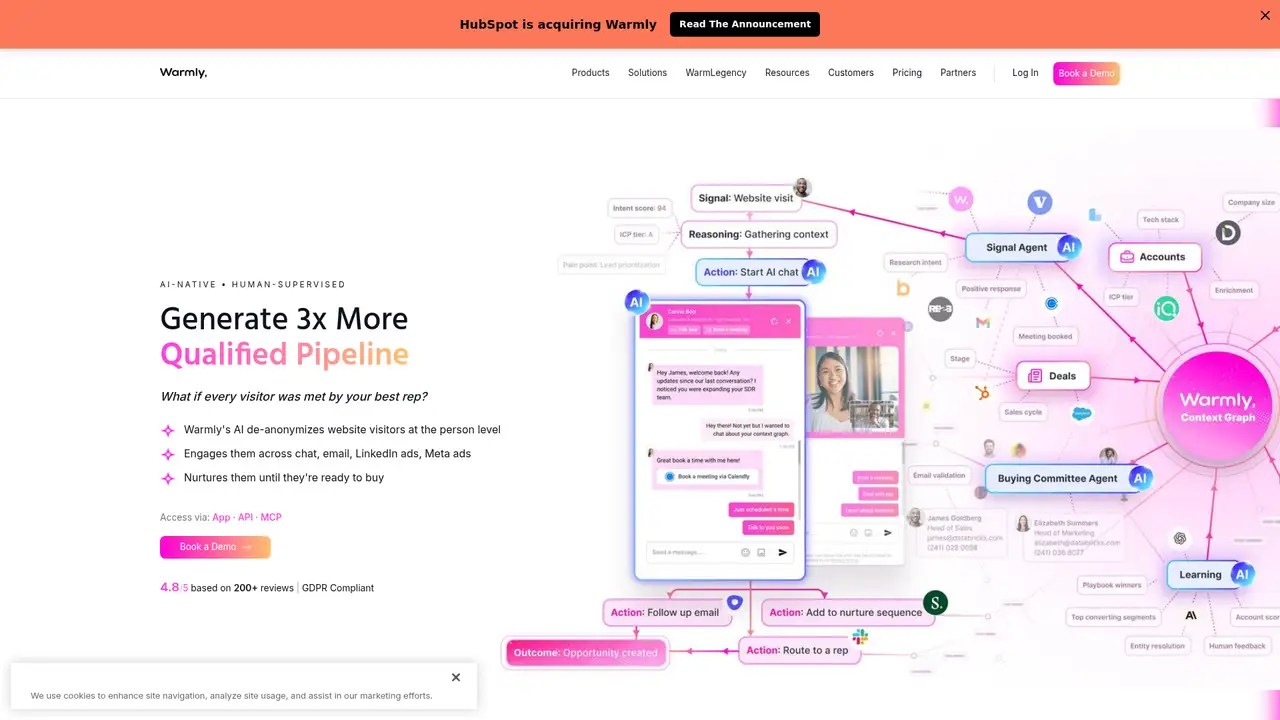
Warmly was founded in 2020 by Max Greenwald, Carina Boo, and Alan Zhao. The company announced an $11 million Series A in October 2023 and a $6 million Series A+ round in February 2025, bringing reported funding to $17 million. In 2024, Warmly reported more than 300 customers, $3 million in annual recurring revenue, and a global team of 50 people. The company is based in San Francisco and was built for B2B sales and marketing teams. On June 30, 2026, Warmly announced an agreement to be acquired by HubSpot. It says existing contracts, pricing, account teams, product experience, and integrations remain unchanged during the transition.
Warmly begins with a website snippet and connected data sources, giving revenue teams a way to turn visitor activity into operational signals. It can identify companies and, through permitted methods, contacts, then apply ideal customer profile filters and intent signals to prioritize activity. Teams can send real-time alerts to Slack, route leads into customer relationship management systems, and activate follow-up through webhooks. Inbound Chat adds an AI chatbot, live Warm Calling, chat metrics, and automated email follow-up, supporting conversations and qualification while visitors are active. Retargeting supports email, LinkedIn, and advertising workflows for continued engagement. Integrations include Salesforce, HubSpot, Marketo, Outreach, Salesloft, Apollo, 6sense, Clearbit, Bombora, Demandbase, Slack, Microsoft Teams, and ActiveCampaign.
Warmly’s current product language includes AI Web-Deanonymization, Inbound Chat, and AI Inbound Autopilot. Inbound Chat includes one AI Studio Agent, while Autopilot adds unlimited agents, goal setting, qualification, decision-making, mini-demo slide generation, written chat follow-up, automated email generation, and chat improvement. Warmly describes a Context Graph with more than 220 million people profiles, 40 million company profiles, and 33 million annual intent signals. Its Trust Center lists SOC 2, GDPR, CCPA, and EU Data Act materials, giving buyers reference points for security and privacy review. Company-level JavaScript identification does not identify individuals by itself. Person-level identification comes through other permitted methods, so teams must evaluate consent, notices, and applicable privacy obligations before using those capabilities.
Warmly publishes a free plan and three main paid product levels. Free costs $0 and identifies up to 500 website visitors monthly at company level, with real-time Slack alerts but no automation. AI Web-Deanonymization starts at $10,000 annually with annual billing, or $4,875 quarterly, and includes at least 10,000 monthly credits. Inbound Chat starts at $20,000 annually, or $6,500 quarterly. AI Inbound Autopilot starts at $30,000 annually, or $9,750 quarterly. GTM Signals, the 24/7 Video Chat Agent, and Warm Experiences each cost $10,000 annually. These options let teams begin with basic identification or add chat, automation, signals, and personalized experiences as operational needs expand. Credit use and privacy requirements need active oversight.
Warmly’s main tradeoff is price combined with operational breadth. Paid entry is high for teams seeking visitor identification alone, and credit consumption requires monitoring so usage stays aligned with traffic and campaign volume. RB2B concentrates more narrowly on person-level website identification and alerts, which may simplify adoption for focused prospecting teams. 6sense focuses on account-based intent and buying-stage signals, while Demandbase offers broader account-based marketing capabilities. Qualified is a closer website-agent comparison, especially for Salesforce-centered teams, but uses custom pricing. Warmly can require coordination among marketing, sales, and revenue operations because its value depends on connecting several workflows. Choose Warmly when a revenue team wants to connect identified intent with chat, CRM routing, automated follow-up, and retargeting across one workflow.
Who is Warmly best for?
- B2B teams acting on website intent in real time.
- Revenue operations teams connecting CRM and chat.
- Marketers running intent-based retargeting.
- Teams wanting inbound and outbound agents.
Warmly Pricing (2026)
Pricing model: Freemium. All prices in USD.
| Plan | Price | What you get |
|---|---|---|
| Free | $0 | Up to 500 monthly company-level visitors, real-time Slack alerts, and no automation. |
| AI Web-Deanonymization | $10,000/year or $4,875/quarter | From 10,000 monthly credits; contact and company identification, ICP filtering, alerts, routing, CRM sync, webhooks, and retargeting. |
| Inbound Chat | $20,000/year or $6,500/quarter | From 10,000 monthly credits; one AI Studio Agent, chatbot, Warm Calling, metrics, and automated email follow-up. |
| AI Inbound Autopilot | $30,000/year or $9,750/quarter | From 10,000 monthly credits; unlimited agents, autonomous qualification, slides, and automated follow-up. |
| GTM Signals add-on | $10,000/year | Intent, hiring, funding, competitive, and related buying signals. |
| 24/7 Video Chat Agent add-on | $10,000/year | AI video avatar for visitor engagement, demonstrations, and qualification. |
| Warm Experiences add-on | $10,000/year | Personalized website experiences based on visitor identity and intent. |
Pros and Cons
Pros
- Warmly combines visitor identity, intent, chat, and routing.
- Its free tier supports 500 monthly company-level visitors.
- It connects CRM, webhook, Slack, and advertising workflows.
- Its Trust Center publishes security and privacy materials.
Cons
- Paid entry pricing is high for smaller teams.
- Credit consumption requires regular monitoring.
- Person-level identification creates consent obligations.
Who should look elsewhere?
- Buyers seeking a low-cost contact database.
- Teams without enough traffic for credits.
- Organizations requiring self-hosted software.
Technical Details
Frequently Asked Questions
How much does Warmly cost?
Warmly has a free plan and three paid levels. AI Web-Deanonymization starts at $10,000 yearly with annual billing, or $4,875 quarterly. Inbound Chat starts at $20,000 yearly, or $6,500 quarterly. AI Inbound Autopilot starts at $30,000 yearly, or $9,750 quarterly. GTM Signals, Video Chat Agent, and Warm Experiences cost $10,000 yearly each.
What does Warmly's free plan include?
The free plan costs $0 and identifies up to 500 website visitors monthly at company level. It includes real-time Slack alerts but no automation. Person-level identification, CRM synchronization, routing, retargeting, AI chat, and larger credit allowances belong to paid products. Teams should also review consent requirements for their markets before installing website tracking.
How does Warmly compare with RB2B?
RB2B focuses primarily on person-level website visitor identification, while Warmly combines identification with intent signals, CRM and webhook workflows, chat, routing, automated follow-up, and advertising activation. Warmly covers more revenue operations, but paid plans start at $10,000 yearly. RB2B may suit teams seeking identification and alerts without broader conversation and campaign functions.
Does Warmly train AI on customer data?
Warmly explains that CRM data, website data, chat messages, and integrations can support its services, while customers choose CRM read or write access. Its Trust Center lists SOC 2, GDPR, and CCPA materials. Public product information does not make a blanket statement that all customer data trains general models, so buyers should review contracts and privacy terms.
Can Warmly be used for commercial lead generation?
Yes. Warmly is designed for B2B sales and marketing. Paid plans support identification, ICP filtering, intent signals, routing, CRM synchronization, chat, email follow-up, and retargeting. Customers remain responsible for lawful collection, notices, consent where required, and appropriate use of visitor and business-contact data. Warmly's compliance guidance specifically highlights customer responsibilities under applicable privacy rules.
Best Warmly Alternatives in 2026
These tools do the same job as Warmly, with different pricing, limits and trade-offs.

A Salesforce-native AI SDR for turning inbound interest into pipeline.

Identify website visitors and route sales signals to sales tools
Account intent data, predictive buying stages and RevvyAI agents for B2B revenue teams
Account-based marketing suite with intent data, B2B ads and Mojo campaign agents