
PrivateGPT Review, Pricing & Alternatives (2026)
An open-source API layer for private AI applications
Last updated: October 26, 2026
What is PrivateGPT?
PrivateGPT is an Apache-licensed application API that adds messages, file ingestion, retrieval, citations, tools, data access, and orchestration above local or self-hosted model servers. It is aimed at developers and organizations building private AI applications. The software entry price is $0, while computing, storage, inference services, and Zylon's separate commercial platform cost extra.
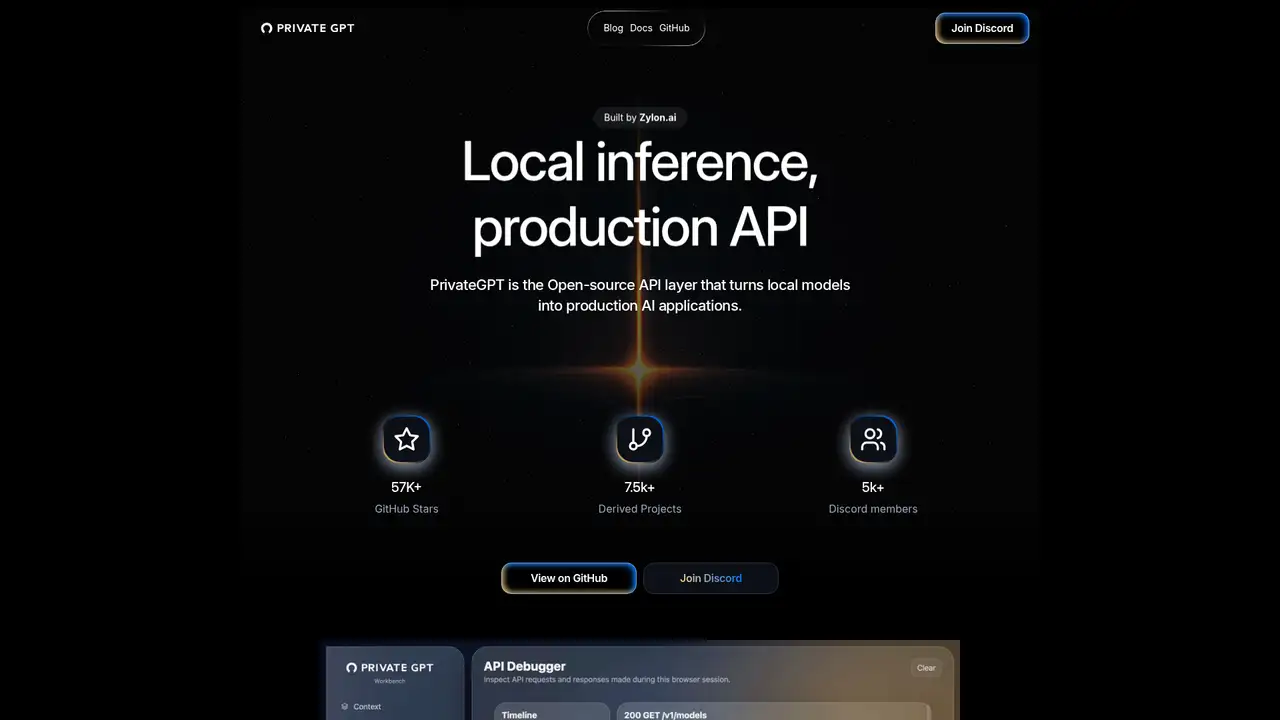
PrivateGPT is an open-source application API layer for building private AI applications on local or self-hosted model servers. It is maintained by Zylon, whose commercial platform is built on top of the project. The original project launched in 2023 as an offline retrieval-augmented generation implementation, while PrivateGPT 1.0 was published on June 3, 2026, after two years of development in a private fork. The project’s site reports more than 57,000 GitHub stars, over 7,500 derived projects, and more than 5,000 Discord members. Those figures indicate substantial public interest and reuse, but do not establish deployment quality or support levels. In practical terms, PrivateGPT supplies a reusable application layer, allowing developers to build private AI products without implementing common backend capabilities from scratch.
A typical workflow starts by pointing PrivateGPT at an OpenAI-compatible model server and configuring the application through its environment and profiles. An application or the built-in Workbench then sends messages through the API, with streaming, asynchronous processing, model selection, and token counting available where needed. For document-based use, a developer uploads files or other artifacts, lets the system process them and create embeddings, and issues questions against the resulting collection. Retrieval can supply relevant context and citations, while agentic retrieval and tool use support more involved requests. The same backend can expose databases, CSV files, and tabular data, or invoke web search, extraction, custom tools, MCP connectors, and code execution. This separates interface design from ingestion, retrieval, orchestration, and model calls.
PrivateGPT 1.0 is built as a Claude API compatible application layer above an external OpenAI compatible inference server. The server must expose chat completions and model endpoints, while PrivateGPT supplies messages, model selection, streaming, asynchronous processing, files and artifacts, retrieval with citations, embeddings, tools, MCP connectors, structured database and CSV access, web extraction, code execution, and token counting. This separation lets a deployment retain its existing Ollama, llama.cpp, vLLM, or similar model service, but it also means model serving, capacity, and compatibility remain separate operational concerns. The included Workbench UI is intended for testing and inspection rather than replacing the API. Version 1.0.1 made local setups more practical by making embedding credentials optional, correcting Docker database dependencies, standardizing PGPT_HOME paths, and improving publisher readiness.
PrivateGPT itself is free software under Apache License 2.0, with no per-seat charge or published API tariff. That license permits use, modification, reproduction, distribution, and sublicensing, subject to providing the license, marking changed files, and preserving applicable notices. The patent grant can terminate if a user brings patent litigation alleging infringement by the work or its contributions. Free code does not make a deployment costless: the model server remains a separate dependency, so self-hosting requires suitable compute, storage, maintenance, and power. Using remote inference or embedding services can instead introduce provider usage charges, and local engines may still require model files and their associated resources. Organizations should also account for the major-version migration requirement, because the original API is not forward-compatible with PrivateGPT 1.0.
PrivateGPT’s main limitation is that it adds application capabilities without supplying the inference layer, so deployment still requires a compatible model server, hardware, configuration, and ongoing operations. Its 1.0 release also breaks compatibility with the original API, making migration work necessary for existing integrations. Compared with Ollama and LM Studio, it is less useful as a standalone way to download, run, and interact with models. Compared with Onyx and Open WebUI, it provides less of a finished workspace because its included UI is primarily for testing and demonstrations, not the main product. Dify and AnythingLLM likewise offer more immediately usable application interfaces, whereas PrivateGPT suits teams building their own experience around an API. Pick PrivateGPT if you need an Apache-licensed, API-first layer over infrastructure you control.
Who is PrivateGPT best for?
- Developers building private RAG applications.
- Organizations requiring self-hosted APIs.
- Teams integrating local inference with Claude clients.
- Engineers needing citations, tools, and MCP.
PrivateGPT Pricing (2026)
Pricing model: Free. All prices in USD.
| Plan | Price | What you get |
|---|---|---|
| PrivateGPT open source | Free | Apache-2.0 self-hosted software; users supply inference, models, compute, and storage. |
| Zylon commercial platform | Custom | Commercial pricing is provided through a sales process. |
Pros and Cons
Pros
- Apache 2.0 permits commercial deployment.
- It works above several inference servers.
- The API covers retrieval and tools.
- Zylon work now feeds the public repository.
Cons
- It excludes the underlying inference server.
- Version 1.0 breaks the original API.
- Self-hosting requires multiple services.
Who should look elsewhere?
- Users wanting hosted chat subscription.
- Teams unwilling to operate inference services.
- Projects locked to the old API.
Technical Details
Frequently Asked Questions
How much does PrivateGPT cost?
The open-source PrivateGPT application costs $0 under the Apache License 2.0. That does not include computers, storage, model weights, inference servers, embeddings, monitoring, or operations. Remote model and search providers can add their own usage fees. Zylon is a separate commercial platform, and its pricing is custom rather than publicly listed.
Does PrivateGPT have a free plan?
Yes. The single free software option is the self-hosted open-source repository, priced at $0. It provides the application API and workbench, while the operator supplies a compatible inference server, models, compute, storage, and integrations. There is no documented hosted PrivateGPT subscription with bundled inference in the published pricing information.
PrivateGPT or AnythingLLM: which is better?
AnythingLLM is the closer choice for a ready-made document-chat application and workspace. PrivateGPT is better suited to developers who want an API-first backend with Claude-style messages, citation-aware retrieval, tools, databases, CSV analysis, custom tools, and MCP. The choice depends on whether the primary need is a finished interface or an application layer to integrate into a product.
Does PrivateGPT train on user documents?
A self-hosted deployment can keep documents and prompts within the operator's infrastructure because PrivateGPT connects to a model server under that operator's control. Data can leave that environment when the deployment uses remote inference, embeddings, web search, extraction, connectors, or other online providers. The software's privacy outcome therefore depends on the configured stack.
Can PrivateGPT be used commercially?
The current repository carries the Apache License 2.0, which grants commercial use, modification, distribution, and sublicensing rights subject to its conditions, including preserving required notices and providing the license. Third-party components, model weights, and connected services can have separate terms. Zylon's commercial platform is separately sold and is not required to use the open-source code commercially.
Best PrivateGPT Alternatives in 2026
These tools do the same job as PrivateGPT, with different pricing, limits and trade-offs.

A local-first workspace for documents, agents, and many model providers.

Visual infrastructure for production AI applications
A self-hosted interface for local and hosted AI models

A private, self-hosted AI assistant for notes, research, and automation
Open-source context engineering for RAG, agents, and workflows