
LlamaIndex Review, Pricing & Alternatives (2026)
Open-source context engineering for RAG, agents, and workflows
Last updated: October 26, 2026
What is LlamaIndex?
LlamaIndex is a free, MIT-licensed Python and TypeScript framework for context engineering, retrieval, agents, connectors, and workflows. Its separate LlamaParse service starts at $0 per month with 10,000 monthly credits, while paid plans begin at $50 per month. Model, vector database, storage, and compute charges remain separate from the framework and service credits.
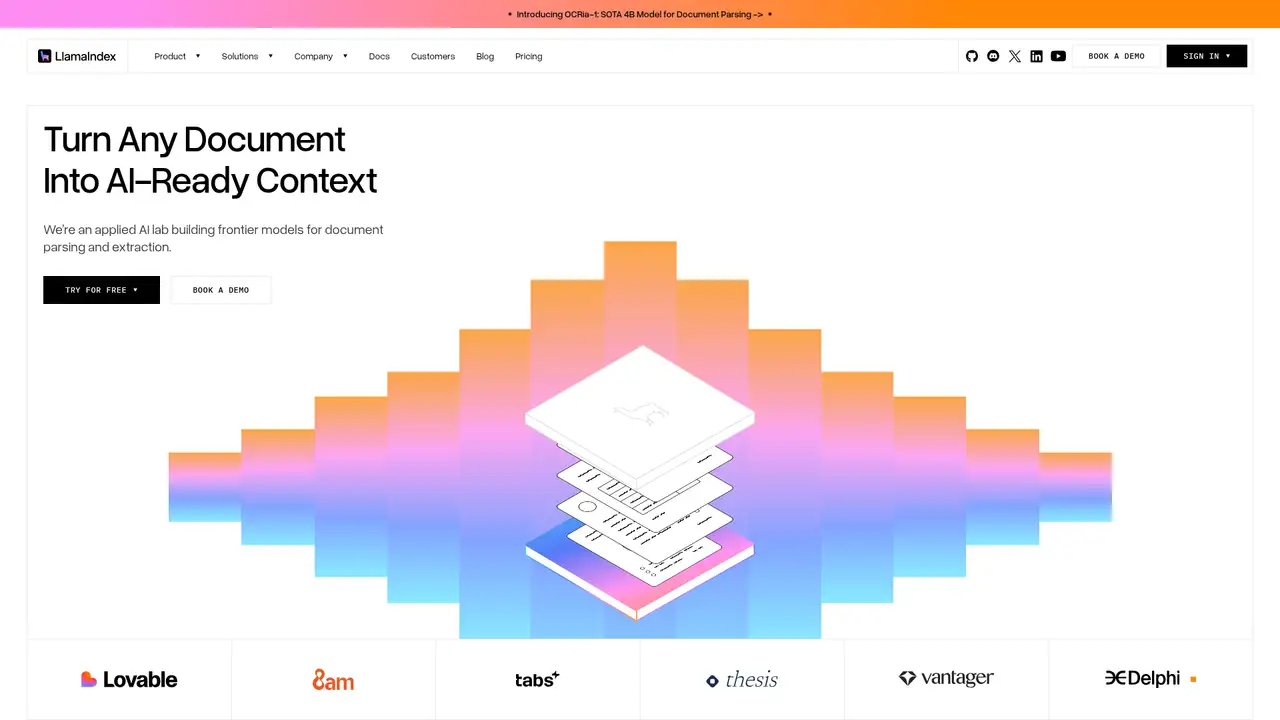
LlamaIndex is an active open-source framework from LlamaIndex, Inc. for context engineering, retrieval-augmented generation, agents, workflows, connectors, indexes, evaluation, and observability. It supports Python and TypeScript, while the company’s commercial platform provides LlamaParse and related document services for parsing, extraction, classification, splitting, and indexing. On March 4, 2025, LlamaIndex announced LlamaParse general availability and a $19 million Series A led by Norwest, bringing reported total capital to $27.5 million. The announcement described SaaS and on-premise options, SOC 2 Type 2, and GDPR-compliant European SaaS. The framework remains available under the MIT license, separate from the commercial platform. LlamaIndex’s framework and LlamaParse represent separate offerings: the former is MIT-licensed software, while the latter is a commercial document platform. The company’s March 2025 announcement also described LlamaCloud availability as SaaS and on-premise, with SOC 2 Type 2 and European GDPR-compliant SaaS options.
LlamaIndex provides ingestion, indexing, retrieval, query engines, agents, tools, and event-driven multi-step workflows. Workflows can branch, retry, and include human review. Document applications can combine connectors, parsers, embeddings, vector stores, and model providers selected by the developer. Official integrations cover OpenAI, Anthropic, Google, Mistral, DeepSeek, Hugging Face, Bedrock, Vertex, Azure, and other providers. Vector-store options include in-memory storage, Chroma, Qdrant, Postgres with pgvector, Milvus, Weaviate, Pinecone, Redis, Elasticsearch, and FAISS. LlamaParse adds managed parsing, extraction, classification, splitting, and indexing through a commercial service, while the framework can run with local models and local vector stores. Its workflow model supports asynchronous, event-driven steps that can branch, retry, and pause for human review. Developers can connect ingestion pipelines to query engines, agents, and tools, then select model and storage providers independently for each application.
The open-source repository remains actively maintained as of October 26, 2026. GitHub tags list version 0.14.25 on September 21, 2026, after 0.14.24 on August 19 and earlier 0.14 releases in 2026. The 0.14.24 notes include security-alert fixes, structured-output and AgentWorkflow improvements, citation and query-engine changes, and support for newer Anthropic models. The repository README says company focus shifted toward LlamaParse, liteparse, and benchmarks while the open-source projects remain available. Local model support includes Ollama, and developers can choose their own deployment infrastructure. LlamaIndex’s documented integrations include hosted and local model choices, including Ollama, alongside vector stores such as Postgres with pgvector, Qdrant, Milvus, Weaviate, Pinecone, Redis, Elasticsearch, and FAISS. GitHub tags list version 0.14.25 dated September 21, 2026, following multiple 0.14 releases during 2026.
The LlamaIndex Framework has no subscription and is free under the MIT license. LlamaParse pricing lists Free at $0 per month with 10,000 monthly credits, Starter at $50 per month with 40,000 credits, Pro at $500 per month with 400,000 credits, and Enterprise at Custom pricing. The platform converts 1,000 credits to $1.25. Parsing tiers range from 1 credit per page for Fast to 45 for Agentic Plus. Retrieval queries cost 1 credit, exported pages cost 2, chat turns cost 100, and retained storage costs 100 credits per gigabyte per day. The LlamaParse Free plan includes 10,000 monthly credits, five concurrent processing jobs, five indexes, and 50 files per index. Paid plans raise credits and storage limits, while credit usage varies by operation, including parsing pages, exported pages, retrieval queries, chat turns, and retained storage.
LlamaIndex suits teams building document-heavy RAG, retrieval systems, data connectors, and agent workflows that need provider and deployment choice. LangChain and LangGraph are broader orchestration competitors, while Haystack emphasizes search and RAG pipelines. Semantic Kernel and Microsoft Agent Framework focus on enterprise Microsoft integration and agent workflows. Privacy depends on deployment and connected providers: local models and vector stores can keep data within operator infrastructure, while hosted services and remote model APIs process content under applicable terms. LlamaIndex’s main distinction is document ingestion, indexing, retrieval, and data-connected workflows, whereas LangGraph and LangChain cover broader orchestration and Haystack emphasizes search and RAG pipelines. Microsoft Agent Framework and Semantic Kernel target Microsoft-oriented agent workflows, while LlamaIndex offers Python and TypeScript deployment choices. Pick LlamaIndex when composable ingestion, retrieval, and document workflows are central.
Who is LlamaIndex best for?
- Document-heavy RAG applications
- Python or TypeScript agent workflows
- Teams needing local deployment choices
- Developers connecting many data sources
LlamaIndex Pricing (2026)
Pricing model: Freemium. All prices in USD.
| Plan | Price | What you get |
|---|---|---|
| Framework | Free | MIT-licensed open-source Python and TypeScript toolkit. Model, vector database, storage, compute, and provider charges are separate. |
| LlamaParse Free | $0/month | 10,000 monthly credits; five concurrent Parse, Extract, Classify, Split, and Index jobs; five indexes; 50 files per index; one project. |
| LlamaParse Starter | $50/month | 40,000 monthly credits; five concurrent Parse, Extract, Classify, Split, and Index jobs; 50 indexes; 500 files per index; one project; pay-as-you-go up to $500/month. |
| LlamaParse Pro | $500/month | 400,000 monthly credits; 20 concurrent Parse, Extract, Classify, Split, and Index jobs; 100 indexes; 2,000 files per index; five projects; pay-as-you-go up to $5,000/month. |
| LlamaParse Enterprise | Custom | Custom credits, limits, concurrency, storage, support, overage, deployment, security, and contract terms. |
Pros and Cons
Pros
- The framework supports Python and TypeScript development.
- Many model and vector-store integrations are documented.
- Local deployment can keep data within operator infrastructure.
- LlamaParse provides structured document processing options.
Cons
- Framework operating costs remain separate from the free license.
- Hosted platform usage is credit based and can vary.
- Privacy depends on connected providers and deployment choices.
Who should look elsewhere?
- Teams wanting a hosted general chatbot
- Projects requiring one bundled model bill
- Users seeking a no-code-only builder
Technical Details
Frequently Asked Questions
How much does LlamaIndex cost?
The LlamaIndex Framework is free under the MIT license. LlamaParse lists Free at $0 per month, Starter at $50 per month, Pro at $500 per month, and Enterprise at Custom pricing. Usage consumes credits for parsing, indexing, retrieval, chat, and retained storage. Model APIs, vector databases, storage, and compute can add separate charges.
Is there a free LlamaIndex plan?
Yes. The open-source LlamaIndex Framework is free under the MIT license and can run on infrastructure selected by the developer. LlamaParse also lists a $0 per month Free plan with 10,000 monthly credits, five concurrent jobs, five indexes, 50 files per index, and one project. Provider and infrastructure charges are separate.
What is the closest competitor to LlamaIndex?
LangChain and LangGraph are the closest broad alternatives for application and agent orchestration. Haystack is a close comparison for search and RAG pipelines, while Semantic Kernel and Microsoft Agent Framework are stronger comparisons for Microsoft-oriented enterprise workflows. LlamaIndex stands apart through document ingestion, indexing, retrieval, and data-connected agent workflows.
Does LlamaIndex use customer data to train models?
The framework has no single hosted data boundary, so handling depends on the models, vector stores, tools, and infrastructure selected. LlamaIndex’s privacy notice describes controller and processor roles, customer instructions, and service processing. Remote providers may receive prompts or documents under their own terms. Local models and storage can keep processing within the operator’s infrastructure.
Can LlamaIndex be used commercially?
Yes. The LlamaIndex Framework’s MIT license permits commercial use, modification, distribution, sublicensing, and sale, subject to the license terms. LlamaParse is a separate commercial platform with its own pricing and contractual terms. Developers should also review licenses and service terms for connected models, data sources, vector stores, tools, and deployment providers.
Best LlamaIndex Alternatives in 2026
These tools do the same job as LlamaIndex, with different pricing, limits and trade-offs.