
Dify Review, Pricing & Alternatives (2026)
Visual infrastructure for production AI applications
Last updated: October 22, 2026
What is Dify?
Dify is LangGenius’s platform for building, deploying, and operating LLM applications, agent workflows, and retrieval systems. It suits developers, product teams, and enterprises wanting visual construction with APIs and deployment choice. Dify Cloud starts at $0/month, while Community self-hosting is free under the Dify Open Source License; model and infrastructure charges can remain separate.
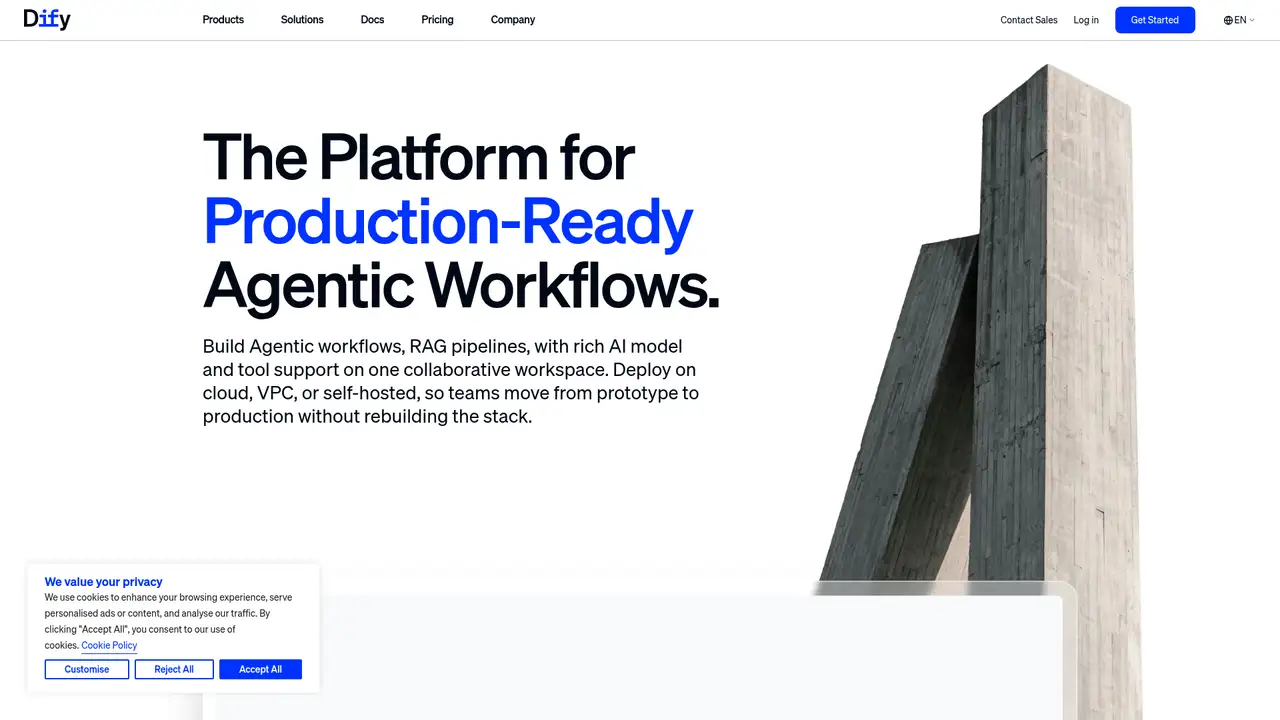
Dify is an application platform from LangGenius, founded in March 2023 according to the company. Its visual workflow canvas connects language models with business systems and covers application building, deployment, monitoring, and knowledge retrieval. LangGenius said in March 2026 that Dify ran on more than 1.4 million machines, reached users in more than 175 countries and regions, and had more than 2,000 teams and 280 enterprises. The announcement also reported a $30 million Series Pre-A led by HSG, with GL Ventures, Alt-Alpha Capital, 5Y Capital, Mizuho Leaguer Investment, and NYX Ventures participating. These figures describe company-reported scale and funding. Dify’s central appeal is control over the application layer, model connections, deployment location, and operational interface.
A typical Dify project begins with an app type such as Chatflow, Workflow, Agent, or text-generation application. The builder connects prompt and LLM nodes, conditional logic, code, HTTP requests, tools, and human-input steps on a canvas. Knowledge bases ingest documents, create embeddings, retrieve passages, and can rerank results for RAG responses. Teams add a provider key, test runs in the visual interface, inspect logs, annotate answers, and publish a web app or call the application through a REST API. Plugins and marketplace integrations add providers and tools. The API documentation covers chat messages, workflow execution, file uploads, conversations, feedback, annotations, knowledge bases, and streaming events. This makes Dify useful for prototypes that need a defined path toward production deployment.
Dify is model-agnostic at the application layer. Its provider system supports LLM, embedding, rerank, speech-to-text, and text-to-speech models. Users connect provider credentials or add a custom model when a listed option is absent. Current documentation names OpenAI, Anthropic, Gemini, xAI, and Tongyi among supported providers, with additional marketplace additions. Billing generally occurs through the connected provider account. Recent releases include self-hosted version 1.17.1 in September 2026, which lists dataset-scoped knowledge-base API keys and marketplace creator profiles. Dify Enterprise’s release page lists version 3.12.1 as the latest August 2026 enterprise release and identifies long-term-support versions. Edition and version numbering differ, so administrators should check the relevant release channel before upgrading.
Dify Cloud’s Sandbox plan costs $0/month and includes 200 message credits, one member, five apps, 50 knowledge documents, 50 MB of knowledge storage, 3,000 monthly trigger events, and a 5,000-per-month API limit. Professional costs $590 per workspace per year and includes 5,000 monthly message credits, three members, 50 apps, 500 documents, 5 GB storage, and 20,000 trigger events. Team costs $1,590 per workspace per year and includes 10,000 monthly message credits, 50 members, 200 apps, 1,000 documents, 20 GB storage, and unlimited trigger events. Enterprise is custom. Community self-hosting is free, while Enterprise self-hosting is custom. Cloud prices exclude applicable taxes, and model-provider charges may continue after included credits run out.
Dify’s main trade-off is operational choice: Cloud reduces administration, while self-hosting puts upgrades, security, storage, and provider credentials under the customer’s control. Community use must comply with the Dify Open Source License, whose source-available terms can restrict some commercial deployments. Langflow and Flowise are closer visual builders, while n8n focuses on broad automation and event integration. Dify fits teams needing a model-flexible LLM application layer, RAG, application APIs, and cloud or self-hosted deployment. Choose n8n when AI is one step inside a wider business process, or Langflow when a developer-oriented orchestration canvas is the priority. Pick Dify if your team needs to build and operate AI applications with visible workflows, knowledge bases, and provider choice.
Who is Dify best for?
- Teams building RAG assistants and agent workflows with visual components.
- Developers needing REST APIs, streaming, logs, and application operations.
- Organizations requiring cloud and self-hosted deployment choices.
- Companies connecting commercial and open model providers.
Dify Pricing (2026)
Pricing model: Freemium. All prices in USD.
| Plan | Price | What you get |
|---|---|---|
| Sandbox | $0/month | 1 member, 5 apps, 50 documents, 50 MB storage, 200 message credits/month, 3,000 triggers/month, and 5,000 API calls/month. |
| Professional | $590/workspace/year | 3 members, 50 apps, 500 documents, 5 GB storage, 5,000 message credits/month, and 20,000 trigger events/month. |
| Team | $1,590/workspace/year | 50 members, 200 apps, 1,000 documents, 20 GB storage, 10,000 message credits/month, and unlimited trigger events. |
| Community | $0/month | Free self-hosted core features under the Dify Open Source License; the operator supplies infrastructure and manages deployment. |
| Enterprise | Custom | Cloud or self-hosted enterprise deployment with commercial authorization, multiple workspaces, SSO, security controls, support, and negotiated SLAs. |
Pros and Cons
Pros
- The visual builder covers workflows, agents, RAG, tools, and human input.
- Cloud, free Community self-hosting, and custom Enterprise deployment are available.
- Application APIs support streaming, files, conversations, workflows, and knowledge bases.
- Provider abstraction connects multiple model and embedding vendors.
Cons
- Community self-hosting has license restrictions for some commercial deployments.
- Cloud message credits depend on model type and may run out during heavy use.
- Self-hosted operators remain responsible for infrastructure, upgrades, and provider billing.
Who should look elsewhere?
- Teams wanting a turnkey general-purpose business automation suite.
- Organizations unwilling to operate upgrades and security on self-hosted infrastructure.
- Commercial users needing enterprise license rights without contacting sales.
Technical Details
Frequently Asked Questions
How much does Dify cost?
Dify Cloud has a $0/month Sandbox plan, Professional at $590 per workspace per year, and Team at $1,590 per workspace per year. Enterprise is custom. The Community edition is free to self-host, while Enterprise self-hosting and commercial authorization require a custom Enterprise arrangement. Taxes and connected model-provider charges may be separate.
Is Dify free to use?
Yes, within stated limits. Sandbox costs $0/month and includes 200 message credits monthly, five apps, 50 documents, and 50 MB of knowledge storage. The Community edition is free to self-host for core features, subject to the Dify Open Source License. Model-provider API charges and infrastructure costs can remain separate.
Dify or n8n: which is better?
Dify focuses on LLM applications, RAG, model providers, prompt workflows, and application APIs. n8n covers broader business automation with many integrations, event triggers, and workflow controls. Pick Dify when the deliverable is an AI application or knowledge assistant. Pick n8n when AI is one step inside a larger business process.
Does Dify train on customer data?
Dify’s June 2026 privacy policy says LangGenius acts as controller for some service processing and as processor for enterprise customers under a Data Processing Agreement. Cloud data is stored on managed infrastructure with encryption in transit and at rest. The policy should be reviewed for the specific service and contract because model-provider retention terms can differ.
Can companies use Dify commercially?
Commercial use depends on deployment and license terms. The free Community edition follows the Dify Open Source License, while Enterprise includes commercial license authorization and enterprise features. Companies should review the repository license before redistributing, branding, or offering a hosted commercial service based on Community code. Contacting Dify is appropriate when the intended use needs enterprise rights.
Best Dify Alternatives in 2026
These tools do the same job as Dify, with different pricing, limits and trade-offs.