
Khoj Review, Pricing & Alternatives (2026)
A private, self-hosted AI assistant for notes, research, and automation
Last updated: October 26, 2026
What is Khoj?
Khoj is an open-source personal AI assistant from Khoj, built for private document chat, web research, custom agents, and scheduled automation. Cloud hosting ended April 15, 2026, leaving self-hosting as the current option. The software costs $0 to license, while model access, storage, hardware, and administration may create separate expenses for operators.
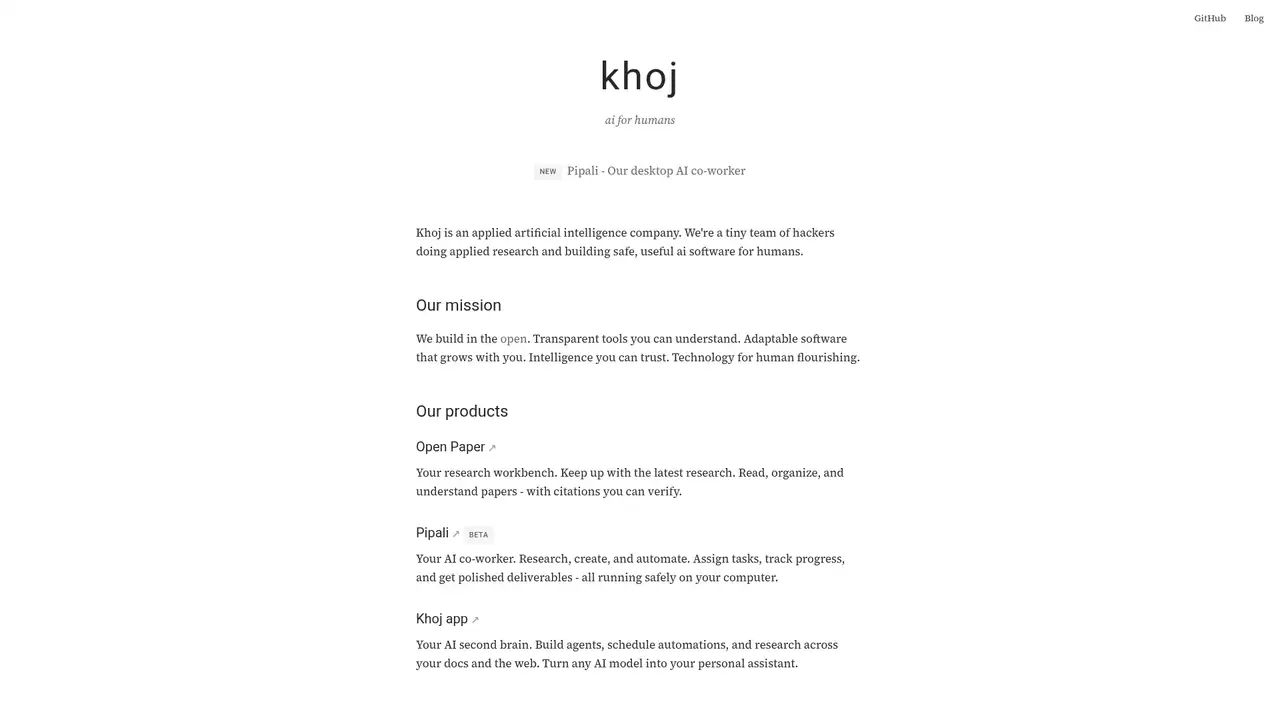
Khoj began in April 2021 as an experimental document-search project and grew into a personal AI application maintained by Khoj AI. Its GitHub repository reports more than 37,000 stars, and the software uses the GNU Affero General Public License v3.0. It can run on consumer hardware or connect to online models, with a stated goal of keeping personal data under the operator’s control. Khoj Cloud, the hosted subscription service introduced in 2023, was sunset on April 15, 2026. The open-source, self-hostable project remains active, making it the durable product rather than a conventional hosted assistant with an active subscription business. This model suits technically comfortable users who want private, model-agnostic document assistance and can manage deployment themselves.
A typical Khoj session begins by importing notes or documents and indexing them for semantic search before users ask questions through its web interface or integrations. Supported sources include PDF, plaintext, Markdown, org-mode, Notion, and Word files. Retrieval supplies relevant notes and metadata to a selected chat model, while commands can limit responses to notes, general knowledge, online information, image generation, code, diagrams, or deeper research. Users can create agents combining a persona, knowledge base, model, and tools. Access is available through browser, desktop, Android, Obsidian, Emacs, and WhatsApp. Because Khoj Cloud ended on April 15, 2026, deployment now requires self-hosting, with operators managing infrastructure, model access, storage, and updates.
Khoj is model-flexible rather than tied to one inference provider. Its repository names GPT, Claude, Gemini, Llama, Qwen, Mistral, and local models, while the chat documentation describes retrieval-augmented generation with offline or online chat. Users can import PDFs, Markdown, plaintext, Notion, Word, and org-mode files, then access them through browser, desktop, Android, Obsidian, Emacs, or WhatsApp interfaces. Recent 2.0.0 beta releases added long-term memories, improved Obsidian batch synchronization, stronger research-agent behavior, a Next.js 15 upgrade, and fixes for PDF processing and memory leaks. Release 2.0.0-beta.28 was published March 26, 2026. Its configurable architecture suits owners who want to swap models, but self-hosters must manage credentials, storage, updates, integrations, and hardware themselves.
Pricing is now primarily a deployment decision. Khoj’s AGPLv3 software costs $0 to self-host, but infrastructure and model usage do not: operators may pay for hosting, storage, electricity, server administration, and online model APIs. Before Khoj Cloud ended on April 15, 2026, its published page listed Humanist at $0 per month with free AI models, unlimited conversations, and 10 MB of uploads, plus Futurist at $30 per month with any AI model, 500 MB of uploads, and longer context. Those plans are historical and cannot be purchased. The current hosted application states that the service has ended, so they should not be treated as active offers. Khoj is for technically comfortable users who accept self-hosting responsibilities and want control over deployment and model choice.
Khoj’s main limitation is operational: self-hosting replaces a subscription checkout with installation, storage, model configuration, updates, and maintenance. The software is free under AGPLv3, but infrastructure, electricity, and model-provider costs remain separate, and Khoj Cloud ended on April 15, 2026. It is more configurable than ChatGPT’s document chat, more integrated with personal notes than Ollama alone, and more private by default than hosted assistants when deployed with operator-controlled storage and local models. ChatGPT offers a smoother managed experience, Ollama a simpler local model runner, and AnythingLLM another self-hosted document-chat workspace. Khoj suits technically comfortable users who want an open, model-agnostic assistant for PDFs, Markdown, Notion, Word, or org-mode files, with agents and integrations, rather than a supported hosted plan or turnkey enterprise administration.
Who is Khoj best for?
- Self-hosters can chat with private notes and documents.
- Obsidian or Emacs users can add assistant features to writing tools.
- Developers can choose models and configure personal agents.
- Researchers can use web search, references, and scheduled research workflows.
Khoj Pricing (2026)
Pricing model: Free. All prices in USD.
| Plan | Price | What you get |
|---|---|---|
| Self-hosted | $0 | AGPLv3 software; hosting, storage, and model-provider costs are separate. |
Pros and Cons
Pros
- AGPLv3 licensing permits self-hosted deployment with source available.
- Retrieval supports PDFs, Markdown, Notion, Word, and org-mode files.
- Agents can combine custom knowledge, personas, models, and tools.
- Online and local model options reduce dependence on one provider.
Cons
- Khoj Cloud was discontinued on April 15, 2026.
- Self-hosters must operate storage, updates, model access, and integrations.
- The old cloud pricing page can mislead readers because its plans are unavailable.
Who should look elsewhere?
- Users requiring an active managed cloud subscription should look elsewhere.
- Teams wanting a turnkey hosted assistant may find self-hosting burdensome.
- Buyers needing one fixed model and vendor-supported workflow may prefer hosted software.
Technical Details
Frequently Asked Questions
Is Khoj still available in 2026?
Yes, the open-source Khoj project remains available for self-hosting. Khoj Cloud was sunset on April 15, 2026, so the hosted app and subscriptions are no longer current options. Users can deploy the software themselves, retain control of stored documents, and select local or online model providers.
How much does Khoj cost?
Self-hosting the AGPLv3 software costs $0 in license fees, but infrastructure and model usage can cost money. The old cloud page listed a free Humanist tier and a $30 monthly Futurist tier, but those plans ended with the hosted service on April 15, 2026. No current hosted subscription is available.
Khoj or ChatGPT for documents?
ChatGPT is easier for a managed, ready-to-use experience. Khoj fits better when document ownership, self-hosting, model choice, and Obsidian or Emacs integrations matter more than a polished hosted service. Khoj also permits local models, while ChatGPT centers its own service and account infrastructure.
Does Khoj train on my documents?
A self-hosted Khoj instance keeps its database and indexed files on infrastructure chosen by its operator, but model-provider handling depends on provider and configuration. Khoj’s hosted terms said email addresses could be retained for security. The safest privacy setup is self-hosting with a local model and reviewing each connected provider’s data policy.
Can I use Khoj commercially?
Khoj’s repository uses AGPLv3, allowing use subject to that license’s conditions. Commercial deployment is possible, but distributing modified or networked versions can trigger source-sharing and notice obligations. Teams should obtain legal advice about their deployment, modifications, and model licenses before embedding Khoj in a proprietary product.
Best Khoj Alternatives in 2026
These tools do the same job as Khoj, with different pricing, limits and trade-offs.