
monday.com AI Review, Pricing & Alternatives (2026)
Credit-metered AI for configurable work management
Last updated: October 26, 2026
What is monday.com AI?
monday.com AI adds assistants, agents, workflows, meeting notes, custom app building, and model access to monday.com’s work-management platform. It suits teams already organizing projects, CRM, development, or service work in monday.com. Paid AI starts at $9 per seat monthly when billed annually, plus a required credit bucket for eligible work-platform accounts.
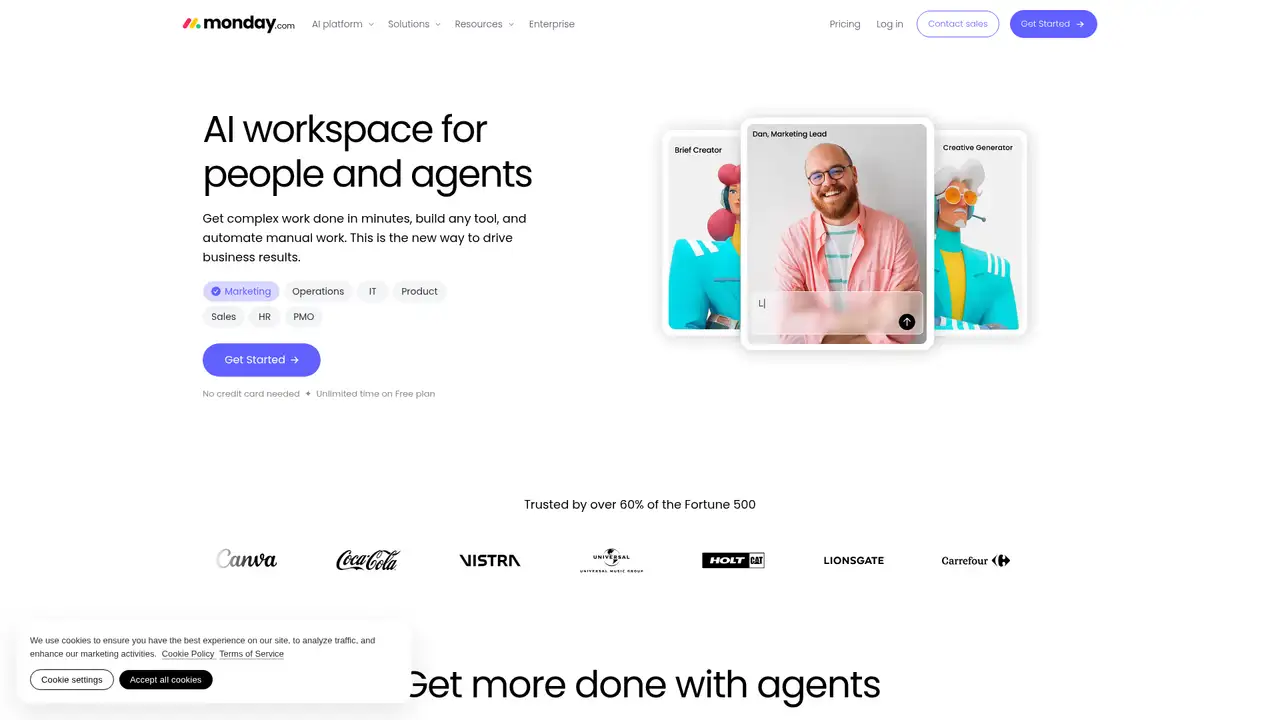
monday.com AI is the AI layer inside monday.com, a work-management platform made by monday.com Ltd., founded in 2012 and listed on NASDAQ as MNDY. Its first AI Assistant announcement came in April 2023, with a beta planned for May, and the company described the product as an open platform for third-party AI applications. monday.com now reports more than 250,000 customers and about 3,200 employees. The product is aimed at teams that want AI alongside boards, workflows, CRM, development, or service work, rather than a standalone chatbot. Its current catalog includes AI blocks, Sidekick, AI Workflows, AI Notetaker, monday agents, and monday vibe. The platform also offers a Models API with OpenAI-compatible endpoints, provider routing, fallbacks, budgets, and spend tracking, while using models from Anthropic, OpenAI, Google, and Sentence Transformers.
monday.com AI combines work management with AI tools that act on boards, workflows and related business data. A typical workflow starts with a natural-language request: AI can generate tasks, draft or rephrase CRM emails, summarize text, build formulas, or run an agent against a configured process. Sidekick handles roughly 10 to 150 credits per message depending on complexity, while AI Notetaker uses 120 credits per meeting hour. Teams can also create AI workflows, specialized agents, custom apps through monday vibe, and monitor consumption through AI governance, with alerts at 80% and 100%. The platform’s Models API adds OpenAI-compatible chat, embeddings, image and audio endpoints, plus model fallbacks, spend tracking and budgets. It draws from Anthropic, OpenAI, Google and Sentence Transformers, while monday.com says customer inputs and outputs are not used for model training.
monday.com AI is a multi-provider layer rather than a proprietary model, combining Anthropic Claude, OpenAI GPT, Google Gemini and Sentence Transformers through Vertex, Bedrock, Azure AI and self-hosted AWS deployments. Its 2026 feature catalog includes agents, the sidekick assistant, AI workflows, AI Notetaker, AI blocks and monday vibe, an AI custom-app builder. The June 2026 model guide specifically names Gemini Flash and ties lightweight messages to roughly 10 to 20 credits, while heavier agentic models can consume about 50 to 500. Its Models API adds OpenAI-compatible chat, embeddings, images and audio endpoints, model fallbacks, budgets and spend tracking, although customers cannot supply their own model or API key. monday.com says customer prompts and outputs are not used to train models, with providers operating under zero-retention commitments, though some Anthropic deployments may retain data briefly for safety.
monday.com’s free tier costs $0 for up to two seats, but it excludes AI, making paid access the practical starting point. Basic costs $9 per seat monthly when billed annually, with 1,000 AI credits and a three-user minimum. Standard is $12 with 2,000 credits, while Pro is $19 with 3,000 credits. Monthly billing is available without the annual discount, and published monthly figures are $12, $14, and $24 respectively. Enterprise pricing is custom. New customers receive a one-time 6,000-credit trial, then extra credits cost $10 per 1,000. Consumption varies sharply: AI blocks use eight credits per action, Notetaker uses 120 per meeting hour, and agents can exceed 250 credits per run. Standard supports three active AI workflows, Pro supports 20, and admins receive usage alerts at 80% and 100%.
monday.com AI is less a standalone assistant than an AI layer inside monday.com’s broader work operating system, and that breadth is its main advantage and constraint. Unlike Asana AI Studio, which offers explicit Basic, Plus, and Pro credit tiers and lets users choose named partner models such as Claude Sonnet 4.5 and GPT-5.2, monday.com uses shared credit buckets across its AI work platform and does not permit customer-supplied models or API keys. Slack AI is stronger for conversation search, recaps, and Slackbot inside team communications, while monday.com reaches further into boards, workflows, CRM, development, and service work. Costs also rise quickly: paid plans start at $9 per seat monthly when billed annually, while AI credits begin at 1,000 for $10, and AI is unavailable to free accounts. Teams wanting configurable work management with integrated automation should pick monday.com AI.
Who is monday.com AI best for?
- Teams already managing projects in monday.com boards.
- Operations groups building repeatable AI workflows.
- Admins needing shared credit budgets and usage alerts.
- Developers needing monday’s OpenAI-compatible Models API.
monday.com AI Pricing (2026)
Pricing model: Freemium. All prices in USD.
| Plan | Price | What you get |
|---|---|---|
| Free | $0 | Up to 2 seats. AI features are unavailable. |
| Basic | $9 per seat per month billed annually | Plans start at 3 users. Includes a required 1,000-credit monthly bucket priced at $10. |
| Standard | $12 per seat per month billed annually | Plans start at 3 users. Includes a required 2,000-credit monthly bucket priced at $20. |
| Pro | $19 per seat per month billed annually | Plans start at 3 users. Includes a required 3,000-credit monthly bucket priced at $30. |
| Enterprise | Custom | Contact sales for seat pricing and the required monthly credit bucket. |
Pros and Cons
Pros
- AI agents, workflows, blocks, and meeting notes share monday.com context.
- The Models API supports OpenAI-compatible endpoints, fallbacks, and budgets.
- Permissions-respecting retrieval and provider zero-retention commitments support governance.
- The platform covers work management, CRM, development, and service use cases.
Cons
- AI features require a paid account and separate credit allocation.
- Usage costs vary by action, message complexity, and agent run.
- monday.com does not let customers supply their own model or API key.
Who should look elsewhere?
- Teams seeking a standalone general-purpose AI assistant.
- Organizations requiring bring-your-own model credentials.
- Small teams unwilling to manage credit-based usage.
Technical Details
Frequently Asked Questions
How much does monday.com AI cost?
monday.com AI requires a paid monday AI work-platform account. Annual seat prices are $9 for Basic, $12 for Standard, and $19 for Pro, with Enterprise listed as custom. Eligible plans also require monthly AI-credit buckets priced at $10 for 1,000 credits, $20 for 2,000, or $30 for 3,000. Monthly seat billing is available, but its monthly figures are not published on the pricing page.
Does monday.com AI have a free plan?
The monday.com Free plan costs $0 and supports up to two seats, but AI features are unavailable on that plan. Every account receives a one-time trial allocation of 6,000 AI credits under monday.com’s plan guidance. After those credits are used, paying customers can purchase additional credits. The free plan remains useful for basic work management without monday AI.
How does monday.com AI compare with Asana AI Studio?
monday.com AI covers a broad configurable work platform and includes agents, sidekick, AI blocks, meeting notes, workflows, custom app building, and a first-party Models API. Asana AI Studio is a no-code workflow layer inside Asana with account-level Basic, Plus, and Pro credit tiers and documented model selection. monday.com fits teams already using its boards and cross-product work surfaces.
Does monday.com train models on customer data?
monday.com says it does not use customer input or output to train machine-learning models and does not allow its providers to do so. It says providers operate under zero-data-retention commitments, while noting that some Anthropic Fable 5 deployments may retain input and output for up to 30 days for harm prevention. monday.com may temporarily access data for service monitoring and improvement for up to 60 days, but not for model training.
Can I use monday.com AI commercially?
monday.com AI is part of a commercial work-management service, and paid customers can use its features within their monday.com accounts. The platform supports task creation, summaries, formulas, meeting notes, agents, and custom apps. The published terms describe platform access and provider handling, but do not grant a separate license for generated output. Organizations should review their contract and applicable monday.com terms for output ownership and licensing.
Best monday.com AI Alternatives in 2026
These tools do the same job as monday.com AI, with different pricing, limits and trade-offs.
Connected docs, projects, databases, and AI for teams
No code AI workflows built directly into project work

A database-first workspace for building structured apps and workflows
AI assistance for pages, search, meetings, and recurring work

Turn conversations, files, and team knowledge into usable answers

Collaborative docs that combine writing, tables, formulas, and automation