
Airtable Review, Pricing & Alternatives (2026)
A database-first workspace for building structured apps and workflows
Last updated: October 26, 2026
What is Airtable?
Airtable is a hosted database and app-building workspace for individuals, small teams, operations groups, and departments that need structured data, interfaces, automations, and AI assistance in one place. A free plan is available, while paid access starts at $20 per user per month with annual billing or $24 monthly.
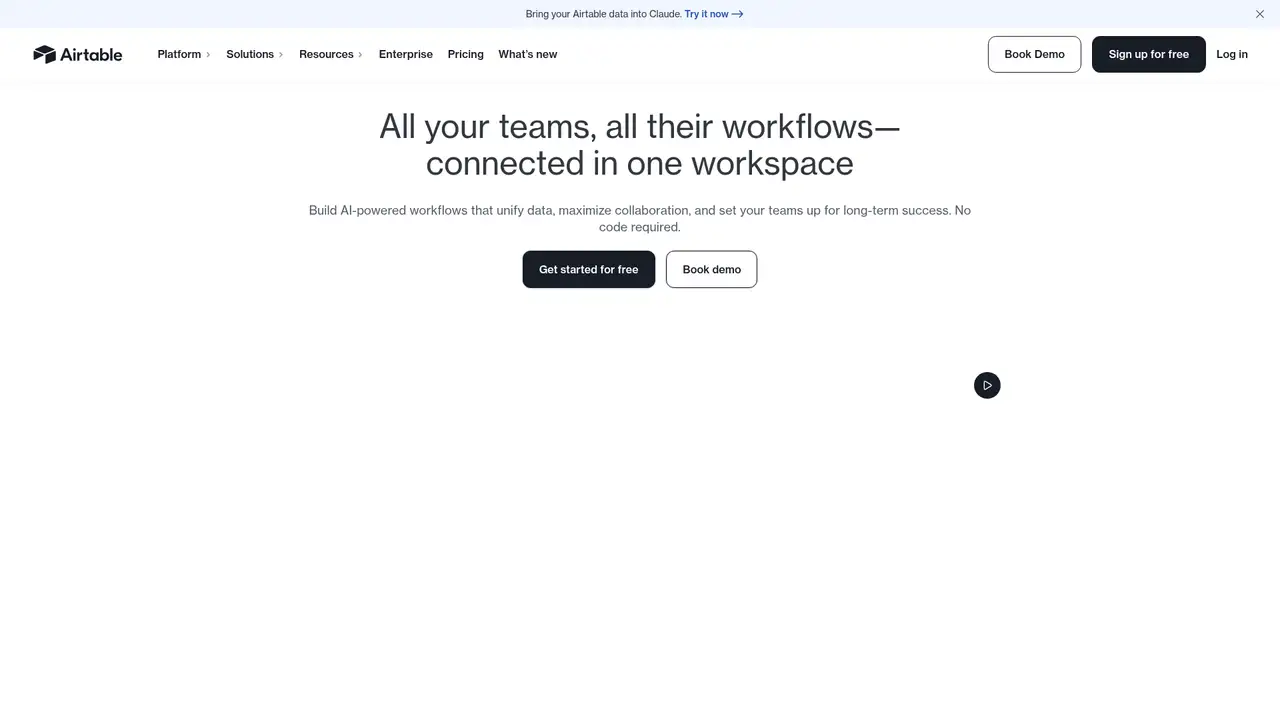
Airtable is a spreadsheet-like database platform made by Airtable, Inc., founded in 2012 and publicly launched in 2015. Its central idea is to let teams model work as linked records, then turn those records into applications, rather than forcing every process into a fixed project-management template. The company introduced an API and embeddable views in May 2015, giving each base a customized API for integrations. Airtable’s current plans include a free tier, Team at $20 per user monthly when billed annually, Business at $45, and Enterprise Scale with custom pricing. The free plan allows 1,000 records per base, 1,000 API calls per workspace monthly, 1 GB of attachment storage, and 500 AI credits per editor or higher each month. It is best understood as a database-first productivity tool, with forms, automations, interfaces, and AI layered around that foundation.
Airtable’s practical strength is turning structured data into a shared workflow. A team can start with a base, define tables and fields, then connect records through linked fields and present the same information in grid, calendar, timeline, Gantt, form, or interface views. Automations handle triggers and actions, while extensions and integrations connect outside services. A typical process might collect requests through a form, store each submission as a record, assign owners and deadlines, and use an automation to notify a channel or update a status. Omni adds a natural-language layer that can build apps, edit data, answer questions, and analyze records, with actions governed by existing permissions. The free plan allows 1,000 records per base and 1,000 API calls per workspace each month, while Team raises those limits to 50,000 records and 100,000 calls.
Airtable’s AI layer is built around Omni, launched across plans in June 2025, rather than a single disclosed proprietary model. Omni can build apps, edit records, analyze data, and respect existing permissions, while Airtable supports selected external models and connectors, including Claude, ChatGPT, Gemini, and Cursor. Airtable’s April 2026 update specifically names Claude Opus 4.6, Claude Sonnet 4.6, and GPT-5.4. The company’s Fall 2026 release added Omni 2.0, generally available MCP support, agent audit logs, and Canvas in open beta. AI usage is credit-based and varies by model and output: Omni questions cost 10 credits, web searches cost 10, and analyzing a 10-page document costs 200. Airtable also says it will not use customer inputs or outputs to train generative AI models, although Free and Team providers may retain data for up to 30 days for safety moderation.
Airtable’s Free plan costs $0 and is practical for individuals or very small teams, with 1,000 records per base, 1,000 API calls per workspace monthly, 1 GB of attachment storage, and 500 AI credits per editor monthly. The catch is that the first workspace receives a 14-day Team trial, while later free workspaces do not. Team costs $20 per collaborator monthly with annual billing, raising capacity to 50,000 records, 100,000 API calls, 20 GB of storage, and 15,000 AI credits per billable collaborator. Self-serve Business costs $45 annually or $54 monthly, with 125,000 records, 100 GB of storage, unlimited API calls, and 20,000 AI credits per paid user. AI usage consumes pooled credits, and extra packs begin at $20 for 10,000 credits, making heavy automation the point where costs climb quickly.
Airtable’s main limitation is scale by plan: Free bases cap at 1,000 records, 1,000 API calls monthly, 1 GB of attachments, and 500 AI credits per editor, while Team raises the record limit to 50,000 but costs $20 per user monthly annually. Its database-first design suits structured workflows better than Coda’s document-first approach, and it is less suited than Notion to wiki-style knowledge management. Smartsheet offers stronger spreadsheet-oriented project controls, while Airtable provides more flexible app building and permission-aware AI features. Costs rise through billable collaborators and metered AI credits, with Team including 15,000 credits per billable collaborator and extra packs starting at $20 for 10,000 credits. Airtable is best for teams building structured, customizable workflow apps around relational data.
Who is Airtable best for?
- Operations teams building structured internal databases and workflows.
- Companies replacing spreadsheets with linked records and custom interfaces.
- Teams that need permission-aware automations and forms.
- Developers connecting internal tools through Airtable's documented API.
Airtable Pricing (2026)
Pricing model: Freemium. All prices in USD.
| Plan | Price | What you get |
|---|---|---|
| Free | $0/month | 1,000 records per base, 1,000 API calls per workspace monthly, 1 GB attachments per base, 500 AI credits per editor monthly. |
| Team | $20/user/month annually or $24/user/month monthly | 50,000 records per base, 100,000 API calls per workspace monthly, 20 GB attachments per base, 15,000 AI credits per billable collaborator monthly. |
| Business | $45/user/month annually or $54/user/month monthly | 125,000 records per base, unlimited API calls, 100 GB attachments per base, 20,000 AI credits per paid user monthly. |
| Enterprise Scale | Custom | 500,000 or more records per base, unlimited API calls, 1 TB attachments per base, and 25,000 AI credits per paid user at list price. |
Pros and Cons
Pros
- Linked records, views, forms, and interfaces support custom operational systems.
- The documented API provides programmatic access to individual bases.
- Omni can build apps, edit data, and analyze records within permission boundaries.
- Free users receive 1,000 records per base and 1,000 monthly API calls.
Cons
- Billable permissions can make collaboration costs rise as teams expand.
- Free bases cap records at 1,000 and attachments at 1 GB.
- AI usage depends on pooled credits that expire at the billing-period end.
Who should look elsewhere?
- Teams seeking a primarily narrative workspace for long-form knowledge management.
- Small groups that need many commenters or editors at low cost.
- Organizations requiring a self-hosted database application.
Technical Details
Frequently Asked Questions
How much does Airtable cost?
Airtable has a Free plan at $0. Team costs $20 per user per month with annual billing or $24 monthly. Business costs $45 per user per month annually or $54 monthly. Enterprise Scale pricing is custom. Billing applies to workspace seats with relevant permissions, while read-only collaborators, form submissions, and share links are not charged under the cited billing rules.
Does Airtable have a free plan?
Yes. Airtable's Free plan includes 1,000 records per base, 1,000 API calls per workspace each month, 1 GB of attachment storage per base, two weeks of revision and snapshot history, 75 unique automations per base, and 100 automation runs per workspace each month. It also includes 500 AI credits per editor or higher permission monthly.
How does Airtable compare with Notion?
Airtable is database-first, with linked records, structured fields, views, forms, interfaces, and automations at the center. Notion is document and knowledge-management-first, with pages and databases inside a more flexible writing environment. Airtable is usually the stronger choice for operational records and app-like workflows, while Notion suits teams organizing documents, wikis, and lightweight databases.
Does Airtable train AI models on customer data?
Airtable's AI Terms say customer inputs, outputs, and other customer data remain customer-owned, and Airtable will not use or permit third-party providers to use them to train generative AI models. Free and Team model providers may retain inputs and outputs for up to 30 days for safety and compliance moderation, while Business and Enterprise Scale providers do not log or retain them for human review.
Can Airtable be used commercially?
Airtable supports commercial business use through its paid plans and Enterprise Scale offering. Its AI Terms identify inputs and outputs as customer data owned by the customer, while also warning that AI output can be inaccurate or non-unique and requires human review. Platform access does not transfer ownership of third-party materials referenced in a base, so users remain responsible for permissions and licensing.
Best Airtable Alternatives in 2026
These tools do the same job as Airtable, with different pricing, limits and trade-offs.
Connected docs, projects, databases, and AI for teams
AI assistance for pages, search, meetings, and recurring work

Collaborative docs that combine writing, tables, formulas, and automation
Spreadsheet-style work management with AI columns, dashboards and MCP connectors

Credit-metered AI for configurable work management