
Asana AI Studio Review, Pricing & Alternatives (2026)
No code AI workflows built directly into project work
Last updated: October 26, 2026
What is Asana AI Studio?
Asana AI Studio is a no code workflow builder for teams managing projects, requests, approvals, and reporting in Asana. It suits marketing, operations, IT, HR, and R&D teams that want AI agents to act on project data. Entry access starts with Asana Starter at $13.49 per user monthly or $10.99 per user monthly with annual billing.
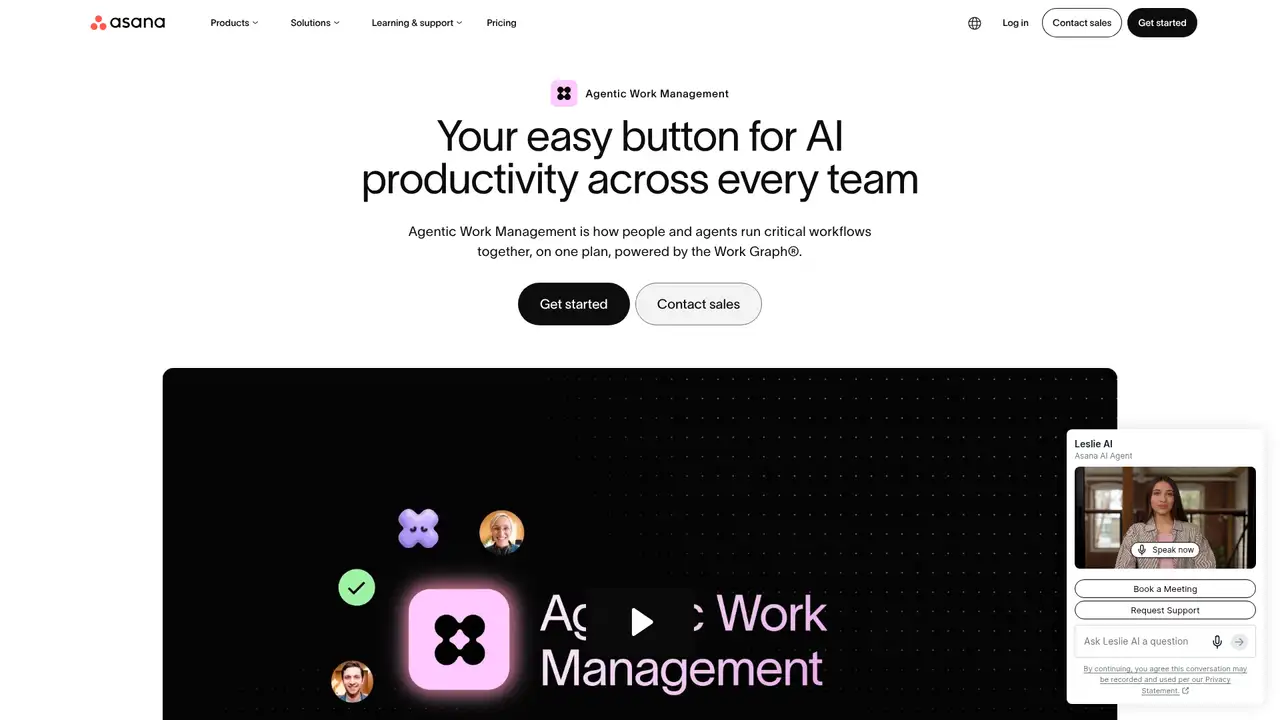
Asana AI Studio is a no-code workflow builder from Asana, Inc., the public work-management company founded in 2008. Asana unveiled it on October 22, 2024, initially offering early access to Enterprise and Enterprise+ customers, with Advanced annual access planned next. The product embeds AI agents in Asana workflows rather than presenting a separate chatbot: teams can design automations for intake, planning, execution, approvals, reporting, and task coordination. It draws context from Asana’s Work Graph, which records relationships across organizational work, and lets users deploy workflows where teams already manage projects. Asana reports roughly 4,459 employees, about $790.8 million in annual revenue, and approximately $454.5 million in total funding, figures attributed to a current company-data summary rather than Asana’s filing. AI Studio is therefore best understood as an enterprise workflow layer built into an established project platform.
Asana AI Studio turns project context into no-code automations for intake, routing, approvals, drafting and reporting. A typical workflow starts with a template or blank design, then adds instructions, triggers and AI steps that act on tasks inside Asana. Teams can use it to classify incoming requests, rewrite or translate content, check work against brand rules, summarize progress, or suggest assignments and sequencing. Its Work Graph supplies relationships among people, tasks, deadlines and projects, giving each step more context than a standalone chatbot. Users can select OpenAI or Anthropic models for individual workflow steps, with lighter models consuming fewer credits than heavier ones. The resulting workflow is deployed where the team already works, while administrators retain control over members, billing and credit consumption. That structure is more practical for repeatable project operations than one-off prompting.
Asana AI Studio is a no-code workflow layer built on Asana’s Work Graph, first unveiled on October 22, 2024. It connects to OpenAI and Anthropic models, including GPT-5.2, GPT-5, GPT-5 mini, Claude Sonnet 4.5, Claude Opus 4.6, and Claude Haiku 4.5, while Asana says it does not train or own those models. A workflow can classify intake, draft content, translate text, route approvals, or update task fields, with model choice made for each step and credit use varying by complexity and data volume. The June 2025 rollout automatically provisioned AI Studio Basic for paid domains, while Plus became available for direct purchase with monthly or annual billing. AI Studio remains an embedded automation system rather than a public LLM API or BYO-model platform, which keeps administration straightforward but limits developers seeking deeper model control.
Asana AI Studio has a free entry point, but not through Asana’s Personal plan. Personal costs $0 and excludes AI Studio, while Starter costs $13.49 per user monthly or $10.99 annually, and Advanced costs $30.49 monthly or $24.99 annually. Paid domains receive Basic automatically, with monthly account allocations of 50,000 credits on Starter, 75,000 on Advanced, and 200,000 on Enterprise and Enterprise+. Those credits are shared across the billing account rather than assigned per seat. Plus adds 100,000 credits per month, starts at $150 monthly or $135 annually, and allows extra 100,000-credit packages up to 1 million. Unused Plus credits do not roll over. Pro includes 5 million credits resetting quarterly, but pricing is sales-only. Costs therefore rise fastest for larger teams or workflows using frequent, complex AI actions.
Asana AI Studio’s main limitation is cost and access: Personal users get no AI Studio, while paid domains receive account-level monthly credits, from 50,000 on Starter to 200,000 on Enterprise+, and Plus begins at $135 per account monthly when billed annually. Its workflow builder is more governed than monday.com’s shared credit pool, but monday also offers an OpenAI-compatible Models API, which Asana does not document for AI Studio. Slack AI is stronger for searching conversations, files, huddles and connected apps, while Asana is better suited to task and project workflows. ZoomMate goes further with agentic search and task completion, but its $20 per user monthly plan includes 2,200 credits and is tied to Zoom Workplace. Choose Asana AI Studio for teams already managing structured projects in Asana that need no-code automation, model choice and administrative control.
Who is Asana AI Studio best for?
- Marketing teams routing and drafting campaign requests in Asana.
- Operations teams automating intake, assignment, and reporting steps.
- IT and HR teams managing repeatable requests inside Asana.
- Project teams that need governed AI actions tied to tasks.
Asana AI Studio Pricing (2026)
Pricing model: Freemium. All prices in USD.
| Plan | Price | What you get |
|---|---|---|
| Personal | $0 | Free plan for individuals and small teams, with no AI Studio access. |
| Starter | $13.49/user/month or $10.99/user/month billed annually | Includes AI Studio Basic with 50,000 credits per billing account each month. |
| Advanced | $30.49/user/month or $24.99/user/month billed annually | Includes AI Studio Basic with 75,000 credits per billing account each month. |
| Enterprise | Custom | Includes AI Studio Basic with 200,000 credits per billing account each month. |
| Enterprise+ | Custom | Includes AI Studio Basic with 200,000 credits per billing account each month. |
| AI Studio Plus | $150/account/month or $135/account/month billed annually | Includes 100,000 monthly credits, with extra 100,000 credit packages up to 1 million. |
| AI Studio Pro | Custom | Annual only tier with 5 million credits resetting quarterly and member level consumption controls. |
Pros and Cons
Pros
- AI workflows act directly on Asana tasks and projects.
- Users can choose models for individual workflow steps.
- Templates reduce setup time for common work processes.
- Paid plans include account level Basic credit allocations.
Cons
- AI Studio requires a paid Asana plan and account level credits.
- Personal users cannot access AI Studio.
- Credits do not roll over between billing periods.
Who should look elsewhere?
- Teams seeking a standalone general purpose AI assistant.
- Organizations needing a separately documented AI specific public API.
- Teams that do not manage work inside Asana.
Technical Details
Frequently Asked Questions
How much does Asana AI Studio cost?
Asana AI Studio is available on paid Asana plans. Starter costs $13.49 per user monthly or $10.99 per user with annual billing, while Advanced costs $30.49 monthly or $24.99 annually. AI Studio Plus costs $150 per account monthly or $135 monthly with annual billing. Enterprise and AI Studio Pro pricing is custom.
Does Asana have a free AI Studio plan?
No. Asana’s Personal plan costs $0 but excludes AI Studio. Paid domains receive AI Studio Basic allocations beginning with Starter, which includes 50,000 credits per billing account monthly. AI Studio Plus and Pro add larger credit pools and billing controls. Included credits belong to the billing account rather than each individual user.
How does Asana AI Studio compare with monday.com AI?
Asana AI Studio is a no code workflow layer centered on Asana’s project graph, with Basic, Plus, and Pro AI Studio tiers and model selection from OpenAI and Anthropic. monday.com AI spans a broader configurable work platform, uses shared credit buckets, and offers a first party Models API with OpenAI compatible endpoints, fallbacks, budgets, and usage tracking.
Does Asana train models on customer data?
Asana says it does not use customer data to train generative AI models used to provide Asana AI, and says its third party AI partners are contractually prohibited from doing so. Its privacy statement also says Asana may use metadata about a domain’s use of Asana to train machine learning models when Asana AI features are enabled. These are separate statements about content and metadata.
Can I use Asana AI Studio commercially?
Asana’s product specific terms say the customer retains all rights, title, and interest in AI input and AI output. Customers remain responsible for their inputs, instructions, permissions, and legal compliance. The terms do not transfer ownership of Asana’s platform, partner models, or third party materials. Commercial presentation licensing therefore depends on the presentation content and any incorporated external material.
Best Asana AI Studio Alternatives in 2026
These tools do the same job as Asana AI Studio, with different pricing, limits and trade-offs.
AI assistance for pages, search, meetings, and recurring work

Credit-metered AI for configurable work management

Turn conversations, files, and team knowledge into usable answers

A database-first workspace for building structured apps and workflows

Collaborative docs that combine writing, tables, formulas, and automation