
Lusha Review, Pricing & Alternatives (2026)
B2B contact data and buying signals for revenue teams
Last updated: October 26, 2026
What is Lusha?
Lusha is a B2B data and sales intelligence platform for sales, marketing, recruiting, and RevOps teams. It offers contact and company search, enrichment, signals, APIs, browser access, and MCP connections. A permanent Free plan costs $0 and includes up to 40 credits monthly, while paid self-serve plans start at $49.90 monthly.
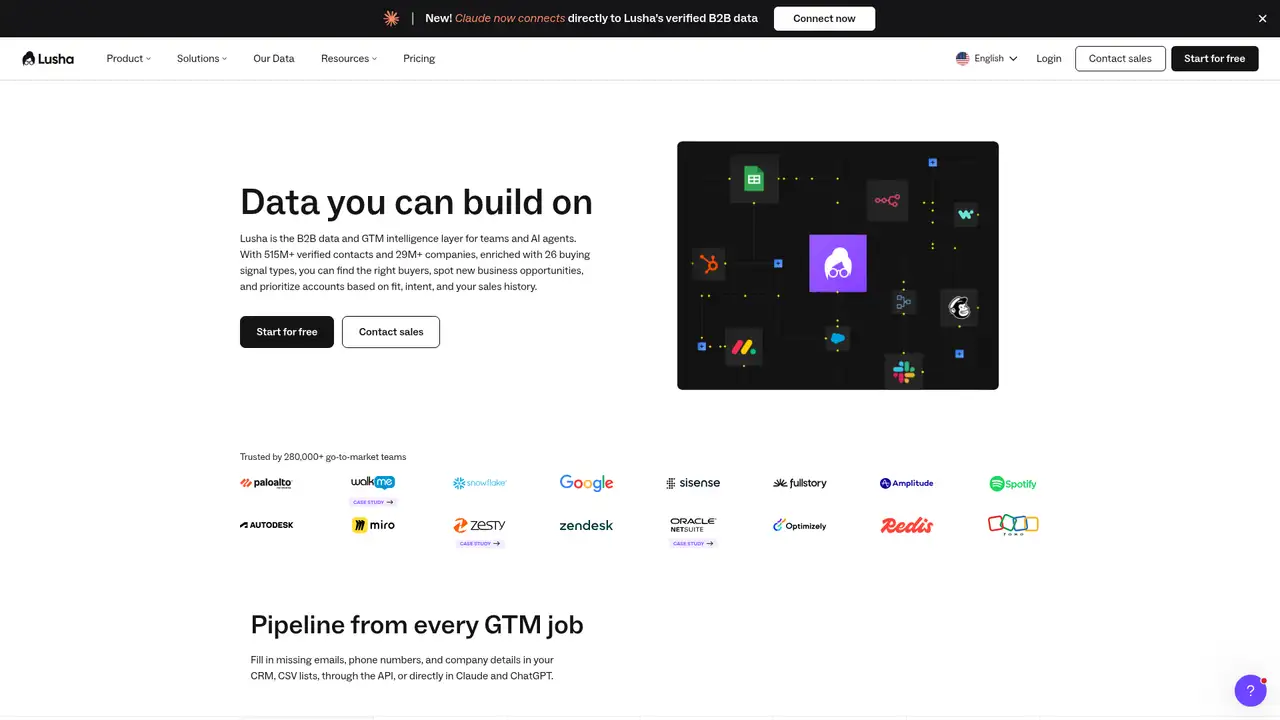
Lusha is a B2B data and sales intelligence company founded in 2016 by Assaf Eisenstein and Yoni Tserruya. The company says its database covers more than 515 million business contacts and 29 million company profiles across North America, EMEA, APAC, and LATAM. It reports 280,000 or more revenue teams, 300 employees, and 7 million new signals processed each week. Lusha says email verification ranges from 95% to 98% by region, while direct dial accuracy exceeds 86%. The privately held company says it raised $245 million across a $40 million Series A and a $205 million Series B in 2021. Its customers include sales, marketing, recruiting, and RevOps teams, with access through Workspace, a browser extension, CRM connections, API, and MCP.
A typical Lusha workflow begins with a person, company, domain, or filter-based search. Users preview records, reveal verified emails or phone numbers, save prospects, enrich existing records, and monitor account activity. The browser extension displays contact information while users browse professional-network pages and business websites. Workspace organizes prospecting tables, while CRM integrations move records into connected systems. Developers can use the REST API for search, enrichment, prospecting, lookalikes, decision makers, website visitors, signals, and webhooks. The API supports real-time and bulk operations. Lusha MCP adds a conversational route through compatible AI clients, including Claude, ChatGPT, n8n, and Cursor. It can search, enrich, find lookalikes, pull signals, score lists, and manage Workspace tables, but it does not send messages or add contacts to sequences.
Lusha does not name a foundation model behind its data platform. Its V3 API uses a search-then-enrich pattern, bulk operations, richer filters, and AI-powered lookalikes. Other endpoints cover decision-maker ranking, website visitors, signals, and webhooks. In October 2025, Lusha announced the Signals API, which can deliver events such as job changes, promotions, hiring, and company expansion. The same update introduced Lusha MCP for connecting verified B2B data to Claude, n8n, and compatible AI tools. MCP uses the existing Lusha credit balance and can search records, enrich profiles, find lookalikes, pull signals, and build tables. Current MCP documentation also describes scoring tools and CRM export options. The service does not permit API data to train or develop AI systems except under stated contractual exceptions.
Lusha’s Free plan costs $0 and includes up to 40 credits each month, basic prospecting features, the browser extension, and CRM integrations. Starter costs $49.90 monthly for 400 credits, Professional costs $69.90 for 600, and Premium costs $399.90 for 3,400. Scale pricing is Custom. Annual billing displays lower monthly equivalents and issues annual credits up front. Revealing one verified email costs one credit, while revealing a phone number costs five. Monthly unused credits can accumulate up to twice the plan limit while the subscription remains active. Annual unused credits reset at the end of the annual cycle. API charges depend on revealed fields, signals, and account terms, so technical use can exceed the visible subscription price. Used credits cannot be revoked or refunded.
Lusha’s credit model is its main constraint: phone reveals consume five credits, and API charges vary by field and signal activity. The agreement limits data to internal B2B sales, marketing, recruiting, intelligence, and fraud-prevention purposes, and prohibits resale or embedding without written consent. Apollo.io adds email sequences and engagement tools, making it better suited to teams that want prospecting and outbound execution together. ZoomInfo targets larger enterprise deployments with broad intelligence and sales workflows. Cognism offers another enterprise-focused contact data option with compliance positioning. Lusha publishes a free tier and self-serve prices, while its API and MCP materials emphasize search, enrichment, signals, and AI access. Pick Lusha if your team needs credit-based B2B prospecting across web, CRM, API, and MCP workflows.
Who is Lusha best for?
- Small sales teams testing B2B contact data with 40 free monthly credits.
- RevOps teams connecting browser, CRM, API, and MCP workflows.
- Recruiters sourcing business contacts for internal hiring work.
- Developers building search, enrichment, signal, or webhook workflows.
Lusha Pricing (2026)
Pricing model: Freemium. All prices in USD.
| Plan | Price | What you get |
|---|---|---|
| Free | $0 | Up to 40 credits monthly, with basic prospecting, browser extension, and CRM integrations. Monthly unused credits can accumulate up to twice the plan limit. |
| Starter | $49.90/month | 400 credits monthly. Annual billing displays a lower monthly equivalent and issues annual credits up front. |
| Professional | $69.90/month | 600 credits monthly. Annual billing displays a lower monthly equivalent and issues annual credits up front. |
| Premium | $399.90/month | 3,400 credits monthly. Annual billing displays a lower monthly equivalent and issues annual credits up front. |
| Scale | Custom | Custom credit volume and enterprise terms. Additional credits may be purchased for an added fee. |
Pros and Cons
Pros
- The Free plan includes up to 40 credits monthly.
- V3 supports search, enrichment, signals, lookalikes, and webhooks.
- MCP connects contact data to compatible AI clients.
- The pricing page publishes four self-serve subscription levels.
Cons
- Phone reveals consume five credits each.
- API billing varies by revealed field and signal activity.
- The agreement restricts data to defined internal business purposes.
Who should look elsewhere?
- Teams needing unlimited phone reveals at a fixed subscription price.
- Buyers requiring self-hosted contact data infrastructure.
- Companies planning to resell or embed Lusha data without written consent.
Technical Details
Frequently Asked Questions
How much does Lusha cost?
Lusha has a Free plan at $0 with up to 40 credits monthly. Starter costs $49.90 monthly for 400 credits, Professional costs $69.90 for 600, and Premium costs $399.90 for 3,400. Annual billing displays lower monthly equivalents and provides annual credits up front. Scale pricing is Custom. Revealed emails cost one credit and phones cost five.
Does Lusha have a free plan?
Yes. Lusha’s Free plan costs $0 and includes up to 40 credits each month, basic prospecting features, the browser extension, and CRM integrations. An email reveal costs one credit and a phone reveal costs five. The pricing page says monthly unused credits can accumulate up to twice the plan limit while the subscription remains active.
How does Lusha compare with Apollo.io?
Lusha centers its published workflow on contact and company search, enrichment, signals, APIs, and MCP access. Apollo.io combines prospect data with engagement features such as email sequences. Lusha therefore fits teams that already have outreach tools or want developer and AI connections, while Apollo.io is a closer fit for teams seeking prospecting and outbound execution in one product.
Does Lusha train AI models on customer data?
Lusha’s published MCP FAQ says data obtained through its API cannot be used to train or develop AI or machine-learning systems, except for specific contractual exceptions. The subscription agreement separately allows Lusha to use non-identifying related information and feedback to test, develop, improve, and enhance its products. Customers should review the applicable agreement for their use case.
Can businesses use Lusha data commercially?
The subscription agreement permits internal business use for B2B sales and marketing, recruiting, business intelligence, or fraud prevention. It grants a limited, non-transferable, non-sublicensable right and restricts resale, transfer, sublicensing, and third-party provision. Businesses must also follow applicable privacy and marketing laws and any order-form limits.
Best Lusha Alternatives in 2026
These tools do the same job as Lusha, with different pricing, limits and trade-offs.

Sales intelligence, outreach, enrichment, and AI workflows together

Compliance-focused B2B data and prospecting for revenue teams

B2B contact research, enrichment, and sales automation for revenue teams

Account research and prioritization folded into ZoomInfo's GTM Workspace
Account intent data, predictive buying stages and RevvyAI agents for B2B revenue teams