
Cognism Review, Pricing & Alternatives (2026)
Compliance-focused B2B data and prospecting for revenue teams
Last updated: October 26, 2026
What is Cognism?
Cognism is a B2B sales intelligence platform for revenue teams selling across international markets, with company and people data, intent signals, enrichment, API access, and an MCP server. It suits larger organizations that need managed data and compliance controls. Standard and Pro pricing is quote-based, with five seats included in each package.
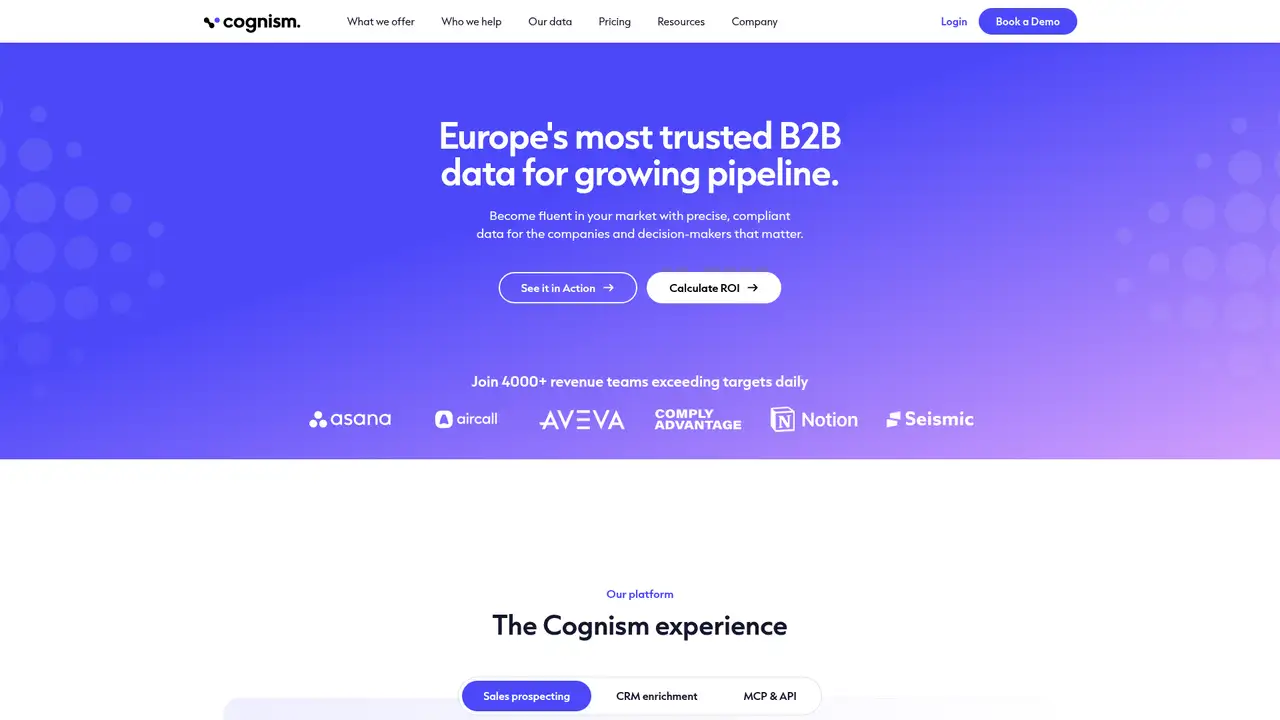
Cognism is a B2B sales intelligence company founded in London in 2015. It built its service for revenue teams selling across EMEA, expanded into Europe and the United States in 2019, acquired Kaspr, and raised Series C funding in 2022. The company does not publish current employee, revenue, or funding totals. Its platform combines company and people records with firmographics, technology data, hiring, funding, mergers and acquisitions, and intent signals. Cognism said in March 2025 that its database contained more than 440 million contacts and 100 million mobile numbers. The company’s 2026 brand update presents Cognism as a global data business focused on professional information, compliance controls, and usable records for sales and marketing teams.
A typical Cognism workflow begins with a company or people search, then narrows results through filters for location, industry, headcount, revenue, technology, funding, hiring, job title, seniority, department, skills, and buying intent. Users can count matching records before retrieving them, resolve accepted filter values through dictionaries, and collect results through paginated searches. Contact details appear only when requested, which controls credit use. Teams can reveal records, export them, enrich CSV files, and connect data to CRM systems. CRM Enrichment can operate as an add-on or standalone service, maintaining records as details change. A previously revealed contact can be viewed without another credit, while a job change can require another credit for updated information.
Cognism provides a REST API over HTTPS with JSON requests and responses, OAuth 2.0 client credentials, count endpoints, dictionaries, pagination, search tokens, credits, and rate limits. Its MCP server exposes the same search functions to assistants such as Claude, ChatGPT, and Cursor. In March 2025, Cognism released Sales Companion with personalized dashboards and recommendations based on intent signals, technology data, hiring trends, and account news. The company announced Data-as-a-Service in August 2025, delivering managed records into Snowflake, Databricks, CRMs, and CDPs. Cognism does not identify a foundation model behind Sales Companion or its AI search. The API and MCP server are newer package capabilities, not universal features of older subscriptions.
Cognism’s current pricing page lists Standard and Pro prospecting packages, each with five included seats, alongside CRM Enrichment and Data-as-a-Service. The company publishes no numeric monthly price. Standard includes company and contact data, firmographic, technographic, and signal filters, AI company research, MCP and API access, AI search, exports, and CSV enrichment. Pro adds higher-quality mobile data, on-demand mobile verification, intent data, and enhanced dashboards. Credits cover revealing, enriching, or exporting contacts, with one credit covering one revealed contact. Additional credits are available, and the same credits work across prospecting, Enrich, and API products. Credit allocations, search-token allowances, rate limits, annual terms, and add-on costs depend on the package and customer agreement.
Cognism’s main weakness is procurement friction. Buyers cannot see current prices, credit allocations, search-token allowances, or API limits before receiving a package proposal, and API access applies only to eligible subscriptions. The EULA limits use to internal business purposes and restricts reproducing, selling, distributing, or commercially exploiting Cognism Data unless an agreement permits it. Lusha offers published self-serve plans and a free tier, making it easier for smaller teams to start. Apollo.io combines contact data with email sequences and sales engagement, while Cognism concentrates on data, signals, enrichment, and delivery. ZoomInfo offers a broader enterprise sales suite. Pick Cognism if your revenue team needs managed enrichment and compliance-focused international data, especially across EMEA.
Who is Cognism best for?
- Enterprise revenue teams prospecting across EMEA and international markets.
- RevOps teams maintaining CRM records with recurring enrichment.
- Teams that need intent signals and mobile verification.
- Developers building B2B search and enrichment workflows.
Cognism Pricing (2026)
Pricing model: Paid. All prices in USD.
| Plan | Price | What you get |
|---|---|---|
| Standard | Custom | Five seats included. Includes core prospecting, filters, exports, CSV enrichment, AI search, MCP, and API access on eligible packages. |
| Pro | Custom | Five seats included. Adds mobile data, on-demand mobile verification, intent data, and enhanced dashboards. |
| CRM Enrichment | Custom | Available as an add-on or standalone product. Pricing depends on subscription structure, usage, and delivery requirements. |
| Data-as-a-Service | Custom | Managed delivery into data warehouses, CRMs, and CDPs. Pricing depends on subscription structure, usage, and delivery requirements. |
Pros and Cons
Pros
- Five seats are included in Standard and Pro packages.
- Previously revealed contacts can be viewed without another credit.
- Pro adds intent data and on-demand mobile verification.
- API, MCP, CRM Enrichment, and DaaS support integrations.
Cons
- Current packages publish no numeric prices.
- Credit allocations and API limits depend on the contract.
- Commercial reuse of Cognism Data is restricted by the EULA.
Who should look elsewhere?
- Solo users seeking public monthly pricing.
- Teams requiring unlimited records at a published flat rate.
- Organizations unable to support enterprise procurement.
Technical Details
Frequently Asked Questions
How much does Cognism cost?
Cognism’s current pricing page lists Standard and Pro as custom-quote products with five seats included. It publishes no numeric monthly price. The page says CRM Enrichment and Data-as-a-Service are priced according to subscription structure, usage, and delivery requirements. Credit allocations, additional credits, API access, and usage allowances depend on the package and customer agreement.
Does Cognism have a free plan?
Cognism does not list a permanent free plan on its current pricing page. Standard and Pro are quote-based sales prospecting packages. CRM Enrichment can be bought as an add-on or standalone product, while Data-as-a-Service is a managed enterprise offering. The company does not publish a free allocation, trial duration, or self-serve signup price on that page.
How does Cognism compare with Lusha?
Both products provide B2B contact data, company information, enrichment, and integrations. Cognism focuses on international prospecting, compliance controls, intent signals, mobile verification, CRM maintenance, API access, and managed delivery. Lusha is more accessible to smaller teams because it offers a free tier and published self-serve pricing. Cognism is better suited to organizations accepting quote-based procurement.
Does Cognism train AI models on user data?
Cognism’s published privacy policy describes processing for operating, maintaining, improving, and analyzing its services, but it does not state that customer data is used to train a named foundation model. Its EULA grants Cognism a license to use Customer Data solely to provide the services. Customers should review their agreement for service-specific data-processing terms.
Can businesses use Cognism data commercially?
Cognism grants access to its services for internal business purposes. Its EULA prohibits reproducing, distributing, selling, or commercially exploiting Cognism Services or Data unless the relevant customer agreement permits it. The EULA also prohibits spam and unlawful use. Customers remain responsible for applicable privacy, marketing, and data-protection requirements.
Best Cognism Alternatives in 2026
These tools do the same job as Cognism, with different pricing, limits and trade-offs.

Sales intelligence, outreach, enrichment, and AI workflows together

B2B contact data and buying signals for revenue teams

Account research and prioritization folded into ZoomInfo's GTM Workspace
Account intent data, predictive buying stages and RevvyAI agents for B2B revenue teams