
Keenious Review, Pricing & Alternatives (2026)
Find, understand and map academic research with AI guidance
Last updated: October 26, 2026
What is Keenious?
Keenious is a research companion for students, researchers and university libraries. It combines semantic scholarly search, editable topic maps and an AI Companion across the web, Microsoft Word and Google Docs. The free plan costs $0, while Plus Individual starts at $10 per month when billed annually. University customers receive custom annual quotes with campus access features.
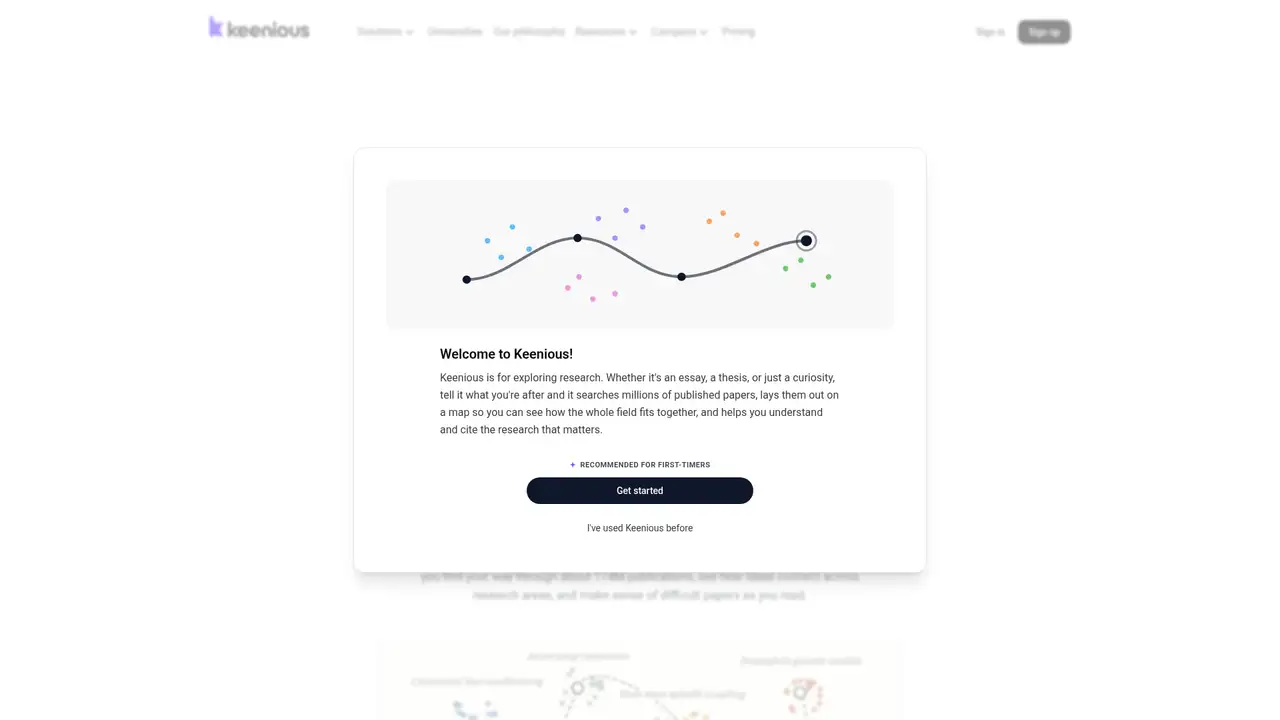
Keenious is a Norwegian research discovery company that began at UiT The Arctic University of Norway in Tromsø. Innovation Norway identifies Anders Rapp and Frode Opdahl as founders and dates the company foundation to 2017. The company says its product grew from consultations with 52 librarians and work with researchers. Spintop Ventures reports a €1.3 million funding round in June 2024, led by Spintop Ventures with Investinor co-leading, after its first investment in 2020. The investor lists Frode Opdahl as CEO, while a March 2026 university training recording describes a team of eight and around 60 institutions using Keenious. Its hosted service focuses on helping people discover and understand scholarly literature, while university plans add resolver links, SAML SSO, usage reporting and EU hosting.
Keenious begins with a scholarly query or source document and uses semantic context to find related publications. Users can inspect results, open original papers, build and edit 2D topic maps, and discuss concepts or methods with the AI Companion. A typical workflow moves from search to visual exploration, paper access and conversational explanation. The service supports PDF uploads, web search, and add-ins for Microsoft Word and Google Docs. Its index contains about 174 million publications in 130 languages, with weekly curation, OpenAlex data, Unpaywall open access links, and Norwegian Scientific Index peer review ratings. University users can connect library resolver links and campus access. The Companion explains difficult material and points to papers, while declining requests to draft text or produce a ready-made field report.
Keenious does not publish a proprietary model family name. Its privacy policy names Google Gemini among the providers used for language model and natural language processing features. The retrieval layer uses scholarly records, and a March 2026 training presentation says recommendations come directly from the OpenAlex dataset rather than being generated as fictional papers. Keenious describes a workflow that uses a researcher's context and refines results through natural language discussion. The AI Companion is designed to explain concepts and methods while declining requests to draft text or produce ready-made field reports. Privacy materials say prompts, uploads, messages and responses are processed in the EU, with default raw-content retention of 24 hours. Maps, document context and direct links to published research remain central.
Keenious Free costs $0 with no time limit. It includes scholarly search results, 2D topic maps, three AI Companion conversations per day with five replies each, PDF uploads up to 3 MB, and access through the web, Microsoft Word and Google Docs. Plus Individual starts at $10 per month when billed annually and removes conversation and reply limits, adds RIS, BibTeX, Zotero, EndNote and CSV exports, and raises PDF uploads to 20 MB. Team starts at $20 per user per month when billed annually, adding seat administration, billing controls, two factor authentication controls and dedicated support. University plans use annual custom quotes and add SAML SSO, resolver links, usage reporting, GDPR DPA support and EU hosting.
Keenious is less suitable for researchers who need an API, local deployment, or a tool that writes a literature review from a prompt. Its refusal to generate finished reports can protect academic authorship, although users retain more reading and drafting work. Compared with Connected Papers, Keenious adds an AI conversation layer, document add-ins, and library routing alongside editable 2D maps. Compared with Elicit, it emphasizes exploration and comprehension rather than automated evidence tables. Compared with ResearchRabbit, it combines discovery with conversational explanation and exports in RIS, BibTeX, Zotero, EndNote, and CSV formats. Privacy controls include EU processing, 24-hour default retention for prompts and outputs, and no training on user inputs. Pick Keenious if you want guided scholarly discovery inside a browser or document editor, with maps and campus library connections.
Who is Keenious best for?
- Students who need guided discovery across unfamiliar academic terminology.
- Researchers who prefer editable maps alongside semantic search results.
- Libraries seeking campus integrations and usage reporting.
- Writers who want explanations without automated report drafting.
Keenious Pricing (2026)
Pricing model: Freemium. All prices in USD.
| Plan | Price | What you get |
|---|---|---|
| Free | $0 | Unlimited time, three conversations per day with five replies each, and PDF uploads up to 3 MB. |
| Plus Individual | $10/month | Starting price when billed annually, with unlimited searches, maps, conversations and replies, citation exports, and PDF uploads up to 20 MB. |
| Team | $20/user/month | Starting price when billed annually, with Plus features, seat administration, billing controls, two factor authentication controls and dedicated support. |
| University | Custom | Annual campus license with SAML SSO, resolver links, usage reporting, GDPR DPA support, EU hosting and onboarding. |
Pros and Cons
Pros
- Its index covers about 174 million publications across 130 languages.
- The AI Companion points to papers while declining ready-made field reports.
- Plus supports exports for RIS, BibTeX, Zotero, EndNote and CSV.
- University plans include SAML SSO, resolver links and EU hosting.
Cons
- The free plan limits users to three conversations per day.
- Free PDF uploads are limited to 3 MB.
- Keenious does not publicly offer an API or self hosted package.
Who should look elsewhere?
- Teams requiring a public API or self hosted deployment.
- Users seeking automatic literature reviews ready for submission.
- Researchers who need unlimited large document uploads on the free plan.
Technical Details
Frequently Asked Questions
How much does Keenious cost?
Keenious Free costs $0 with no time limit. Plus Individual starts at $10 per month when billed annually, while Team starts at $20 per user per month when billed annually. University customers receive annual custom quotes. The pricing page also supports monthly, quarterly and annual billing selections in account settings, so displayed starting prices reflect annual billing.
Does Keenious have a free plan?
Yes. The free plan includes scholarly search results, 2D topic maps, three AI Companion conversations per day with five replies each, PDF uploads up to 3 MB, and access through the web, Microsoft Word and Google Docs. It has no time limit. Plus adds unlimited conversations and replies, larger PDF uploads and citation exports.
How does Keenious compare with Connected Papers?
Both products help users explore related scholarly literature visually. Keenious adds an AI Companion, document context through Word and Google Docs, library resolver links and citation exports. Connected Papers is a more focused visual exploration tool. Choose Keenious for conversational explanations and campus workflows, and Connected Papers for a narrower paper relationship map.
Does Keenious train models on user data?
Keenious says user prompts, uploads, messages and AI responses are not used to train Keenious or provider models. Its privacy policy says this information is processed and hosted in the European Union, with raw prompt and output retention set to 24 hours by default. University customers control institutional research suggestion data, while Keenious acts as processor.
Can I use Keenious for commercial research?
Keenious offers Individual, Team and University plans, so commercial or institutional use is handled through paid subscriptions. Team adds administration, billing controls, two factor authentication controls and dedicated support. Organizations should review the applicable subscription terms and any university or institutional agreement before deployment, because the pricing page does not describe a separate commercial license.
Best Keenious Alternatives in 2026
These tools do the same job as Keenious, with different pricing, limits and trade-offs.

Visual maps for discovering related academic papers
AI workflows for literature search, review, and research reports

Visual citation discovery that grows from the papers you know

AI-assisted search and discovery for scientific literature
Visual citation mapping for finding and monitoring research