
Connected Papers Review, Pricing & Alternatives (2026)
Visual maps for discovering related academic papers
Last updated: October 22, 2026
What is Connected Papers?
Connected Papers is a visual literature discovery tool for exploring papers related to a known seed. Its graph shows prior work, derivative work, and connected research using citation relationships and bibliographic coupling. Free access costs $0 with five monthly graphs, while Academic and Business plans remove that limit. It supports orientation, not systematic review completeness.
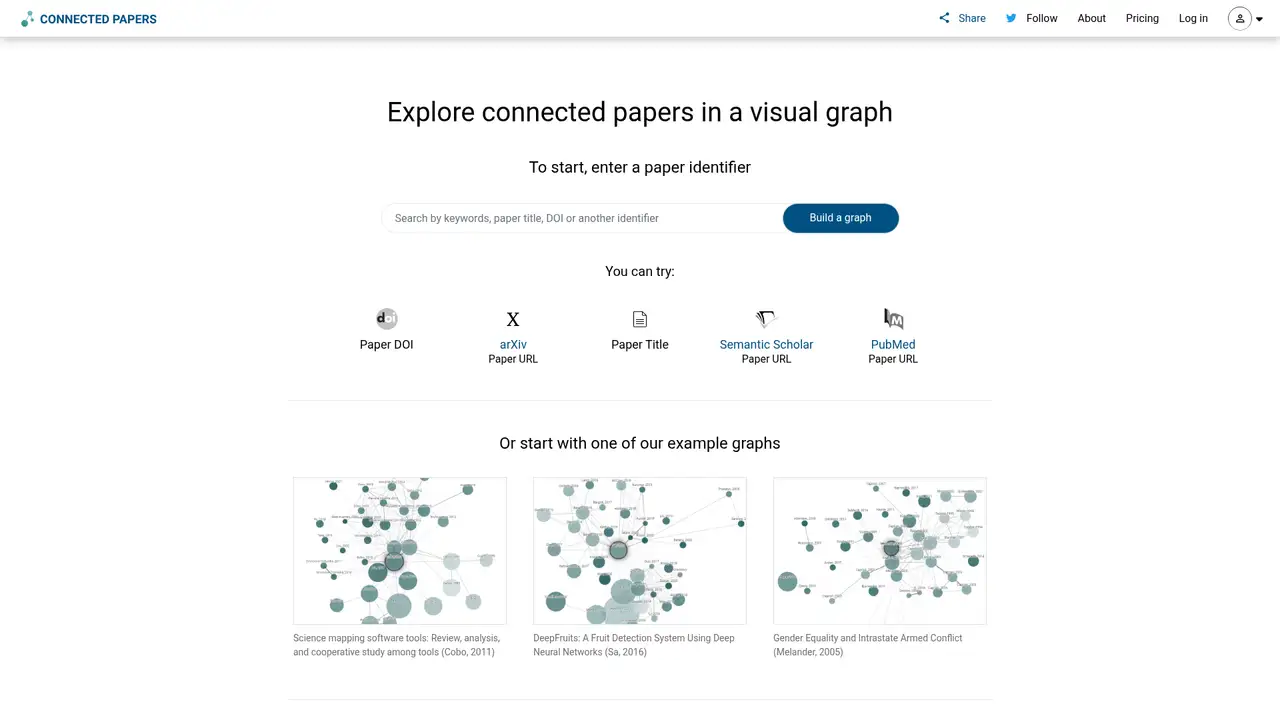
Connected Papers is a visual literature discovery service for researchers, students, and applied scientists who begin with a paper they already know. A user enters an origin paper and receives a map of related research, making the product useful for orientation before deeper reading. It publicly launched after beta in June 2020. Its About page links team profiles but does not state current headcount or funding. A 2022 announcement said the service was building more than 50 graphs per minute and had reached more than two million researchers in the prior year, which are historical company claims. The product remains active and focused on discovery rather than drafting. Its main tradeoff is convenience versus coverage, since a visual neighborhood can clarify a field without representing every relevant publication.
The workflow begins with a paper title or identifier, then Connected Papers analyzes a surrounding corpus and presents a force-directed graph of strongly related papers. Node size indicates citation influence, color indicates recency, and line strength indicates similarity. Prior Works highlights common ancestors, while Derivative Works surfaces later studies and reviews. Multi-origin graphs refine discovery around several seed papers, and saved papers plus history support repeated sessions. This workflow helps students understand intellectual structure, trace foundations, locate later extensions, and find review papers that may be missed by a single keyword query. It also shifts effort from query construction to result interpretation. Each promising item still requires independent reading, source checking, and confirmation that the apparent relationship is substantively relevant.
The technology uses co-citation and bibliographic coupling rather than a generative language model. The About page says each graph examines roughly 50,000 papers and selects a few dozen with the strongest connections. Its corpus connects to Semantic Scholar’s Open Research Corpus, which the Terms identify as ODC-BY licensed. A 2022 announcement introduced multi-origin graphs and unlimited paid usage. No dated 2025 or 2026 official release note identifies a new algorithm or major rewrite. This approach offers an interpretable basis for mapping relationships, but it depends on citation patterns and bibliographic records. Papers with weak indexing, limited citation histories, or unusual terminology may be less visible. Similarity therefore signals a data relationship, not proof that studies address the same question.
Free costs $0 and includes five graphs monthly with core features, including similarity graphs, prior and derivative works, multi-origin graphs, saved papers, and history. Academic and Business plans remove the graph restriction and offer unlimited graphs. Academic is for academic, nonprofit, educational, or personal research, while Business is intended for commercial work. Annual and quarterly billing, automatic renewal, group seats, prorated additions, and scholarships are described. PayPro Global handles payment, and Connected Papers says it does not store card information. Paid subscriptions use a checkout that displays the applicable charge before purchase. The practical tradeoff is clear: occasional users can explore at no cost, while frequent researchers or organizations must evaluate plan eligibility, renewal terms, and intended usage before choosing unlimited access.
Connected Papers is a strong choice for orientation, citation chaining, and finding intellectual neighborhoods around a known paper. ResearchRabbit is broader for collections, author following, and ongoing monitoring, Litmaps emphasizes tracking and alerts, and Semantic Scholar provides conventional search; OpenAlex and Inciteful are additional alternatives. Connected Papers is not a complete search system because graph similarity is not keyword recall, corpus coverage is bounded, and the service cannot replace full-text access, screening, duplicate handling, or source verification. Pick it when a visual map is the fastest way to understand a field or extend a seed-paper search. For systematic reviews, use it alongside explicit database searches, inclusion criteria, screening records, and reference checking so visual prominence does not determine coverage alone.
Who is Connected Papers best for?
- It is best for researchers beginning with a strong seed paper and exploring related work.
- It suits students who prefer visual maps over a text-only discovery process.
- It works for teams tracing prior studies, derivative work, and review papers.
- It fits users seeking related papers that conventional keyword searches may miss.
Connected Papers Pricing (2026)
Pricing model: Freemium. All prices in USD.
| Plan | Price | What you get |
|---|---|---|
| Free | $0 | Five graphs monthly, with similarity graphs, prior and derivative works, multi-origin graphs, saved papers, and history. |
| Academic | Custom | Unlimited graphs for academic, nonprofit, and personal research; annual and quarterly billing are offered. Confirm the USD charge at checkout. |
| Business | Custom | Unlimited graphs for commercial use; annual and quarterly billing are offered. Confirm the USD charge at checkout. |
| Academic Group | Custom | Unlimited graphs for academic and nonprofit groups, with multiple seats and a single invoice. Confirm the USD charge at checkout. |
| Business Group | Custom | Unlimited graphs for commercial teams, with multiple seats and a single invoice. Confirm the USD charge at checkout. |
Pros and Cons
Pros
- Graphs make paper clusters and relationships visible at a glance.
- Prior and derivative views show earlier foundations and later research.
- Multi-origin graphs help refine discovery around several seed papers.
- The free plan includes core mapping features for initial exploration.
Cons
- The free plan is limited to five graphs each month.
- Similarity indicates a relationship but does not prove topical relevance.
- Exact paid USD prices are not readable on the public pricing page.
Who should look elsewhere?
- It is not sufficient as the sole method for a complete systematic review.
- It may not suit researchers who require conventional Boolean database searching only.
- It is not suited to teams needing a documented standard-product API.
Technical Details
Frequently Asked Questions
How much does Connected Papers cost?
Free costs $0 and permits five graphs monthly. Academic and Business plans offer unlimited graphs with annual or quarterly billing, with the applicable paid charge displayed during checkout. The Academic plan is for academic, nonprofit, educational, or personal use, while Business is intended for commercial use.
Is it free?
Yes. Free includes five graphs per month and similarity, prior, derivative, multi-origin, saved-paper, and history features. It is useful for trying the mapping workflow or examining a small number of seed papers. Researchers conducting repeated searches may need an unlimited plan because the monthly graph allowance is fixed.
Connected Papers or ResearchRabbit?
Connected Papers is a focused seed-paper graph tool. ResearchRabbit is broader for collections, author following, and ongoing monitoring. Connected Papers may be preferable when the immediate need is a compact visual map around one or several known papers. ResearchRabbit may suit users who want continuing collection management and author-oriented exploration.
What data does it collect?
The Privacy Policy lists account details, search entries, saved papers, usage activity, and third-party analytics. Data is stored in Microsoft Azure; no blanket no-training promise is stated. Users should consult the current policy before entering sensitive notes or unpublished information, and organizations should assess account, analytics, payment, and retention practices against their own requirements.
Can businesses use it?
Yes. Business is intended for commercial use, while Academic is restricted to academic, nonprofit, educational, or personal use under the Terms. Organizations should select the plan that matches their activity and review group-seat, renewal, payment, and usage provisions. The public pricing text does not expose exact paid USD amounts for either unlimited plan.
Best Connected Papers Alternatives in 2026
These tools do the same job as Connected Papers, with different pricing, limits and trade-offs.