
Iris.ai Review, Pricing & Alternatives (2026)
Research review and enterprise knowledge infrastructure for specialist teams
Last updated: October 26, 2026
What is Iris.ai?
Iris.ai is a Norwegian research and enterprise knowledge platform for R&D, regulatory, innovation, and specialist teams. Its current products include RSpace for literature review, RAG-as-a-Service and API capabilities, and Neuralith for agentic infrastructure. RSpace Individual Membership is listed at €292 per month or €3,500 per year, while enterprise products use custom quotations.
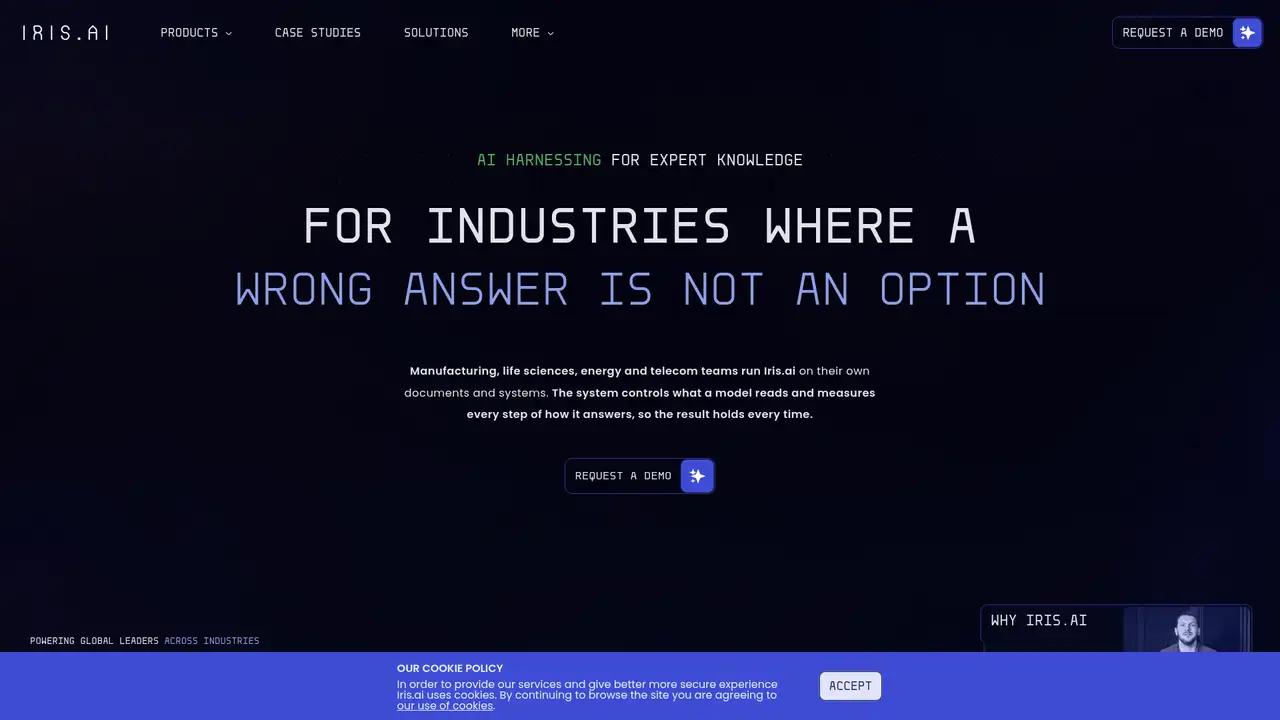
Iris.ai is a Norwegian company whose team formed at Singularity University in 2015. Victor Botev is CEO and CTO, while Anita Schjøll Abildgaard is CSO, and both are co-founders. The company announced a €7.64 million Series A in 2024, led by Silverline Capital with matching EIC Fund participation, bringing reported total funding to €16 million. Its current customers include manufacturing, life sciences, energy, telecom, R&D, intellectual property, regulatory, and innovation teams. The company has moved beyond its earlier consumer-facing science assistant. Its current product set includes RSpace for research review, RAG-as-a-Service and API capabilities for enterprise retrieval, and Neuralith for agentic knowledge infrastructure. The company presents these products as infrastructure for specialist organizational workflows.
RSpace is the research-facing workspace from Iris.ai, aimed at literature review, R&D, intellectual property, regulatory, and innovation teams. A typical workflow starts with imported or connected document collections, followed by indexing, retrieval, filtering, mapping, extraction, summarization, and dataset chat. The May 2025 Analyze release described topic modeling, automated concept extraction, keyword and topic generation, and document classification across about 150 million documents. RSpace 1.3, released in December 2025, added monitoring, OpenAlex access, full-text chat, automatic dataset synchronization, versioning, JSONL and DOC support, project document counts, and an unsupported-file view. The company also advertises cloud or on-premises deployment for related RAG services and visibility into connected enterprise knowledge workflows.
Iris.ai describes a Multi-RAG approach that selects among vector search, knowledge graphs, semantic search, metadata retrieval, and keyword search. Specialized agents handle strategy selection, result evaluation, prompt optimization, and user communication. The company says it evaluates language models across more than 20 metrics and supports customer models alongside in-house, modified, and fine-tuned open-source models. RSpace 1.3, released in December 2025, added monitoring, OpenAlex access, full-text chat, automatic dataset synchronization, versioning, a redesigned interface, JSONL and DOC support, and unsupported-file views. Iris.ai also advertises cloud and on-premises deployment for its RAG service. Its privacy policy places data in AWS regions in Ireland and Germany, while Neuralith provides agentic infrastructure for knowledge workflows.
Pricing depends on which Iris.ai product you choose. The current RSpace Individual Membership is listed at €292 per month or €3,500 per year, with a 10-day trial and automatic billing after the trial. The directory-listed description gives cloud import limits of 10,000 documents and 5 GB, with English-language documents. Enterprise Edition, RAG-as-a-Service and API capabilities, and Neuralith use quotations. Current enterprise deployments can run in the cloud or on premises, and customers can connect their own models or use Iris.ai models. A separate legacy subscription page lists Basic as free and Premium at €75 monthly, €202.5 quarterly, or €720 annually, but those prices cover retiring Explore and Focus tools. Treat those figures as legacy consumer pricing, not current enterprise tiers or a complete catalog.
Iris.ai is better suited to specialist teams than casual paper discovery. Its enterprise scope and on-premises option distinguish it from Keenious, which emphasizes scholarly search, editable maps, add-ins, and a lower-priced free tier. Elicit focuses on research questions and evidence synthesis, while Consensus centers on finding answers from academic papers. Compared with these tools, Iris.ai offers more explicit dataset controls, monitoring, versioning, structured extraction, and enterprise deployment, while requiring a larger commercial commitment. Iris.ai stores data in AWS regions in Ireland and Germany, and its terms assign generated training datasets to Iris.ai even though users retain uploaded and created content. Pick Iris.ai for managed research and knowledge workflows that need deployment control, structured data, or enterprise integration.
Who is Iris.ai best for?
- R&D teams reviewing large scientific and technical document collections.
- Regulated organizations needing structured retrieval and evaluation workflows.
- Teams requiring cloud or on-premises RAG deployment.
- Organizations connecting research data with agentic enterprise systems.
Iris.ai Pricing (2026)
Pricing model: Paid. All prices in USD.
| Plan | Price | What you get |
|---|---|---|
| RSpace Individual Membership | €292/month or €3,500/year | Includes a 10-day trial. The directory-listed description gives cloud import limits of 10,000 documents and 5 GB, with English-language documents. |
| RSpace Enterprise Edition | Custom | Enterprise pricing is quoted for organizations requiring dedicated support, stronger security protocols, and customizable integrations. |
| RAG-as-a-Service and API | Custom | The company describes cloud and on-premises deployment and the ability to connect customer models or Iris.ai models. |
| Neuralith | Custom | Sold through a demonstration and scoped enterprise engagement for agentic knowledge infrastructure. |
| Legacy Basic | €0 | Legacy Explore and Focus access. These tools are marked for retirement and are not the current enterprise catalog. |
| Legacy Premium | €75/month, €202.5/quarter, or €720/year | Legacy Explore and Focus subscription with a 10-day trial. Subscribers transfer to Researcher Workspace. |
Pros and Cons
Pros
- RSpace combines literature review, extraction, dataset chat, monitoring, and versioning.
- Multi-RAG can combine vector, graph, semantic, metadata, and keyword retrieval.
- Neuralith supports agentic knowledge infrastructure for enterprise workflows.
- RAG deployment can run in the cloud or on premises.
Cons
- Current enterprise products require quotations instead of public prices.
- The RSpace individual price is high for independent researchers.
- Terms assign generated training datasets to Iris.ai.
Who should look elsewhere?
- Casual users seeking a low-cost paper discovery assistant.
- Teams needing a transparent self-serve price for every product.
- Users expecting an open-source Iris.ai deployment.
Technical Details
Frequently Asked Questions
How much does Iris.ai cost?
The current RSpace Individual Membership is listed at €292 per month or €3,500 per year, with a 10-day trial. Enterprise Edition, RAG-as-a-Service and API capabilities, and Neuralith use custom quotations. A separate legacy page lists Basic at no charge and Premium at €75 monthly, €202.5 quarterly, or €720 annually, but those prices apply to retiring Explore and Focus tools.
Does Iris.ai have a free plan?
The legacy subscription page lists Basic at no charge for the older Explore and Focus tools. Iris.ai says those tools are soon retiring, and subscribers transfer to Researcher Workspace. The current RSpace listing describes a 10-day trial rather than a continuing free tier. Enterprise Edition, RAG-as-a-Service and API capabilities, and Neuralith are commercial offerings with quoted pricing.
How does Iris.ai compare with Keenious?
Iris.ai is aimed at enterprise knowledge workflows, structured extraction, monitoring, agent orchestration, and on-premises deployment. Keenious focuses on scholarly search, editable topic maps, Word and Google Docs add-ins, and library routing. Keenious publishes a free tier and lower paid plans, while Iris.ai targets larger organizational deployments. Choose Iris.ai for managed R&D infrastructure, and Keenious for affordable individual discovery.
Does Iris.ai train models on user data?
Iris.ai says client domain-adapted and fine-tuned models remain exclusive to that client, with no knowledge transfer between clients. Its terms also state that all training datasets generated in the service belong to Iris.ai, while users retain uploaded and created content. Organizations should review the terms and contract before placing sensitive research data into the service.
Can Iris.ai be used commercially?
Yes. Iris.ai targets commercial R&D, intellectual property, regulatory, manufacturing, life sciences, energy, telecom, and innovation teams. Its enterprise products are designed for organizational data and workflows, with cloud or on-premises deployment available for its RAG service. Commercial rights and treatment of generated training datasets should be reviewed in the applicable agreement before deployment.
Best Iris.ai Alternatives in 2026
These tools do the same job as Iris.ai, with different pricing, limits and trade-offs.
AI workflows for literature search, review, and research reports

Evidence-linked search and synthesis for academic literature

Citation context and evidence checks for scientific research

Visual citation discovery that grows from the papers you know

Find, understand and map academic research with AI guidance