
Close Review, Pricing & Alternatives (2026)
CRM with built-in calling, messaging, automation, and AI sales assistance
Last updated: October 26, 2026
What is Close?
Close is a hosted CRM and sales engagement platform for small and midsize sales teams. It combines lead records, email, calling, SMS, sequences, workflows, reporting, and AI sales assistance in one application. Plans start at $9 per user per month with annual billing, while calling, SMS, and some AI usage can add separate charges.
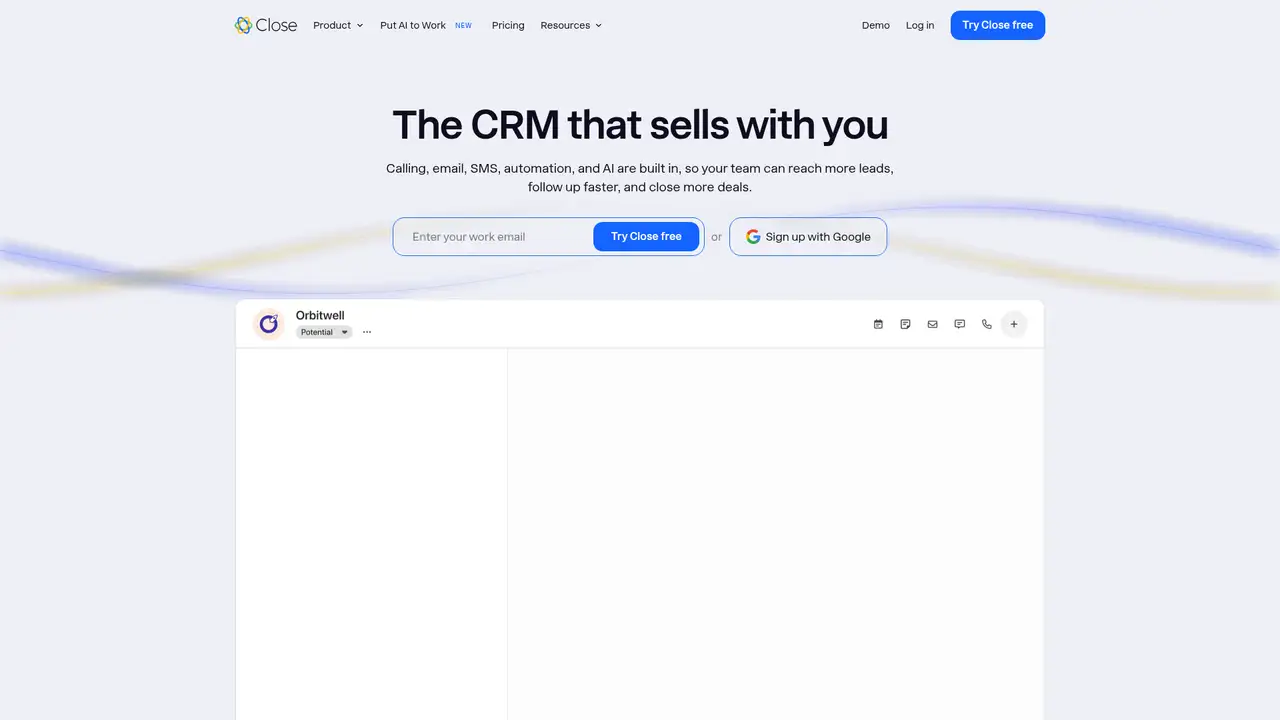
Close is a hosted CRM and sales engagement platform made by Close, a company founded in 2013 by Steli Efti, Anthony Nemitz, and Thomas Steinacher. The product launched publicly as Close.io in January 2013 after the founders worked at Elastic Sales. Close adopted its current name after acquiring the close.com domain in 2019. Y Combinator lists Close in its Winter 2011 batch and identifies the company as active. Close describes its growth as bootstrapped, while contemporaneous coverage reported an early 2013 seed round. The company sells to sales teams that want customer records, outreach, calling, and sales operations in one hosted application instead of separate CRM and engagement products.
Close organizes sales work around leads, contacts, opportunities, and activities. A typical workflow begins with importing or creating leads, adding contacts, and recording email, call, or SMS interactions on each lead record. Reps can use built-in calling, texting, email sequences, forms, and workflows for follow-up. Growth adds Power Dialer, bulk email, custom activities, and broader automation. Scale adds predictive dialing, live call coaching, permissions, lead visibility rules, custom objects, and user groups. Reporting covers pipeline and activity performance. Developers can connect external systems through the REST API, OAuth 2.0, webhooks, event logs, pagination, rate limits, and the MCP server. This keeps communication history close to opportunity data.
Close does not name the underlying model used by its AI features. Recent product work includes Chloe, an AI sales agent that the company says can call, qualify prospects, book meetings, send follow-up, and update records inside Close. The 2025 and 2026 changelog includes native scheduling, a ChatGPT app, workflow improvements, Forms API updates, Playbooks API, blocked phone numbers, form submissions, field enrichment, WhatsApp messages, transcription fields, and an OpenAPI specification. Close also documents an MCP server for compatible AI agents. These additions extend automation around the CRM. Chloe is positioned as an in-product sales agent, while the ChatGPT connection has separate OpenAI account and data controls.
Close has four public seat plans and a 14-day free trial. Solo costs $19 per user monthly or $9 per user monthly with annual billing, supports one user, and allows up to 10,000 leads. Essentials costs $49 monthly or $35 annually per user and adds collaboration, forms, email, calling, SMS, and unlimited contacts and leads. Growth costs $109 monthly or $99 annually and adds workflows, Power Dialer, custom activities, and bulk email. Scale costs $149 monthly or $139 annually and adds advanced permissions, predictive dialing, extended recording, coaching, custom objects, and user groups. Calling and SMS are billed separately, while AI features use credits or plan allowances. The advertised annual Solo price is less than half its monthly equivalent. Higher-tier features therefore carry both seat and usage costs.
Close does not offer a self-hosted or open-source edition, and heavy calling, SMS, or AI use can make the total cost harder to predict. Avoma is a closer fit for meeting recording, transcription, conversation intelligence, scheduling, and revenue insights across conferencing tools. Salesforce offers broader enterprise customization and administration, while HubSpot combines sales with larger marketing and service products. Close instead concentrates on native sales communication, pipeline activity, and programmable CRM workflows. Its one-user Solo plan also limits the cheapest entry point for teams. Small and midsize teams that want CRM records, calling, messaging, and sales automation in one focused workspace should pick Close.
Who is Close best for?
- Small sales teams that want CRM records and communication tools in one application.
- Teams that need native calling, SMS, email sequences, and workflow automation.
- Sales organizations building integrations through REST APIs, webhooks, or MCP.
- Companies testing AI-assisted calling and record updates inside a CRM.
Close Pricing (2026)
Pricing model: Paid. All prices in USD.
| Plan | Price | What you get |
|---|---|---|
| Solo | $19/user/month or $9/user/month billed annually | One user and up to 10,000 leads. Email open tracking is excluded. |
| Essentials | $49/user/month or $35/user/month billed annually | Unlimited contacts and leads, collaboration, forms, email, calling, and SMS. Communication usage is billed separately. |
| Growth | $109/user/month or $99/user/month billed annually | Adds workflows, Power Dialer, custom activities, bulk email, and additional automation. Calling, SMS, and AI usage can add cost. |
| Scale | $149/user/month or $139/user/month billed annually | Adds permissions, lead visibility rules, predictive dialing, extended recording, live coaching, custom objects, and user groups. |
Pros and Cons
Pros
- Close combines CRM records with native email, calling, SMS, and sales sequences.
- The REST API supports API keys, OAuth 2.0, webhooks, pagination, and event logs.
- Growth and Scale add progressively deeper sales automation and dialing tools.
- Chloe can perform sales tasks and update records within Close.
Cons
- Calling, SMS, and AI usage can increase the advertised per-seat price.
- Solo is limited to one user and 10,000 leads.
- Close does not provide a self-hosted or open-source edition.
Who should look elsewhere?
- Organizations requiring a self-hosted CRM or open-source deployment.
- Large enterprises seeking a broad marketing, service, and commerce suite.
- Teams needing predictable costs for heavy calling, SMS, or AI usage.
Technical Details
Frequently Asked Questions
How much does Close cost?
Close costs $19 per user monthly on Solo, $49 on Essentials, $109 on Growth, and $149 on Scale. Annual billing lowers those prices to $9, $35, $99, and $139 per user monthly. Close offers a 14-day trial. Calling and SMS are billed separately, and AI features can consume credits or plan allowances.
Does Close have a free plan?
Close does not publish a permanent free plan. It offers a 14-day free trial. The entry Solo plan costs $19 per user monthly or $9 per user monthly with annual billing. Solo supports one user and up to 10,000 leads, and it excludes email open tracking.
How does Close compare with Avoma?
Close is a CRM and sales engagement platform with native email, calling, SMS, sequences, workflows, and sales records. Avoma focuses on meeting recording, transcription, summaries, scheduling, conversation intelligence, and revenue intelligence across conferencing and CRM tools. Close is better suited to running sales activity in the CRM, while Avoma is better suited to meeting analysis and coaching.
Does Close use customer data to train AI models?
Close says Chloe operates inside Close and that its data does not leave the platform to a third-party AI vendor. Close’s ChatGPT integration documentation warns that OpenAI may use chats for training depending on the ChatGPT plan and settings. Customers should distinguish Chloe’s stated handling from the separate controls and terms governing ChatGPT.
Can businesses use Close commercially?
Yes. Close is sold as a paid CRM for commercial sales operations. Customers remain responsible for privacy compliance, communication rules, SMS requirements, and recording consent. Close’s data processing terms address confidentiality, subprocessors, security controls, and data-subject assistance. A subscription does not remove the customer’s responsibility to obtain required consent for calls or messages.
Best Close Alternatives in 2026
These tools do the same job as Close, with different pricing, limits and trade-offs.

Visual sales CRM for pipelines, activities, automation and growth

AI-assisted workflows for prospecting, deals, forecasting, coaching, and expansion

Revenue orchestration connecting buyer signals with seller action
CRM-grounded AI assistants, agents, and workflows for go-to-market teams

Enterprise agents connected to Salesforce data, workflows, and channels