
Salesforce Agentforce Review, Pricing & Alternatives (2026)
Enterprise agents connected to Salesforce data, workflows, and channels
Last updated: October 22, 2026
What is Salesforce Agentforce?
Salesforce Agentforce is an AI agent platform for customer and employee workflows across websites, phone, apps, CRM, and messaging. Salesforce Foundations is listed at $0, while paid options include Flex Credits, conversations, per-user licensing, flat-fee access, and editions. It fits organizations using Salesforce data, permissions, workflows, and channels for governed automation.
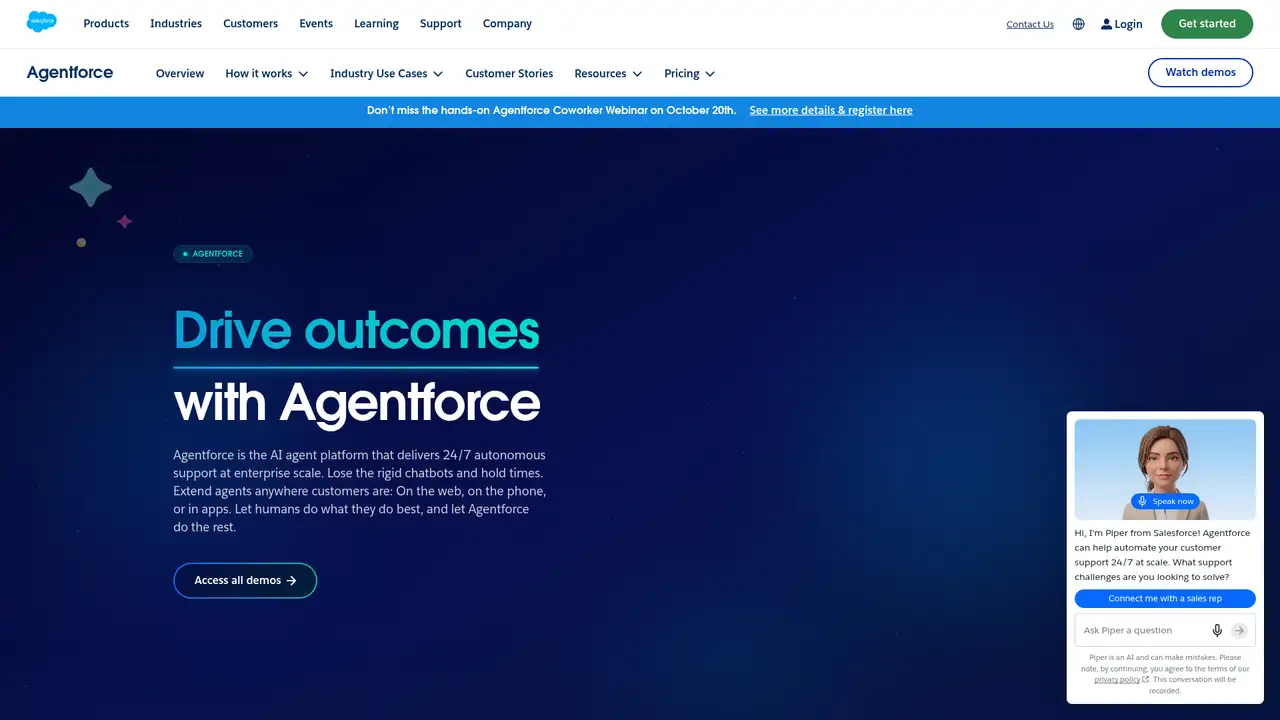
Salesforce Agentforce is an active AI agent platform for customer and employee work across sales, service, HR, marketing, commerce, websites, apps, phone, messaging, and CRM. Salesforce presents agents that answer questions, retrieve business knowledge, take actions, and transfer work to people when required. Its components include Agent Builder, job-specific subagents, prebuilt actions, Salesforce context, Agentforce Voice, observability, and multi-agent orchestration. The product is a practical choice for organizations already treating Salesforce as the main record for customers, permissions, workflows, and engagement. Before adoption, buyers should confirm which Salesforce edition they have, assign administration ownership, review data access, test production scenarios, and plan monitoring. Foundations is listed at $0, while other options use credits, conversations, licenses, or editions.
Teams create agents with Agent Builder, Agent Script, prompts, actions, instructions, and guardrails. Existing Flows, Apex, JavaScript, MuleSoft APIs, CRM data, and Data 360 context can support agent behavior. Documented tasks include answering questions, resolving cases, updating records, scheduling appointments, recommending products, qualifying leads, booking meetings, employee support, and event assistance. Agentforce Voice extends delivery across telephony, mobile, and web channels. MCP Client, MCP server support, and A2A patterns provide connections to external tools and agents. A sensible rollout starts with one bounded workflow, a defined permission set, approved actions, test conversations, and a human handoff. Data, workflows, and permissions split across Salesforce organizations or other systems require an orchestration design rather than assuming one agent can reach everything.
Salesforce describes a lifecycle covering design, building, testing, evaluation, deployment, experimentation, observation, monitoring, control, and orchestration. Agentforce Studio supports multi-turn simulation, custom scoring, batch testing, and checks for probabilistic behavior. Production experiments can compare configurations through traffic splits and metrics. Observability includes session insights, health monitoring, analytics, and a Session Trace Data Model. Salesforce identifies the Atlas Reasoning Engine as part of Agentforce, but the published pages do not identify an underlying proprietary large language model. Security material describes masking, zero data retention, policy controls, secure retrieval, audit trails, toxicity detection, encryption, identity controls, and monitoring. Teams should verify regional availability and agreement terms, then review logs and failure cases before allowing agents to update records or contact customers without approval.
Salesforce lists Foundations at $0, Flex Credits at $500 per 100,000 credits, Conversations at $2 per conversation, the Agentforce User License at $5 per user monthly, and Flat Fee Access at $125 per user monthly. One Agentforce action uses 20 Flex Credits, while a Voice action uses 30. Credits do not roll into later subscription terms, and Flex Credits and Conversations cannot be used together in the same organization. Salesforce's 2026 announcement lists Core at $195 per user monthly with 500,000 annual Flex Credits, Advanced at $395 with 1 million, and Max at $550 with 2.75 million. Buyers should estimate users, conversations, actions, voice activity, and existing Salesforce charges before choosing a model. Pricing, packaging, availability, and contract terms may change.
Agentforce fits organizations where Salesforce records, permissions, workflows, and channels anchor business operations. It offers CRM-native actions, connections through MCP and A2A patterns, testing, observability, audit trails, and usage controls, but it is not a self-hosted product or a standalone assistant with one predictable price. Constraints include Salesforce administration, data quality, separated-organization boundaries, external MCP contract changes, and privacy requirements for A2A connections. Administrators should begin with a limited workflow, document escalation rules, forecast consumption, and measure outcomes before expanding. Microsoft Dynamics 365 Sales agents suit Microsoft CRM deployments, ServiceNow AI Agents suit IT and service operations, HubSpot Breeze Agents suit HubSpot teams, Intercom Fin centers on support, and Google Vertex AI Agent Builder fits Google Cloud services. Choose Agentforce when Salesforce is central; otherwise compare those alternatives first.
Who is Salesforce Agentforce best for?
- Salesforce customers automating service, sales, and employee workflows with CRM permissions.
- Large teams needing testing, observability, audit trails, and usage controls.
- Organizations connecting agents to Flows, Apex, APIs, Data 360, and Slack.
- Businesses able to forecast consumption and fund Salesforce administration.
Salesforce Agentforce Pricing (2026)
Pricing model: Usage-based. All prices in USD.
| Plan | Price | What you get |
|---|---|---|
| Salesforce Foundations | $0 | Free add-on. Enterprise Edition or above can receive 100,000 Flex Credits under Salesforce guidance. |
| Flex Credits | $500/100,000 credits | Per 100,000 credits. Agentforce actions use 20 credits and Voice actions use 30. Credits do not roll into later subscription terms. |
| Conversations | $2/conversation | Per conversation. Conversations and Flex Credits are not supported together in the same organization. |
| Agentforce User License | $5/user/month | Per user monthly under the applicable Salesforce agreement. |
| Flat Fee Access | $125/user/month | Per user monthly. Included capabilities and availability depend on the applicable Salesforce agreement. |
| Agentforce Core Edition | $195/user/month | Per user monthly. Includes 500,000 Flex Credits per organization annually. Availability varies by agreement. |
| Agentforce Advanced Edition | $395/user/month | Per user monthly. Includes 1 million Flex Credits per organization annually. Availability varies by agreement. |
| Agentforce Max Edition | $550/user/month | Per user monthly. Includes 2.75 million Flex Credits per organization annually. Availability varies by agreement. |
Pros and Cons
Pros
- Agent actions can reuse Salesforce Flows, Apex, APIs, and CRM permissions.
- MCP and A2A patterns support connections with external tools and agents.
- Trust Layer features include masking, audit trails, policy controls, and zero data retention claims.
- Testing, observability, session traces, and experiments support production governance.
Cons
- Consumption, user, add-on, edition, and base CRM charges can create a complex bill.
- Production deployment depends on Salesforce data quality, permissions, and administration.
- Flex Credits do not roll over into later subscription terms.
Who should look elsewhere?
- Small teams seeking a standalone chatbot without Salesforce administration.
- Buyers needing one predictable price for unpredictable interaction volume.
- Organizations whose core data and workflows live outside Salesforce.
Technical Details
Frequently Asked Questions
How much does Salesforce Agentforce cost?
Salesforce lists Foundations at $0, Conversations at $2 per conversation, the Agentforce User License at $5 per user monthly, and Flex Credits at $500 per 100,000. Flat Fee Access is $125 per user monthly. Core, Advanced, and Max editions list $195, $395, and $550 per user monthly. Other Salesforce products and contract terms can add costs.
Is there a free Agentforce plan?
Yes. Salesforce Foundations is listed at $0 and includes Agentforce Builder, Prompt Builder, Agent Script, Agentforce Coworker, and Agentforce Vibes. The $0 price does not make every Salesforce subscription or usage cost free. Salesforce also says Enterprise Edition or above can receive 100,000 Flex Credits under applicable guidance.
What is the closest competitor to Agentforce?
Microsoft Dynamics 365 Sales agents are a close alternative for teams centered on Microsoft CRM, Microsoft 365, and related services. Agentforce is better aligned with Salesforce records, Flows, Apex, Data 360, and Salesforce permissions. ServiceNow AI Agents and HubSpot Breeze Agents may fit better for IT service or HubSpot CRM workflows.
Does Salesforce train external models on Agentforce data?
Salesforce describes Trust Layer protections including sensitive-data masking, policy controls, secure retrieval, audit trails, and zero data retention for external model calls. Actual handling depends on configuration and applicable terms. Organizations should review Salesforce privacy, security, and data-processing terms for selected products, integrations, and external model services.
Can businesses use Agentforce commercially?
Salesforce presents Agentforce for customer-facing and employee-facing business use through consumption, user-license, flat-fee, and edition models. Commercial deployment remains subject to subscriptions, permissions, channel configuration, availability, and contract terms. Organizations should test and monitor agents before permitting production record updates, customer communications, or automated decisions.