
Brave Search API Review, Pricing & Alternatives (2026)
Independent, privacy-focused web search and AI grounding API
Last updated: October 26, 2026
What is Brave Search API?
Brave Search API serves independent-index web, news, image, video, place, LLM Context, Answers, autocomplete, and spellcheck requests. It suits privacy-conscious developers, agents, and search products that need live sources without Google or Bing fallback. Public entry pricing starts at $5 per 1,000 Search requests, with recurring monthly credits on each public plan.
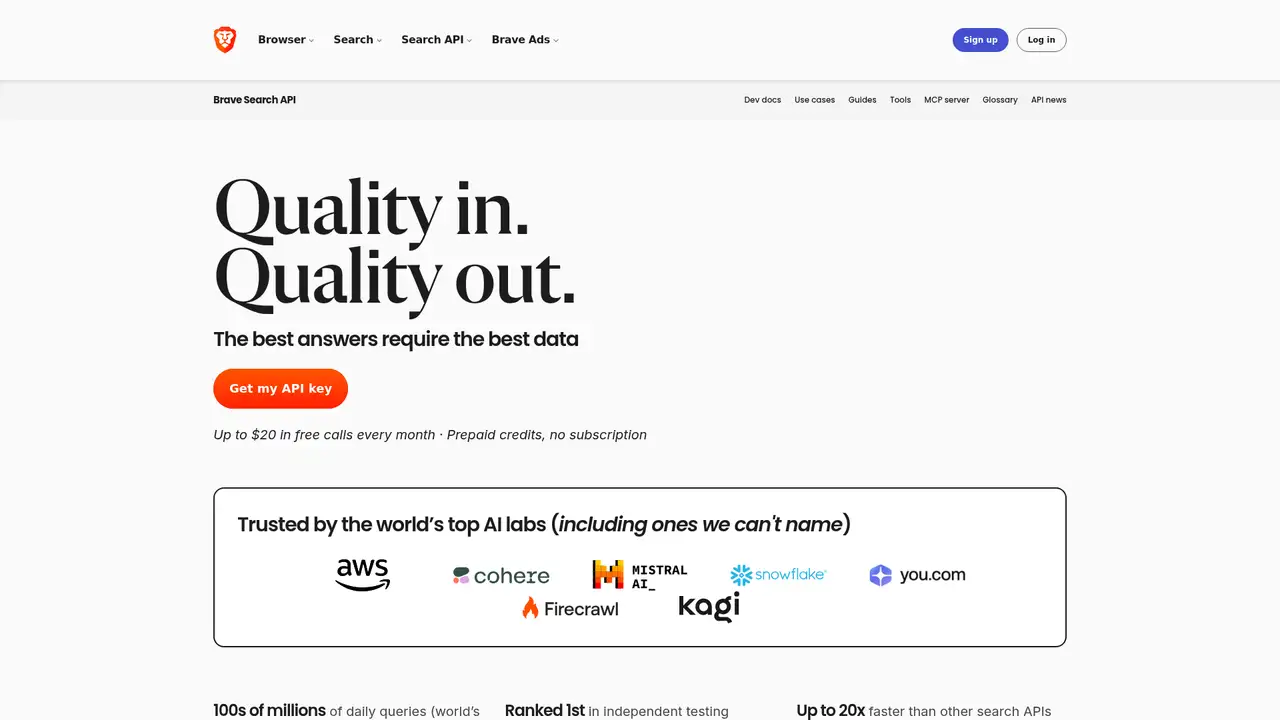
Brave Search API is Brave’s developer interface for an independent web index that operates without Google or Bing fallback. It supports web, news, image, video, place, knowledge graph, structured data, autocomplete, spellcheck, and AI grounding requests. Brave presents the service as privacy focused, source traceable, and suitable for applications that need current online material without routing queries through a major search intermediary. Brave reports hundreds of millions of daily queries, 150 billion total queries answered, and first place in an AIMultiple agent quality test. Those company and third party claims frame the API as a foundation for search products, agents, and model grounding. Developers can select focused endpoints or combine several content types within one broader search workflow. The product is an API rather than an open source or self hosted search system.
The Search plan combines web results, LLM Context, news, images, videos, places, schema enriched data, extra snippets, and Goggles based reranking. Standard search returns titles, snippets, URLs, and related result fields for applications that want to manage retrieval and presentation themselves. LLM Context returns ranked passages from relevant pages, including text, tables, code, JSON, forum discussions, and video captions, with controls for context length and relevance thresholds. Results include source URLs and timestamps, and freshness filters can target recent material. Brave also documents a chat completions endpoint compatible with an OpenAI client pattern. Requests use an X Subscription Token header. Official examples cover Python, JavaScript, Go, cURL, and OpenAI compatible integrations, reducing the amount of request handling developers must write. Answers instead returns a cited response when the application wants a fuller response endpoint.
Brave’s February 2026 redesign consolidated public access around Search and Answers plans and added LLM Context as a retrieval endpoint intended for model input. The product page describes LLM Context as a single call that extracts and ranks passages, allowing an application to pass focused source material to its own model. Documentation also covers location aware results, places and map data, custom site selection through Goggles, and filtering to the previous 24 hours. Brave reports a 94.1% SimpleQA F1 result in its AI Grounding announcement. Its current page cites AIMultiple testing for agent quality and latency, and presents Brave as faster than several named search APIs in that comparison. These performance statements are vendor published or externally attributed claims, not universal guarantees for every workload. The available controls let teams decide how much retrieval and model work remains in their application.
Search costs $5 per 1,000 requests and includes a $5 recurring monthly credit, with a documented limit of 50 queries per second. The displayed Search price covers web, LLM Context, news, images, videos, and places, so one plan can support several retrieval needs. Answers costs $4 per 1,000 web searches plus $5 per million input and output tokens, includes a $5 recurring monthly credit, and allows two queries per second. Autocomplete and Spellcheck each cost $5 per 10,000 requests and include $5 monthly credits. There is no standalone free subscription, and activating an account requires a card. Enterprise terms are custom and can cover capacity, endpoints, invoicing, support, contracts, and zero data retention agreements. Separate credits and token billing mean teams should distinguish endpoint usage when estimating costs, especially for Answers workloads.
Brave suits teams building search infrastructure, agent grounding, or applications that need news, images, videos, and places from one independent index. Compared with Parallel, it offers less built in asynchronous research orchestration, while Parallel focuses on specialized research and enrichment workflows. Compared with Tavily, Brave provides broader vertical search and its own index, while Tavily presents a research oriented developer service. Compared with Exa, Brave emphasizes ranked search, LLM Context, and privacy rather than semantic discovery. Practical constraints include separate plan credits, token charges for Answers, required card activation, and lower Answers throughput. Choose Brave when your application needs direct control over retrieval and grounding, independent live web data, and request based billing. Choose Parallel when the provider should manage deeper multi step research or enrichment workflows for the intended user.
Who is Brave Search API best for?
- Privacy-conscious teams building search or grounding products.
- Agents needing independent live web data.
- Teams preferring predictable request-based billing.
- Applications requiring news, images, videos, or places.
Brave Search API Pricing (2026)
Pricing model: Usage-based. All prices in USD.
| Plan | Price | What you get |
|---|---|---|
| Search | $5/1K requests | Web, LLM Context, news, images, videos, and places; 50 QPS; $5 recurring monthly credit. |
| Answers | $4/1K web searches + $5/M tokens | Grounded answers; 2 QPS; $5 recurring monthly credit. |
| Autocomplete | $5/10K requests | Suggestions and entities; $5 recurring monthly credit. |
| Spellcheck | $5/10K requests | Spellchecking; $5 recurring monthly credit. |
| Enterprise | Custom | Custom capacity, endpoints, contracts, invoicing, support, and zero-data-retention agreements. |
Pros and Cons
Pros
- The independent index avoids Google and Bing fallback.
- One Search plan covers several content verticals.
- Recurring credits can cover small proofs of concept.
- LLM Context returns compact material for model input.
Cons
- There is no standalone free subscription.
- Answers adds token charges beyond web-search charges.
- Separate plan credits complicate multi-endpoint budgeting.
Who should look elsewhere?
- Deep multi-step research without application orchestration.
- Projects unable to provide a payment card.
- Answers workloads requiring high request throughput.
Technical Details
Frequently Asked Questions
Is Brave Search API free?
Brave does not offer a standalone free API plan. Each public plan includes a $5 recurring monthly credit, which can cover limited usage such as 1,000 Search requests. Activation requires a credit card, and users can set a zero prepaid amount and usage limits. Usage beyond included credits follows the selected plan’s request and token rates.
How does Brave compare with Parallel?
Brave is suited to independent-index search, LLM Context, vertical search, and request-based pricing. Parallel provides specialized workflow APIs for asynchronous deep research, structured Task runs, FindAll, Monitor, and Entity Search. Brave fits applications whose teams manage orchestration and retrieval. Parallel fits projects where the provider should perform broader multi-step research or enrichment.
Does Brave track API users or queries?
Brave describes its Search API as privacy-focused and says its index operates without Google or Bing dependence. Enterprise offerings include contractual zero-data-retention agreements. Customers should distinguish public product positioning from the terms of a selected plan, endpoint, storage arrangement, and logging configuration. Teams sending sensitive queries should review those conditions before production use.
Can I use Brave Search API commercially?
Yes. Brave offers public usage plans and custom enterprise arrangements for applications, agents, model grounding, and search-enabled software. Commercial use remains subject to applicable terms, attribution requirements, storage rights, and restrictions concerning training or retaining results. Brave states that storage and model-training rights depend on the plan, so production buyers should confirm those rights before creating persistent datasets.
What is the difference between Search, LLM Context, and Answers?
Search returns conventional web and vertical results, including URLs and snippets. LLM Context supplies ranked, extracted passages intended for a model that your application operates. Answers performs research and returns a cited response, charging for web searches and input or output tokens. Choose Search or LLM Context when your team wants model control, and Answers when it wants a fuller response endpoint.
Best Brave Search API Alternatives in 2026
These tools do the same job as Brave Search API, with different pricing, limits and trade-offs.

Web research infrastructure for AI agents and applications

Agent-ready web search, extraction, crawling, and research APIs

Semantic web search infrastructure for AI applications
Real-time search results API for Google, Bing, Amazon and dozens of other engines