
Exa Review, Pricing & Alternatives (2026)
Semantic web search infrastructure for AI applications
Last updated: October 26, 2026
What is Exa?
Exa is a hosted web search and research API for developers building AI agents, retrieval systems, coding tools, and research products. Its Free plan includes $10 in monthly credits, and paid usage starts from $4 per 1,000 Lite Search requests. Separate endpoints support page extraction, answers, monitoring, and asynchronous research.
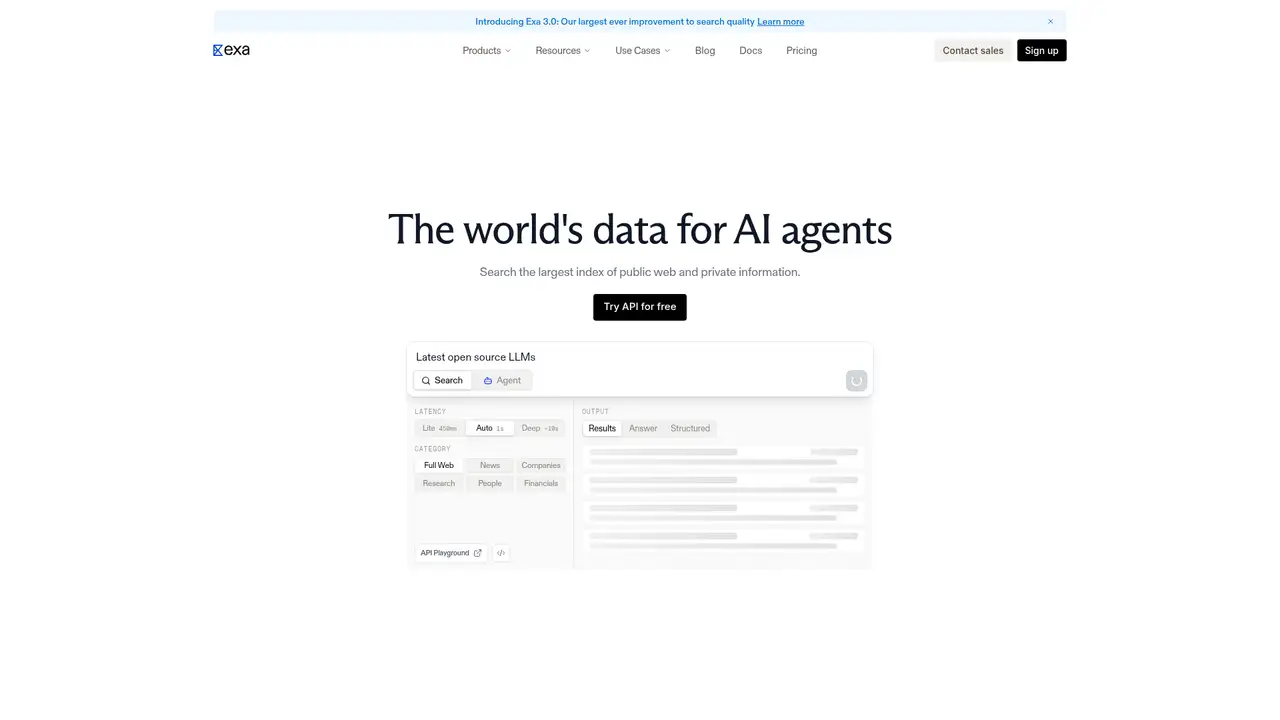
Exa is a hosted web search company founded in 2021 by Will Bryk and his team. It launched its first search engine in November 2022 and introduced a web search API for AI applications in early 2023. The company says its crawlers track more than 500 billion URLs and that over 400,000 developers use its service. Exa announced an $85 million Series B at a $700 million valuation in September 2025, followed by a $250 million Series C at a $2.2 billion valuation in May 2026. The product is delivered through an API, dashboard integrations, and connectors. Exa is proprietary infrastructure, with no open source release or self-hosted version of its search index.
Exa’s standard workflow sends a natural-language request to Search, where developers select Lite, Auto, Deep, or another supported type. They can request up to 100 ranked results with highlights or page text, then narrow retrieval by domain, publication date, category, or user location. Search can return content for known URLs through Contents, which extracts highlights, full text, or summaries from JavaScript-rendered pages, PDFs, and complex layouts. Answer supplies responses with web-grounded citations. Monitors reruns searches at a specified cadence and delivers updates through webhooks. Agent supports asynchronous deep research, list building, and enrichment with structured outputs and citations. Together, these endpoints suit teams building semantic retrieval workflows without running crawlers or page parsers, especially AI agents and research products.
Exa says its technology combines web-specific embedding models with end-to-end neural architectures trained on a GPU cluster containing hundreds of H200 GPUs. The company also describes custom vector databases, large-scale crawlers, and specialized models for code search. Products and releases announced during 2025 and 2026 include Agent, Deep Search, Exa Connect data providers, and revised Search and Contents pricing. Search documentation lists approximate search latency from about 450 milliseconds for Lite to roughly one second for Auto, while Deep modes take about four to 15 seconds. Those figures describe search with cached content. Fresh page fetching, summaries, output schemas, and multi-step Agent work add processing time and can create extra charges.
Exa’s Free plan provides $10 in monthly credits, a one-time $10 onboarding bonus, access to every endpoint, 10 QPS, and 50 active Agent runs. The monthly grant resets and unused credits do not accumulate, while the onboarding bonus does not expire. Pay as you go uses prepaid credits without a subscription or minimum spend, and Lite Search starts at $4 per 1,000 requests. Auto costs $7, Deep Search $12, Answer $5, and Contents $1 per 1,000 requests or pages. Results beyond 10 add $1 per 1,000, and Agent runs range from $0.012 to $1 based on effort. Enterprise adds custom volume pricing, higher limits, invoicing, SSO, SCIM, SLAs, and zero data retention. Exa is best for teams needing granular API usage control.
Exa offers more endpoint and retrieval control than a single answer API, but billing changes with endpoint, result count, page views, summaries, and research effort. Teams must manage prepaid credits, QPS limits, concurrency, and fresh-fetch settings. Its Lite mode suits high-volume, cost-sensitive workloads, while Auto balances quality and speed and Deep modes support multi-step research. Contents extracts text, highlights, and summaries from JavaScript-rendered pages, PDFs, and complex layouts. Tavily provides a more prescriptive agent stack built around Search, Extract, Map, Crawl, and Research. Perplexity Sonar emphasizes generated answers with citations, while Brave Search API provides conventional web results and AI-oriented access. Exa is strongest for developers who need semantic retrieval, extracted content, citations, monitoring, and configurable research depth behind one API.
Who is Exa best for?
- AI agents needing semantic web retrieval with citations.
- Research products requiring extracted page content.
- Teams combining search, monitoring, and enrichment.
- Developers preferring endpoint-level usage billing.
Exa Pricing (2026)
Pricing model: Usage-based. All prices in USD.
| Plan | Price | What you get |
|---|---|---|
| Free | $0 | $10 in monthly credits plus a one-time $10 onboarding bonus, 10 QPS, and 50 active Agent runs. |
| Pay as you go | From $4/1,000 requests | No subscription or minimum spend. Lite Search starts at $4 per 1,000 requests, with separate rates for other endpoints and options. |
| Enterprise | Custom | Custom volume pricing, QPS, concurrency, SLAs, SSO, SCIM, monthly invoicing, and zero data retention options. |
Pros and Cons
Pros
- Search returns ranked results with highlights or page text.
- Multiple search modes cover low-latency and deep research workflows.
- Contents handles PDFs and JavaScript-rendered pages.
- Enterprise plans include zero data retention options.
Cons
- Costs vary with endpoints, result counts, and content options.
- The search index cannot be operated locally.
- Deep research takes longer and can cost more.
Who should look elsewhere?
- Teams requiring a self-hosted search index.
- Buyers needing one fixed all-inclusive subscription.
- Consumers seeking a general-purpose search website.
Technical Details
Frequently Asked Questions
How much does Exa cost?
Exa has a Free plan with $10 in monthly credits and a one-time $10 onboarding bonus. Pay as you go has no subscription or minimum spend, with Lite Search starting from $4 per 1,000 requests. Contents costs $1 per 1,000 pages, Answer costs $5 per 1,000 requests, and Deep Search costs $12 per 1,000 requests. Agent usage is billed separately by effort.
Does Exa have a free plan?
Yes. The Free plan includes $10 in credits each month and a one-time $10 onboarding bonus. It provides access to all endpoints, 10 QPS, 50 active Agent runs, MCP server access, a Claude Connector, a ChatGPT plugin, and more than 50 integrations. The monthly balance resets, and unused monthly credits do not accumulate.
How does Exa compare with Tavily?
Both are hosted search APIs for AI agents. Exa separates Search, Contents, Answer, Monitors, Deep Search, and Agent, with Lite, Auto, and Deep retrieval modes. Tavily centers its product around Search, Extract, Map, Crawl, and Research using a credit system. Exa is better suited to teams wanting endpoint, result-count, and latency control.
Does Exa train on customer data?
Exa publishes zero data retention as an Enterprise option, including for product endpoints. Its public plan information does not describe one identical retention setting for every Free and Pay as you go request. Organizations handling sensitive queries should use the Enterprise data-processing terms and configured retention option before production deployment.
Can I use Exa commercially?
Yes. Exa offers commercial Pay as you go and Enterprise plans for applications, agents, coding tools, research products, and business workflows. Commercial use remains subject to Exa's service terms and any Enterprise order form. Customers receive hosted API access, not a license to operate Exa's search index or crawler infrastructure.
Best Exa Alternatives in 2026
These tools do the same job as Exa, with different pricing, limits and trade-offs.

Agent-ready web search, extraction, crawling, and research APIs
Source-linked AI search with multi-model research and agent features

Independent, privacy-focused web search and AI grounding API
Real-time search results API for Google, Bing, Amazon and dozens of other engines