
Tavily Review, Pricing & Alternatives (2026)
Agent-ready web search, extraction, crawling, and research APIs
acquired: Nebius announced the acquisition on February 10, 2026. SEC filings report that the transaction closed in February 2026. Tavily continues under its current brand.
Last updated: October 26, 2026
What is Tavily?
Tavily is a hosted web search and research service for developers building AI agents and RAG applications. Its APIs cover Search, Extract, Map, Crawl, and Research, with SDK, CLI, and MCP access. The free Researcher plan includes 1,000 monthly credits, paid plans start at $30 per month, and pay as you go costs $0.008 per credit.
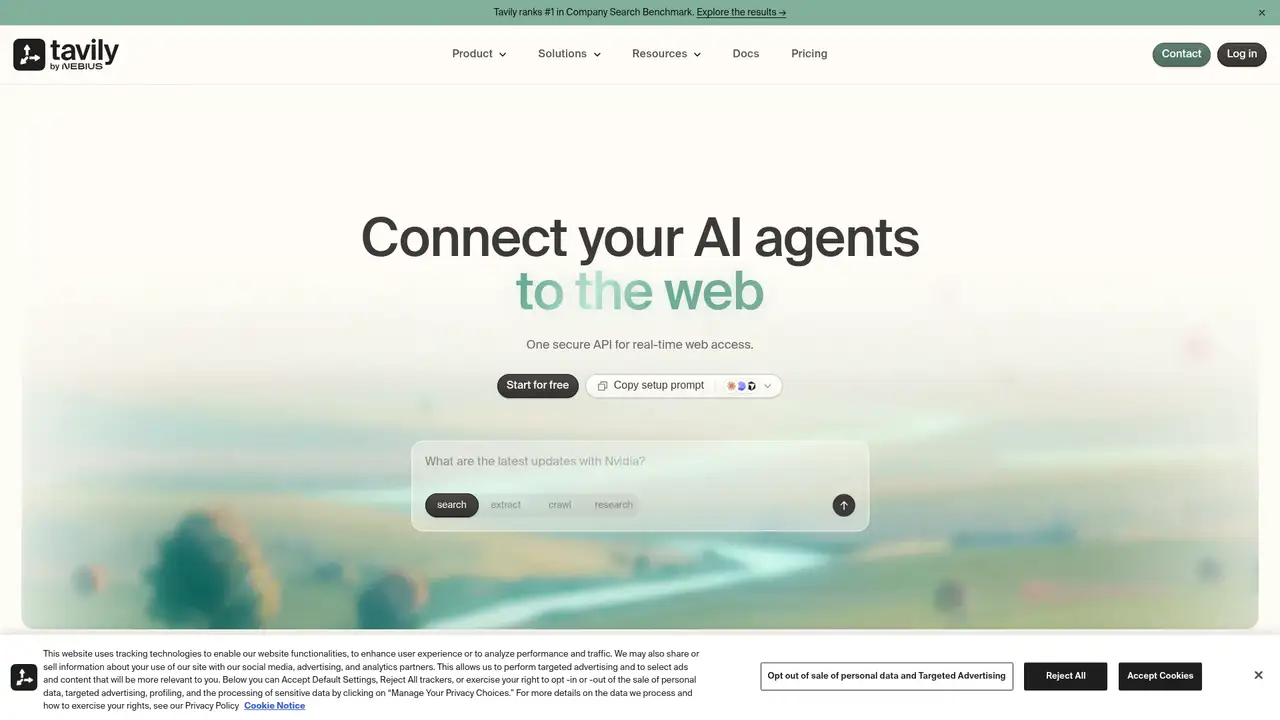
Tavily is a hosted web search and content service operated by AlphaAI Technologies Inc. for developers building LLM applications and autonomous agents. Its documentation describes APIs that search, scrape, filter, and extract material from online sources. The company says its developer community exceeds one million users and its SDKs receive more than three million monthly downloads. Nebius announced an agreement to acquire Tavily in February 2026, and a later filing records $177.3 million in cash paid at closing, with additional possible payments tied to employees and performance targets. Tavily continues under its own brand, while its team and technology now sit within Nebius’s AI cloud business. The company does not publish a founding year or total funding figure in the cited materials.
Tavily’s main workflow separates discovery from deeper site operations. Search returns current web results, with basic requests costing one credit and advanced requests costing two. Extract processes known URLs, Map discovers pages across a site, and Crawl combines mapping with extraction. Research performs multistep searches, source synthesis, and report generation with citations. Developers can call these functions through HTTP APIs, Python and JavaScript packages, the tvly command-line tool, or a remote MCP server. The CLI supports JSON output for scripts and agent pipelines. A typical RAG application sends a question to Search, passes the returned content to a language model, then calls Extract or Crawl when the initial result set lacks enough detail. Domain filters, parsing controls, response limits, and search depth shape the request.
Tavily is a retrieval and content-processing service rather than a published general-purpose foundation model. Its proprietary systems score, filter, and rank sources, while Research offers mini and pro modes with different depth and credit ranges. The documentation says Search can aggregate up to 20 sites and lets developers control search depth, domains, parsing, context, and response tokens. Recent documented additions include Crawl, Map, Research, the remote MCP server, Agent Skills, and CLI workflows. Tavily recommends advanced search and multiple chunks per source when applications need stronger supporting material, although those settings consume more credits. The company does not publish the underlying ranking model or offer an open-source index. Its product documentation centers on retrieval APIs and content operations rather than model training or model hosting.
Tavily’s free Researcher plan includes 1,000 credits each month, with no credit card required. Project costs $30 for 4,000 credits, Bootstrap costs $100 for 15,000, Startup costs $220 for 38,000, and Growth costs $500 for 100,000. Pay as you go costs $0.008 per credit, while Enterprise pricing is custom. Basic Extract charges one credit per five successful URLs, advanced Extract charges two, regular Map charges one credit per ten successful pages, and Map with instructions charges two. Research ranges from 4 to 110 credits for mini and 15 to 250 credits for pro. Crawl combines mapping and extraction charges, so larger site jobs consume credits faster than Search. Project, Bootstrap, Startup, and Growth plans reduce the effective credit rate compared with standalone usage.
Tavily’s main limitation is cost predictability for deep, multistep work. Research can consume up to 250 credits per pro request, and Crawl combines two metered operations. The hosted service does not provide a self-hosted index, and its privacy policy says portions of query data may be used to improve responses unless a contract says otherwise or the account opts out. Exa offers search modes, contents, answers, monitors, and deep-search products. Perplexity focuses on generated answers with citations, while Brave Search API provides conventional web search access. Tavily is the stronger fit when one API must cover retrieval, extraction, site mapping, crawling, MCP, and cited research. Choose it for agent pipelines that need current web material and programmable site operations.
Who is Tavily best for?
- Developers building agents that need current web sources.
- RAG systems that need extracted page content.
- Teams integrating retrieval through MCP or SDKs.
- Research workflows that require cited reports.
Tavily Pricing (2026)
Pricing model: Usage-based. All prices in USD.
| Plan | Price | What you get |
|---|---|---|
| Researcher | $0 | 1,000 credits per month. |
| Project | $30/month | 4,000 credits per month, equivalent to $0.0075 per credit. |
| Bootstrap | $100/month | 15,000 credits per month, equivalent to about $0.0067 per credit. |
| Startup | $220/month | 38,000 credits per month, equivalent to about $0.0058 per credit. |
| Growth | $500/month | 100,000 credits per month, equivalent to $0.005 per credit. |
| Pay as you go | $0.008/credit | Billed per credit used. |
| Enterprise | Custom | Custom credits, rates, security, support, and service levels. |
Pros and Cons
Pros
- One service covers Search, Extract, Map, Crawl, and Research.
- The free plan includes 1,000 monthly credits.
- SDK, CLI, and remote MCP integrations support automation.
- Research produces reports with citations.
Cons
- Pro Research can consume up to 250 credits per request.
- The ranking system and search index are proprietary.
- Query-data use depends on privacy settings and contracts.
Who should look elsewhere?
- Teams requiring a self-hosted search index.
- Workloads with unpredictable deep-research volume.
- Buyers seeking a conventional consumer search engine.
Technical Details
Frequently Asked Questions
How much does Tavily cost?
Tavily has a free plan with 1,000 monthly credits. Paid plans cost $30 for 4,000 credits, $100 for 15,000, $220 for 38,000, and $500 for 100,000. Pay as you go costs $0.008 per credit, while Enterprise pricing is custom. Search depth, extraction mode, Crawl, and Research affect credit consumption.
Does Tavily have a free plan?
Yes. Tavily’s Researcher plan includes 1,000 API credits each month and does not require a credit card. Basic Search costs one credit per request, while advanced Search costs two. Credits also cover extraction, mapping, crawling, and Research according to the operation’s published usage rules.
How does Tavily compare with Exa?
Both provide hosted web retrieval APIs for AI applications. Tavily combines Search, Extract, Map, Crawl, Research, CLI, SDK, and MCP tools in one service. Exa offers search modes alongside Contents, Answer, Monitors, Deep Search, and Agent products. Tavily is the closer fit when site operations and one integrated workflow matter.
Does Tavily train on user queries?
Tavily’s privacy policy says it collects query data and uploaded documents to provide the service. Unless a contract states otherwise, it may use certain portions of query data to improve future responses. The policy describes an account setting and an objection process for disabling improvement use. Queries may also be shared with third-party search indexes when Tavily cannot retrieve requested content.
Can I use Tavily commercially?
Yes. Tavily offers monthly plans, pay-as-you-go billing, and Enterprise access for applications and agents. Its API, SDKs, CLI, and MCP server are hosted services rather than an open-source search index. Commercial deployments remain subject to Tavily’s terms, usage limits, privacy policy, and any Enterprise contract covering the account.
Best Tavily Alternatives in 2026
These tools do the same job as Tavily, with different pricing, limits and trade-offs.

Semantic web search infrastructure for AI applications
Source-linked AI search with multi-model research and agent features

Independent, privacy-focused web search and AI grounding API
Real-time search results API for Google, Bing, Amazon and dozens of other engines