
Parallel Review, Pricing & Alternatives (2026)
Web research infrastructure for AI agents and applications
Last updated: October 26, 2026
What is Parallel?
Parallel provides APIs for search, extraction, deep research, answers, entity discovery, and monitoring. Founded by former Twitter CEO Parag Agrawal, it launched broadly in 2025 and reports millions of daily research tasks. Developers pay usage fees, with Search starting at $1 per 1,000 requests, for workflows requiring current web information and citations.
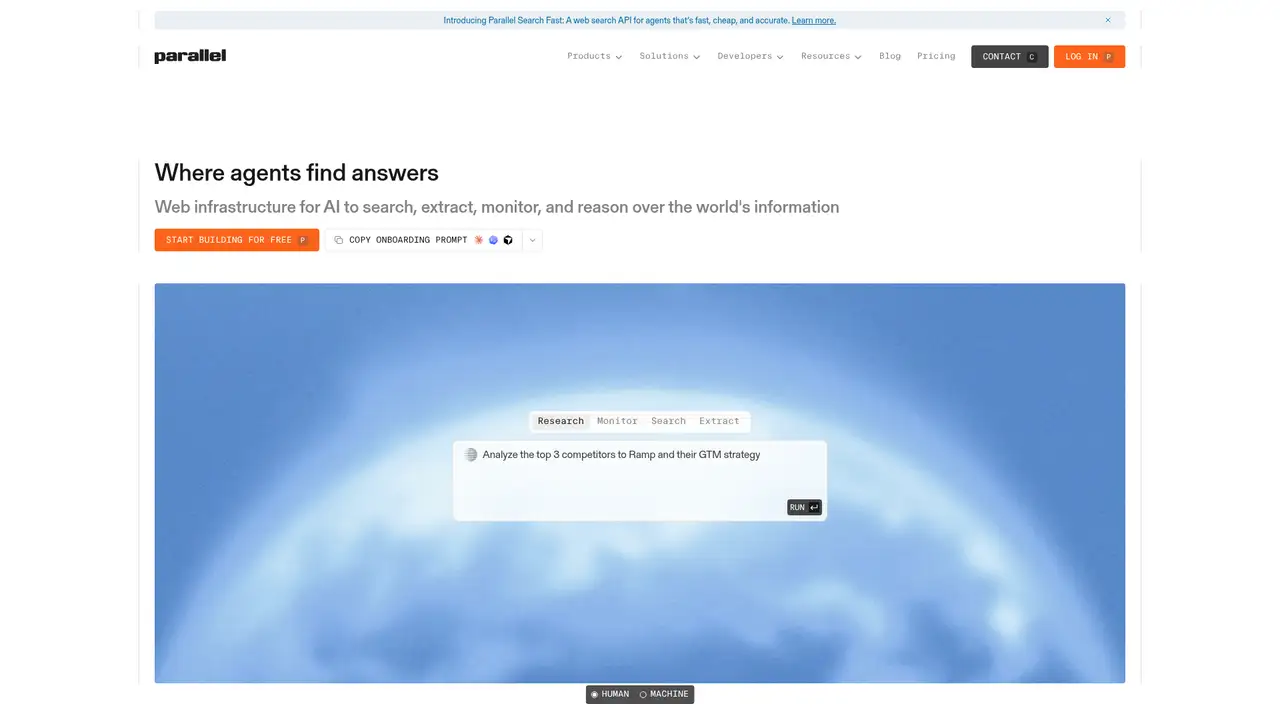
Parallel is a web research infrastructure company founded by former Twitter CEO Parag Agrawal and publicly launched its platform in August 2025. The company says its systems handle millions of research tasks daily for startups and enterprises. Reuters reported a $100 million Series A in November 2025, co-led by Kleiner Perkins and Index Ventures, at a $740 million valuation. Earlier backers included Khosla Ventures, First Round Capital, Terrain, and Spark Capital. Parallel frames its mission around serving AI agents that consume and reason over current online information, rather than people browsing a site directly. Its practical audience is developers building research products, automated workflows, and production applications that need web-grounded results, citations, and structured information. That positioning makes Parallel infrastructure for applications, not a consumer research assistant. Teams considering it should therefore evaluate API fit, workflow requirements, and evidence needs rather than expect a conventional graphical research product.
Parallel’s workflow coverage spans search, extraction, deep research, answers, entity discovery, and monitoring. Search is intended for ranked pages and excerpts, while Extract handles page content and documents timing of one to twenty seconds. Responses provides OpenAI-compatible answers grounded in live research, and Task supports asynchronous structured research. FindAll is aimed at verified lists, Entity Search at synchronous people or company lookup, and Monitor at recurring checks. This range lets a team choose an endpoint according to the job instead of treating every request as generic search. Parallel identifies teams building web-grounded AI agents, structured company and people enrichment, citation-based research, and recurring monitoring as suitable users. The practical tradeoff is that workflows must account for different processors, outputs, and timing. Fast Search suits latency-sensitive requests, while higher Task processors fit difficult research that can require more processing time.
Parallel exposes APIs for retrieval, research, enrichment, and monitoring, with citations, confidence, and field-level basis intended to support verification. Its systems are designed for current online information, which matters when an application needs web-grounded results rather than a static dataset. Task billing applies only to successful runs, according to the published documentation, so failed runs are not billed. Enterprise options include zero data retention, data protection agreements, single sign-on, EU data residency, onboarding, and support, with availability depending on the agreement and endpoint. The platform is API-based, and the listed use case is agent web research and structured enrichment. Teams sending confidential material should confirm retention, connector treatment, licensed-source handling, and processing terms before use. Its technology choice consequently fits developers integrating research capabilities into products, rather than teams seeking to operate the underlying system themselves.
Parallel uses usage-based pricing rather than a conventional free subscription. Search costs $1 to $5 per 1,000 requests, with ten results included and extra results priced at $1 per 1,000. Image Search is $1 to $5 per 1,000 requests, with up to twenty results included. Task ranges from $5 to $2,400 per 1,000 runs, Responses from $10 to $250 per 1,000, and Monitor from $3 to $10 per 1,000 checks. FindAll uses a per-run and match model, while Entity Search costs $5 per 1,000 requests, with 100 results included and extras at $0.05 per 1,000. These units make forecasting important, especially across processors and result allowances. Public pricing does not list a standing free tier, which may matter to small projects seeking a conventional graphical free plan.
Parallel may be a poor fit for static datasets that never need web freshness, small projects seeking a conventional graphical free plan, or latency-critical calls that cannot tolerate seconds or minutes. Deep research timing can extend to two hours, and many processors and billing units require careful cost control. Its alternatives include Brave Search API, Tavily, Exa, Perplexity Sonar, and Google Vertex AI Grounding. Brave focuses more narrowly on search retrieval and documents $5 per 1,000 requests, while Parallel combines search with asynchronous research, structured enrichment, monitoring, entity search, and field-level evidence. Neither is better in general, but the difference clarifies the choice: Parallel is oriented toward broader research workflows, while a narrower retrieval need may call for another option. Teams should also review source rights, storage permissions, connector licenses, attribution, limits, and data-processing terms. Pick Parallel if you need API-based, cited web research and structured enrichment across evolving workflows.
Who is Parallel best for?
- Teams building web-grounded AI agents.
- Teams needing structured company and people enrichment.
- Researchers requiring citations and confidence.
- Teams building recurring web monitoring workflows.
Parallel Pricing (2026)
Pricing model: Usage-based. All prices in USD.
| Plan | Price | What you get |
|---|---|---|
| Search | $1-$5/1K requests | 10 results included; extra results $1/1K. |
| Image Search | $1-$5/1K requests | Up to 20 results included. |
| Extract | $1/1K URLs | URL extraction; documented timing is 1-20 seconds. |
| Task | $5-$2,400/1K runs | lite through ultra8x; successful runs only. |
| Responses | $10-$250/1K | low, medium, or high reasoning effort. |
| Monitor | $3-$10/1K checks | lite or base processors. |
| FindAll | $0.10-$10/run + match | Preview, base, core, and pro generators. |
| Entity Search | $5/1K requests | 100 results included; extras $0.05/1K. |
| Enterprise | Custom | Custom limits, SSO, DPA, ZDR, onboarding, and support. |
Pros and Cons
Pros
- Multiple APIs cover retrieval, research, enrichment, and monitoring.
- Successful-run billing avoids charges for failed Task runs.
- Citations, confidence, and field-level basis support verification.
- Enterprise options include ZDR and EU data residency.
Cons
- Deep research timing can extend to two hours.
- Many processors and billing units require careful cost control.
- Public pricing does not provide a conventional always-free tier.
Who should look elsewhere?
- Static datasets that never need web freshness.
- Small projects seeking a conventional graphical free plan.
- Latency-critical calls that cannot tolerate seconds or minutes.
Technical Details
Frequently Asked Questions
Does Parallel have a free plan?
Parallel’s published model is usage-based rather than a conventional free subscription. Search, Extract, Task, Responses, Monitor, FindAll, and Entity Search are priced by request, run, check, URL, or match. Enterprise terms are custom. The documented entry price is $1 per 1,000 Search turbo or fast requests, while the published pricing does not list a standing free tier.
How does Parallel compare with Brave Search API?
Parallel provides asynchronous research, structured enrichment, monitoring, entity search, and field-level evidence alongside search. Brave Search API focuses more narrowly on search retrieval and offers a documented $5 per 1,000 requests price. Parallel’s broader workflow coverage can suit production research agents, while Brave can suit independent-index retrieval and straightforward search calls.
What happens to submitted data?
Parallel’s documented enterprise options include zero data retention, data protection agreements, single sign-on, and EU data residency for eligible Search and Extract usage. Availability depends on the applicable agreement and endpoint. Teams should confirm retention, connector treatment, licensed-source handling, and data-processing terms before sending confidential material, because the published pricing page does not make every control universal across all plans.
Can commercial products use Parallel?
Parallel markets its APIs to developers, AI companies, public enterprises, and workflow builders, supporting commercial applications subject to the customer agreement. Commercial users should review source rights, storage permissions, connector licenses, attribution requirements, rate limits, and data-processing terms. Successful Task runs are billable, while failed runs are not billed according to the published pricing documentation.
Which Parallel API should I start with?
Use Search for ranked pages and excerpts, Extract for page content, Responses for OpenAI-compatible answers grounded in live research, and Task for asynchronous structured research. FindAll suits verified lists, Entity Search suits synchronous people or company lookup, and Monitor suits recurring checks. Fast Search is suited to latency-sensitive requests, while higher Task processors fit difficult research requiring more processing time.
Best Parallel Alternatives in 2026
These tools do the same job as Parallel, with different pricing, limits and trade-offs.

Independent, privacy-focused web search and AI grounding API

Agent-ready web search, extraction, crawling, and research APIs

Semantic web search infrastructure for AI applications
Source-linked AI search with multi-model research and agent features