
Undermind Review, Pricing & Alternatives (2026)
An AI co-researcher for complex scientific literature
Last updated: October 22, 2026
What is Undermind?
Undermind is an AI literature research agent for scientists, doctors, and R&D teams investigating difficult technical questions. It asks follow-up questions, searches papers, traces citations, and produces cited reports. A free plan is available, while Academic Pro costs $20 monthly or $16 monthly billed annually.
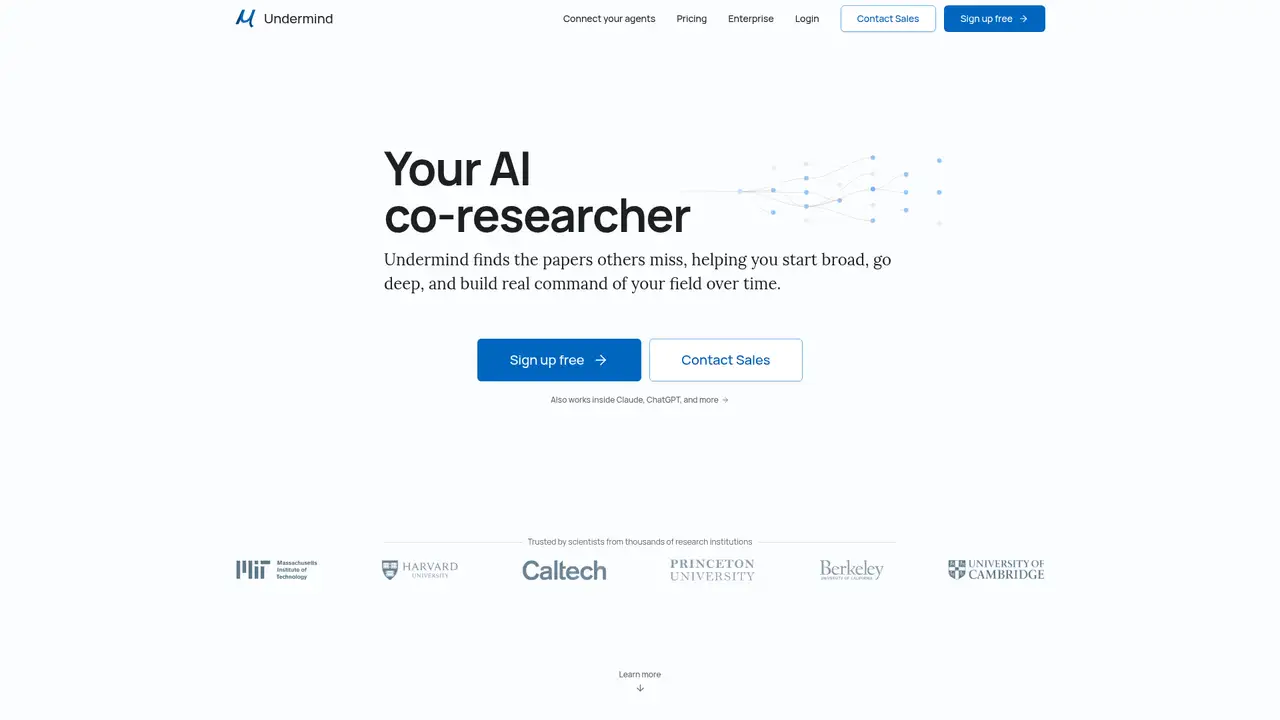
Undermind is an AI research agent for scientific literature, founded in 2023 by quantum physics PhDs Joshua Ramette and Tom Hartke. The company joined Y Combinator’s Summer 2024 batch and is based in San Francisco. Its target users include research scientists, doctors, and R&D teams facing narrow questions that keyword search can miss. Undermind says scientists from thousands of research institutions use the service, and its enterprise page identifies more than 1,000 GSK scientists as users. The founders describe the product as a search engine rebuilt around adaptive exploration, with large language models directing searches through scientific literature instead of matching terms alone. The company does not publish a funding total.
A typical search begins with a natural language research goal. Undermind asks follow-up questions, then reads and evaluates papers, follows citation trails, and continues exploring related authors and work. Users can iterate on reports, inspect full texts, extract details, generate custom tables, and trace statements through inline citations to source papers. Workspaces support shared research, paper libraries, and saved files. The service also offers alerts for new findings in selected areas. The company says a production deep search stops after about 2.9 minutes on average. That delay is deliberate: Undermind is designed for difficult discovery and evidence gathering, not for instant answers to routine questions.
Undermind describes its technology as an agent-like pipeline that uses high-quality language models to adaptively explore a literature database. Its web benchmark covers 23 complex queries and reports 85 percent recall for the 20 most relevant papers, compared with 43 to 50 percent for tested frontier search agents. The company used GPT-5.6 Sol as the benchmark judge and says the benchmark evaluates abstracts, so the result is a vendor claim rather than an independent guarantee. Current documented capabilities include the v2 search engine, full-text analysis, domain-specific knowledge models, alerts, MCP connections, and enterprise API access. The enterprise product can also combine internal and external documents in custom deployments. No separate 2026 model release is documented.
Undermind offers a $0 Free plan for exploratory research. It includes chat, deep searches, reports, shared workspaces, and connected agents, with standard rate limits. Pro adds the latest available models, the deepest full-text analysis, ten times higher usage limits, and unlimited workspaces, files, and paper libraries. Academic Pro costs $20 monthly or $16 monthly billed annually. Industry Pro costs $75 monthly or $60 monthly billed annually. Academic Team costs $18.70 per person monthly or $15 annually, with a three-person minimum. Industry Team costs $75 or $60 annually per person. Enterprise includes increased compute, organizational login, onboarding, administration, custom terms, and support at a custom price.
Undermind fits researchers who value broad discovery and citation trails over speed. Elicit is a stronger choice for structured extraction and paper comparison, Consensus is better for concise evidence summaries, and SciSpace is better suited to explaining individual PDFs. Undermind is also a poor fit for general web research or teams seeking a self-serve public API, because API access is presented as an enterprise feature. Individual terms restrict use of the site and functionality to personal, noncommercial use, although insights may be used in commercial or professional research. Enterprise terms address proprietary data, model training, provider retention, and deletion. Choose Undermind for complex scientific discovery, then verify important findings against the cited papers. Its pricing separates academic subscriptions from commercial research subscriptions.
Who is Undermind best for?
- Scientists investigating narrow questions with unfamiliar terminology.
- R&D teams assessing prior work before investing in projects.
- Grant writers needing citation-backed scientific overviews.
- Organizations adding literature research to agent workflows.
Undermind Pricing (2026)
Pricing model: Freemium. All prices in USD.
| Plan | Price | What you get |
|---|---|---|
| Free | $0 | Includes chat, deep searches, reports, shared workspaces, and connected agents with standard rate limits. |
| Pro Academic | $20/month or $16/month billed annually | Adds latest models, deepest full-text analysis, ten times higher usage limits, and unlimited workspaces, files, and paper libraries. |
| Pro Industry | $75/month or $60/month billed annually | Provides the Pro feature set at the Industry rate. |
| Team Academic | $18.70/person/month or $15/person/month billed annually | Adds member management, priority customer support, and centralized billing. Academic and Industry subscriptions have separate prices. |
| Team Industry | $75/person/month or $60/person/month billed annually | Provides Industry team pricing with member management, priority support, and centralized billing. |
| Enterprise | Custom | Adds increased compute, organizational login, onboarding, administration, custom terms, security review, service levels, and dedicated support. |
Pros and Cons
Pros
- Adaptive citation trails can uncover papers keyword searches miss.
- Reports connect claims to source papers through inline citations.
- Pro includes full-text analysis and ten times higher usage limits.
- Enterprise agreements address training and provider retention.
Cons
- Deep searches take minutes rather than seconds.
- Free searches provide standard access without the deepest full-text analysis.
- Industry pricing is substantially higher than Academic pricing.
Who should look elsewhere?
- Users seeking instant answers to straightforward questions.
- People conducting general web research outside scientific literature.
- Teams requiring a self-serve production API on an individual plan.
Technical Details
Frequently Asked Questions
How much does Undermind cost?
Undermind has a free plan. Academic Pro costs $20 monthly or $16 monthly billed annually. Industry Pro costs $75 monthly or $60 monthly billed annually. Academic Team costs $18.70 per person monthly or $15 annually with three seats required. Industry Team costs $75 or $60 annually per person. Enterprise pricing is custom.
Is Undermind free?
Yes. The Free plan includes chat, deep searches, reports, shared workspaces, and connected agents with standard rate limits. Paid Pro plans add the latest available models, deeper full-text analysis, ten times higher usage limits, and unlimited workspaces, files, and paper libraries. Free access is therefore useful for exploration, while sustained research may require a paid plan.
How does Undermind compare with Elicit?
Undermind emphasizes adaptive discovery for complex scientific questions, including citation trails and extended searches. Elicit is a better fit when the main task is structured extraction and comparison across papers. Choose Undermind when finding overlooked literature is the priority. Choose Elicit when organizing evidence into review fields is the more important step.
Does Undermind train on user data?
Undermind’s enterprise page says proprietary organizational data is not used to train AI models and that model providers do not retain or train on it. The individual terms grant a personal site license but do not provide the same enterprise data commitment. Teams handling sensitive research should review the applicable agreement, especially its training, retention, and deletion provisions.
Can Undermind be used commercially?
The terms allow insights and information from the site to support commercial or professional research, while restricting personal site access and prohibiting reselling or incorporating the service into another product. Industry plans serve commercial teams, and Enterprise adds custom terms and API access. Users should confirm licensing and permitted workflows before embedding outputs in a product or service.
Best Undermind Alternatives in 2026
These tools do the same job as Undermind, with different pricing, limits and trade-offs.
AI workflows for literature search, review, and research reports

Evidence-linked search and synthesis for academic literature

A research workspace for finding, reading, comparing, and writing scientific literature

AI-assisted search and discovery for scientific literature
Source-linked AI search with multi-model research and agent features