
Taskade Review, Pricing & Alternatives (2026)
Build AI apps, agents, and automations in one workspace.
Last updated: October 26, 2026
What is Taskade?
Taskade is a collaborative AI workspace for creators, agencies, and teams building small business apps without conventional development. It combines projects, agents, databases, integrations, and automations, with Genesis turning prompts into hosted apps. The Free plan costs $0 per month, while Pro costs $10 per month when billed annually.
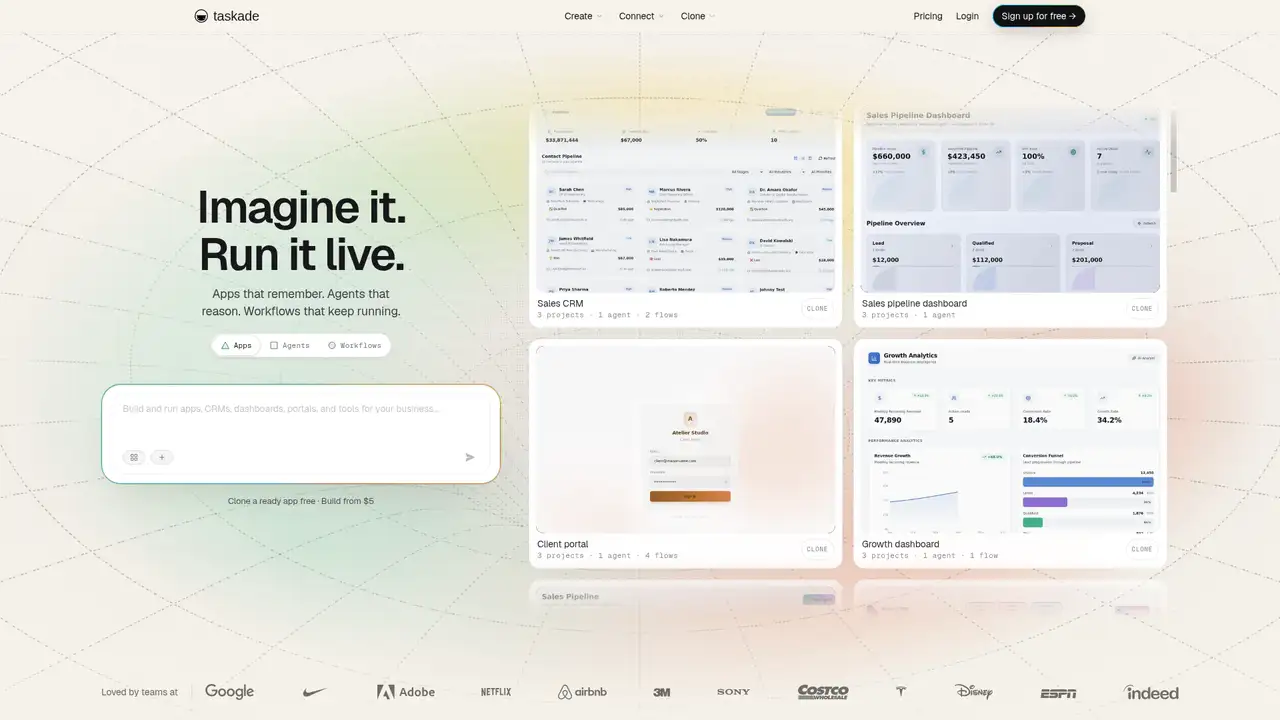
Taskade is an AI workspace operated by Taskcade Inc., a Delaware corporation headquartered in San Francisco. The company positions Taskade as a unified product for projects, databases, AI agents, automations, and Genesis apps. AI features began in December 2022, custom agents arrived in 2023, multi-agent teams in 2024, and Genesis launched in October 2025. In its 2025 review, Taskade reported more than 150,000 generated apps and 3 million automation executions during Genesis’s first 90 days. The current product model links workspace data, agent intelligence, and automated execution. It targets individual builders, agencies, and teams that want to create internal tools, client-facing experiences, and operational systems without assembling a separate development stack or maintaining deployment infrastructure.
A typical build can start from a plain-language prompt, project, database, or existing app. Users may provide files, URLs, Google Drive content, Dropbox content, or project data, then define an agent’s instructions, tools, model, and access. Automations can respond to schedules, forms, webhooks, or data changes, creating tasks, updating records, sending messages, and calling AI steps. Genesis uses the same workspace information to produce dashboards, client portals, CRMs, forms, websites, booking systems, and internal tools. Every published app includes hosting, a database, and client sign-in on every plan. Users can also publish agent pages, embed agents on websites, connect external services, and clone community-built app kits for faster starting points.
Genesis is Taskade’s most significant recent product change. The company describes Workspace DNA as three connected pillars: projects provide memory, agents provide intelligence, and automations provide execution. Genesis launched in October 2025, followed by custom domains, app analytics, mobile app building, a community gallery, and more than 100 integrations. A March 2026 help page lists at least 11 models, including Claude Opus 4.5, OpenAI o3 and GPT-5.2, Gemini 3 Pro, Claude Sonnet 4, o4-mini, and Gemini 2.5 Flash. Taskade also offers TSK-1 with selectable tiers and automatic routing. Pro and higher plans support selected bring-your-own-key configurations, allowing customers to connect certain OpenAI, Anthropic, Google, xAI, Groq, Mistral, or Together AI credentials.
Pricing combines plan limits, automation runs, and AI credits. Free costs $0 monthly and includes up to three hosted apps, two people, client sign-in, and 10 automation runs monthly. Published pages conflict about Free credits: pricing says zero credits initially, while help documentation lists 1,000. Pro costs $10 monthly annually or $20 monthly and includes 50,000 credits, 1,000 runs, unlimited agents, 10 people, and 100-plus integrations. Business costs $25 annually or $50 monthly, with 150,000 credits and 10,000 runs. Max costs $100 annually or $200 monthly, while Enterprise costs $250 annually or $500 monthly. Building apps, agent activity, and AI automation consume credits; published apps and non-AI automations do not.
Taskade combines more product functions than a focused agent builder, which may make administration, model selection, and credit forecasting harder. Its privacy policy says AI requests may be processed outside the United States, including China. Its security page says the company is not SOC 2 Type II certified yet, does not currently provide a signed Data Processing Agreement or Standard Contractual Clauses, and offers no HIPAA Business Associate Agreement. Compared with Notion AI, Taskade provides more explicit agents, automations, and hosted apps, while Notion remains more document-centered. Compared with Zapier Agents, Taskade combines workspace data and app hosting, while Zapier emphasizes connected automation. Compared with Dify, Taskade requires less infrastructure management but offers less deployment control. Choose Taskade if you want to generate and host small AI-powered business apps from one workspace.
Who is Taskade best for?
- Small teams building internal tools without maintaining a conventional software stack.
- Creators combining agents, databases, automations, and hosting.
- Agencies delivering branded client portals and lightweight business apps.
- Users who can manage variable AI credit consumption.
Taskade Pricing (2026)
Pricing model: Freemium. All prices in USD.
| Plan | Price | What you get |
|---|---|---|
| Free | $0/month | Up to 3 hosted apps, 2 people, client sign-in, and 10 automation runs monthly. The pricing page says Free starts with no AI credits. |
| Pro | $10/month billed annually, $20/month monthly | 50,000 AI credits monthly, 1,000 automation runs, unlimited agents, 10 people, and 100+ integrations. |
| Business | $25/month billed annually, $50/month monthly | 150,000 AI credits monthly, 10,000 automation runs, unlimited people, branding, and SAML single sign-on. |
| Max | $100/month billed annually | Eight times Pro AI credits, four times Business's AI request limit, and automatic top-up up to $1,000 at a time. |
| Enterprise | $250/month billed annually | Twenty-two times Pro AI credits, SCIM provisioning, dedicated onboarding, and volume terms from sales. |
Pros and Cons
Pros
- Genesis connects apps to projects, agents, and automations.
- Every plan includes app hosting, a database, and client sign-in.
- Paid plans support web, desktop, mobile, integrations, and custom domains.
- Taskade says providers cannot train on customer content.
Cons
- The pricing page says Free starts with zero AI credits.
- The broad product surface can complicate administration.
- Taskade is not certified for regulated data or HIPAA use.
Who should look elsewhere?
- Organizations requiring HIPAA-certified data handling.
- Teams seeking a narrowly focused agent runtime.
- Workloads needing fully predictable AI costs.
Technical Details
Frequently Asked Questions
How much does Taskade cost?
Taskade has a Free plan priced at $0 per month. Pro costs $10 per month when billed annually or $20 monthly. Business costs $25 annually or $50 monthly, Max costs $100 annually, and Enterprise costs $250 annually. AI work consumes credits, and paid plans can buy additional credit packs. Annual billing saves 50% compared with monthly billing on the listed paid plans.
Is Taskade free?
Yes. The Free plan includes up to three hosted apps, two people, client sign-in, and 10 automation runs per month. Taskade's pricing page says Free starts with no AI credits, while a March 2026 help page lists 1,000 credits, so users should check the account's current allowance. Published apps and non-AI automations do not consume AI credits.
Taskade versus Notion AI, which should I choose?
Taskade is aimed at custom agents, automation triggers, integrations, and hosted Genesis apps that can act as dashboards, portals, CRMs, or internal tools. Notion AI is centered on documents, wikis, and databases. Taskade offers a broader automation and app-building surface, while Notion is the more focused choice for document-based team knowledge.
Does Taskade train AI models on user data?
Taskade says it does not use workspace content to train generalized AI models and says its AI-provider agreements prohibit training on customer content. Taskade processes prompts, workspace content, and outputs to provide requested AI features. The selected model determines the provider, and some requests may be processed outside the United States, including in China.
Can I use Taskade commercially?
Taskade's terms say users own AI outputs as between the user and Taskade, subject to third-party rights and applicable law. The terms also say users are responsible for reviewing outputs, obtaining required permissions, and complying with obligations for published apps. Paid plans support commercial teams, custom domains, branding, and hosted apps, but published-app owners remain responsible for end-user data.
Best Taskade Alternatives in 2026
These tools do the same job as Taskade, with different pricing, limits and trade-offs.
AI assistance for pages, search, meetings, and recurring work

Visual infrastructure for production AI applications

Build business agents, tools, and coordinated AI workforces

Open-source framework for building model-powered agents

Connect AI to 9,000+ apps with governed workflows