
Zapier AI Review, Pricing & Alternatives (2026)
Connect AI to 9,000+ apps with governed workflows
Last updated: October 22, 2026
What is Zapier AI?
Zapier AI adds model-powered steps, agentic tool use, and governance to Zapier automation. It suits teams that need AI to act across business software. Free is available, and Professional starts at $19.99 per month.
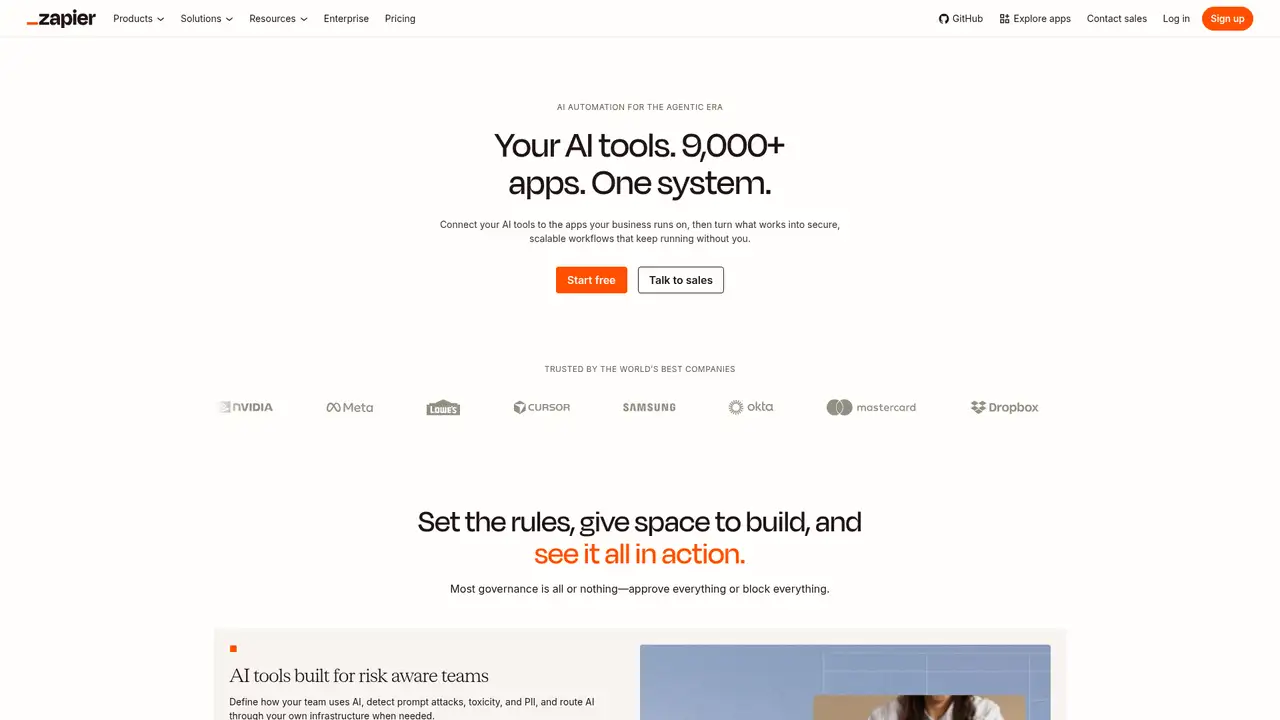
Zapier AI is the artificial intelligence layer within Zapier’s automation platform, from the workflow company founded in 2011. Zapier advertises more than 9,000 apps and 66,000 triggers and actions. The offering includes AI by Zapier steps, embedded agents, chatbots, and MCP connections for assistants such as Claude, ChatGPT, Cursor, and Gemini. Governance features include model policies, PII checks, prompt injection checks, toxicity checks, audit logs, SSO, SCIM, and model opt-out on Enterprise. Zapier also reports more than 593 million AI tasks automated, though it does not publish a separate AI user count. Its practical role is connecting model decisions with app credentials, approvals, retries, records, and repeatable business workflows. AI by Zapier supports OpenAI, Anthropic, Google Gemini, Azure OpenAI, and Amazon Bedrock through built-in connections or customer accounts.
A typical workflow starts with a trigger in a Zap, followed by an AI by Zapier step containing instructions, mapped inputs, and optional structured output fields. The step can summarize, classify, extract, write, or analyze information. Standard handles simple prompts without tools, while Advanced and Premium can use connected app actions and knowledge sources. Returned fields can flow into Gmail, Salesforce, Slack, or another connected application. Users can select Zapier models or connect accounts from OpenAI, Anthropic, Google Gemini, Azure OpenAI, or Amazon Bedrock. Administrators can restrict available models, tools, and agentic behavior, while per-tool approvals can pause sensitive actions before execution. AI by Zapier offers templates for summarizing, writing, classifying, and extracting information when configuring prompts.
Zapier does not present one proprietary foundation model as its sole engine. AI by Zapier offers model tiers and selectable models from several providers. The current documentation lists Claude 4.5 Haiku as the default Auto model for Advanced and Claude 4.6 Sonnet as the default Auto model for Premium. Standard uses one task per run, Advanced uses three, and Premium uses five. Bring Your Own Key uses a one-task rate, including tool calls. Zapier MCP separately lets compatible assistants call selected actions across connected applications. Authentication, permissions, action records, and administrative controls remain managed through Zapier, while migrated Agents now run as AI by Zapier steps inside the Zap editor. AI by Zapier supports OpenAI, Anthropic, Google Gemini, Azure OpenAI, and Amazon Bedrock provider accounts.
Zapier prices AI through the wider shared task allocation rather than a separate universal AI subscription. Free includes 100 tasks monthly and permits previews on unpublished Zaps using Standard. Professional starts at $19.99 monthly, Team starts at $69 monthly, and Enterprise is custom. AI usage follows the selected tier and successful tool calls, with Standard using one task, Advanced three, and Premium five per applicable operation. A step has a default 75-task run limit that can rise to 500, with approval requested if the limit is reached. Pay-per-task billing can keep workflows running after an allocation is reached, or workflows can pause when overages are disabled. The pricing page lists 100, 2,000, 10,000, 100,000, and 2 million task quantities for available plan tiers.
Zapier AI’s main tradeoff is usage complexity because ordinary actions, model multipliers, tool calls, and account limits draw from shared capacity. Outputs can vary, so sensitive writes may need approvals or human review. Make, n8n, and Microsoft Copilot Studio are direct competitors for workflow automation with AI capabilities. Zapier emphasizes a broad app catalog, managed authentication, retries, rate limits, auditability, and business-user simplicity, while technical teams may prefer more granular control or self-hosting elsewhere. ChatGPT and Claude are direct model-native alternatives for conversation-first work, but Zapier adds connected credentials and operational actions. Choose Zapier for governed SaaS automation; choose Make, n8n, or Copilot Studio when their control model fits better. It is best for teams that want hosted, auditable AI workflows across business apps.
Who is Zapier AI best for?
- Operations teams connecting AI to CRM and support apps.
- Companies needing approvals and audit records.
- Business users preferring hosted connectors.
- Existing Zapier customers adding AI to Zaps.
Zapier AI Pricing (2026)
Pricing model: Freemium. All prices in USD.
| Plan | Price | What you get |
|---|---|---|
| Free | $0/month | 100 tasks/month; Standard AI preview on unpublished Zaps. |
| Professional | Starting at $19.99/month | 750 tasks/month entry tier; multi-step Zaps and paid AI tiers. |
| Team | Starting at $69/month | 2,000 tasks/month entry tier; shared workspaces and unlimited users. |
| Enterprise | Custom | Custom volume plus SSO, SCIM, governance, and observability. |
Pros and Cons
Pros
- It advertises more than 9,000 app integrations.
- Model tiers and keys provide provider choice.
- Tool calls and task use appear in Zap history.
- Enterprise controls include SSO and model opt-out.
Cons
- Advanced and Premium calls multiply task use.
- Free users cannot publish higher AI tiers.
- Shared billing makes agent costs harder to forecast.
Who should look elsewhere?
- Developers seeking a self-hosted runtime.
- Teams needing a flat fee for heavy tool use.
- Workflows that cannot send data to model providers.
Technical Details
Frequently Asked Questions
How much does Zapier AI cost?
There is no separate universal AI subscription. Free has 100 tasks monthly, Professional starts at $19.99, Team at $69, and Enterprise is custom. Advanced uses three tasks per run and Premium five, with successful tool calls adding the selected multiplier.
Can I use it for free?
Yes. Free includes 100 tasks monthly and AI preview on unpublished Zaps using Standard. Advanced and Premium cannot be published on Free. New accounts also receive a 14-day Professional trial without a credit card.
How does it compare with Make?
Zapier emphasizes a large catalog, managed authentication, retries, and business-user simplicity. Make offers more granular scenario routing and transformation controls. Zapier is easier for common SaaS workflows, while Make can suit technical users designing detailed scenarios.
Does Zapier train on my data?
Zapier says Enterprise customers can use automatic AI model opt-out and describes PII and prompt controls. Check applicable data terms and each model provider's policy because retention and training treatment can differ by connection and plan.
Can I use it commercially?
Yes, paid plans support business automation, subject to connected-app terms, model-provider terms, and data rights. Review generated material before distribution and confirm that customer permissions and licensing cover the workflow.
Best Zapier AI Alternatives in 2026
These tools do the same job as Zapier AI, with different pricing, limits and trade-offs.