
Spellbook Review, Pricing & Alternatives (2026)
Contract AI for drafting, review, redlining, and negotiation
Last updated: October 22, 2026
What is Spellbook?
Spellbook is a contract AI suite for transactional lawyers, law firms, and in-house legal teams. It supports drafting, review, redlining, playbooks, and document repositories through Microsoft Word and connected tools. Pricing is custom and based on licensed team members, with a seven-day free trial. Spellbook does not publish a dollar entry price.
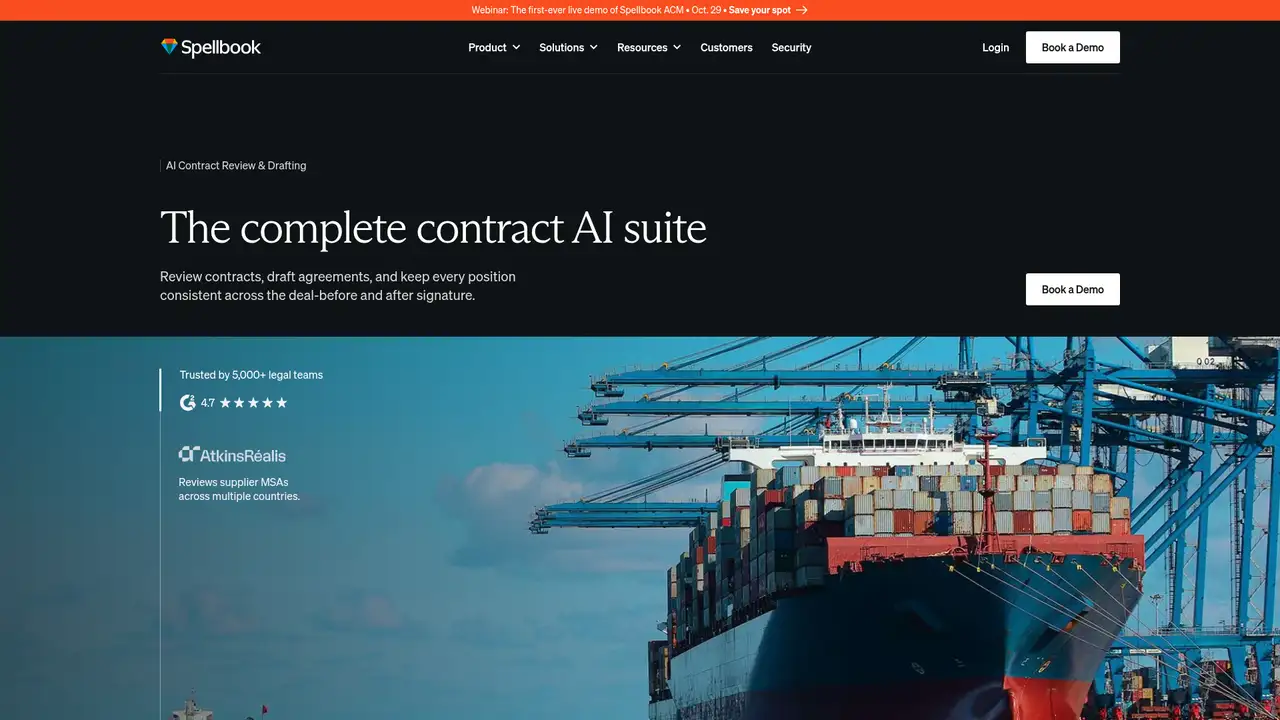
Spellbook is a contract AI suite made by Dialog Enterprises Inc., a Canada-based company that operates under the Spellbook name. The company says its first generative contract review tool launched in 2022, and its current website says more than 5,000 legal teams use the product. Its October 2025 funding announcement reported 4,000 law firms and in-house legal teams in 80 countries, while the current site reports more than 5,000 teams. The company’s product focus is transactional work: drafting agreements, reviewing terms, applying redlines, and keeping positions consistent across a deal. Spellbook is therefore aimed at commercial legal teams rather than users seeking a general legal chatbot or a dedicated case-law research database.
A normal Spellbook workflow starts with a contract or intake request and keeps the lawyer in the review loop. The product can pull contracts from email and Slack, run a first-pass review against team standards, draft clauses or full agreements, and produce tracked redlines in Word. Review, Draft, Ask, Benchmarks, and Playbooks cover the Word add-in workflow. Playbooks turn recurring instructions into reusable review checklists, while Library and Repository features make precedents and signed agreements searchable. Associate is a multi-document agent for transactional matters that works under attorney oversight. Spellbook also lists integrations with Google Docs, OneDrive, Dropbox, SharePoint, Google Drive, and iManage. The lawyer remains responsible for checking suggested language and deciding which changes to accept.
Spellbook says it combines contract-focused AI with multiple large language models, including models from OpenAI and Anthropic. The company does not identify a single underlying model for the whole product. Its 2025 Series B announcement highlighted Market Comparison in beta, Preference Learning, historical-document features through Library, and continued development of Associate for multi-document transactional work. The current product page presents Repository as a place to store, search, and monitor signed contracts for renewals and new risks. Spellbook says it has zero data retention agreements with OpenAI and Anthropic, meaning customer requests and responses are held only in memory for processing by those providers. Its security page lists SOC 2 Type II, HIPAA, GDPR, and EU AI Act compliance claims.
Spellbook uses custom pricing based on the number of team members on a license. The company offers a seven-day free trial, with extended trials potentially available for larger organizations. Its suite includes the Word add-in with Review, Draft, Ask, Benchmarks, and Playbooks, plus Associate, but the pricing page does not publish separate prices or feature-level usage quotas. Academic institutions can receive free access through partnerships. The pricing page also lists training, online support, dedicated support for teams over 10, and a Playbook Build Service for relevant team packages. Buyers should request a quote and confirm which features, support services, integrations, and data terms are included. There is no public dollar entry price for individual users or teams.
Spellbook’s contract focus is useful for lawyers who work in Word and apply repeatable review standards, but it limits the product’s role. Harvey overlaps on AI-assisted legal drafting and analysis, while Ironclad overlaps more closely on contract operations, repository management, and lifecycle workflows. LawGeex is another contract-review alternative. Spellbook publishes no dollar price, requires attorney oversight, and does not present itself as a substitute for legal judgment. Its public pages also do not establish a self-hosted deployment or a public developer API. Choose Spellbook if your team drafts and negotiates commercial contracts and wants Word-based review with reusable playbooks. Choose a broader legal research or contract-lifecycle product when those functions matter more than Word-native review.
Who is Spellbook best for?
- Transactional lawyers who draft and redline commercial contracts in Microsoft Word.
- In-house teams that need reusable review instructions and contract playbooks.
- Law firms handling recurring agreements across multiple matters.
- Teams willing to request custom pricing from a vendor.
Spellbook Pricing (2026)
Pricing model: Paid. All prices in USD.
| Plan | Price | What you get |
|---|---|---|
| Spellbook Suite | Custom | Pricing is based on licensed team members. The package includes the Word add-in and Associate, with Review, Draft, Ask, Benchmarks, and Playbooks. |
| Free trial | $0 for 7 days | Lawyers and legal teams can test the product for seven days. Extended trials may be available for larger organizations. |
| Academic access | Custom | Academic institutions may receive free access through partnerships. Eligibility requires an inquiry. |
Pros and Cons
Pros
- It drafts, reviews, and redlines contracts in Microsoft Word.
- Playbooks turn recurring review instructions into reusable checklists.
- Associate supports supervised work across multiple legal documents.
- The company says OpenAI and Anthropic retain customer requests for zero time.
Cons
- Spellbook does not publish a dollar entry price.
- The product is focused on contracts rather than case-law research.
- Generated suggestions still require attorney review and approval.
Who should look elsewhere?
- Litigators seeking a dedicated case-law research product.
- Buyers requiring transparent per-user pricing before contacting sales.
- Users seeking unsupervised legal advice or final contract decisions.
Technical Details
Frequently Asked Questions
How much does Spellbook cost?
Spellbook does not publish a dollar price. Its pricing page says licenses are custom and based on the number of team members. A seven-day free trial is available, and larger organizations may receive extended trials. Buyers must contact Spellbook for a quote, so the final cost depends on team size and the negotiated package.
Does Spellbook have a free plan?
Spellbook offers a seven-day free trial rather than a permanently free plan. Academic institutions may receive free access through partnerships. The public pricing page does not describe a separate free usage allowance, permanent free tier, or feature quota for individual users.
Spellbook or Harvey: which is better?
Spellbook is focused on contract drafting, review, redlining, playbooks, and transactional document work. Harvey is a competing legal AI product with broader legal work positioning. Choose Spellbook when Word-based contract review is the main requirement. Compare Harvey when the team needs a wider set of legal analysis and drafting workflows.
Does Spellbook train on customer documents?
Spellbook says its agreements with OpenAI and Anthropic provide zero data retention, so those providers do not store customer requests or responses for training. Spellbook’s privacy policy says customer document processing is governed by customer agreements. Organizations should review their subscription, security, and subprocessor terms before uploading confidential documents.
Can companies use Spellbook commercially?
Yes. Spellbook is sold to law firms and in-house legal teams for commercial contract work. Its listed functions include drafting, review, redlining, benchmarks, playbooks, and multi-document transactional assistance. Commercial users should confirm subscription terms, confidentiality obligations, and output responsibilities. The product supports legal work but does not replace attorney review.
Best Spellbook Alternatives in 2026
These tools do the same job as Spellbook, with different pricing, limits and trade-offs.