
Kira Review, Pricing & Alternatives (2026)
Contract intelligence for high-volume legal due diligence
Last updated: October 22, 2026
What is Kira?
Kira is Litera's AI contract intelligence product for law firms and legal teams reviewing large contract collections. It extracts provisions, answers questions, and supports collaborative diligence workflows across M&A, real estate, banking, and finance. Litera does not publish a Kira list price or self-serve tier, so buyers must request a custom quote based on their order terms.
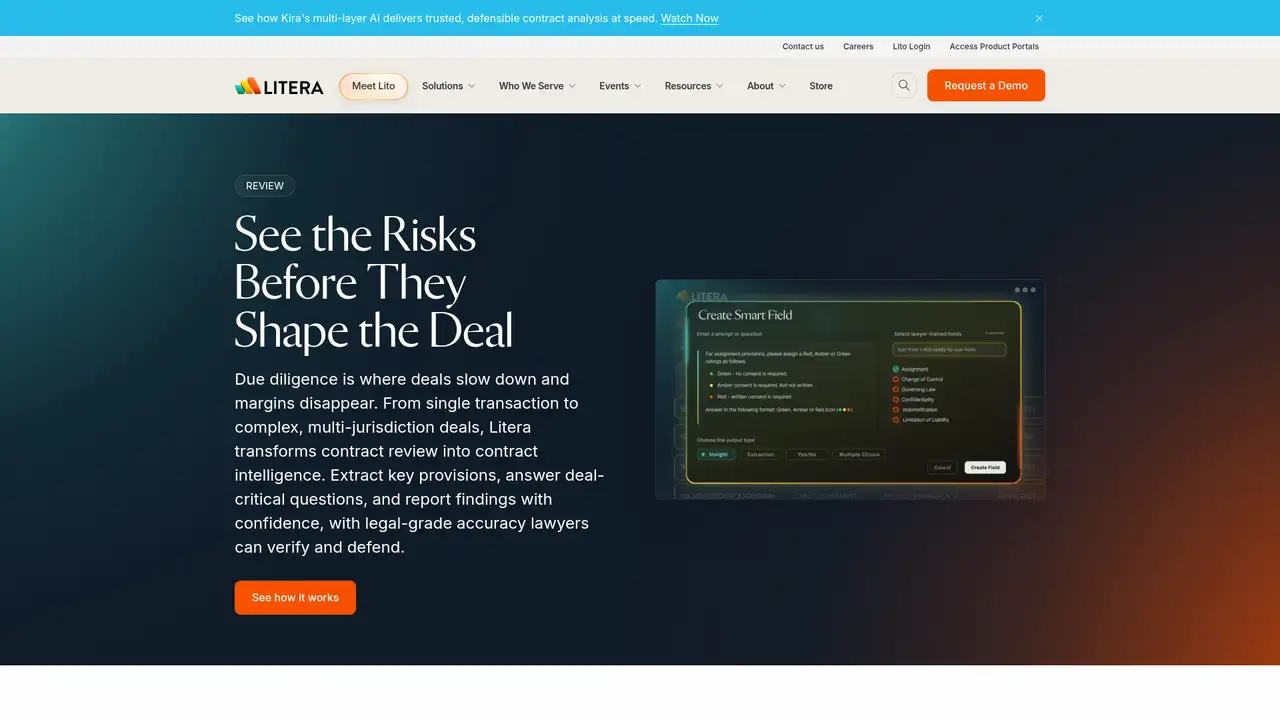
Kira is Litera's contract intelligence product for high-volume legal review and due diligence. Kira Systems was founded in Toronto in 2011, and Litera agreed to acquire it in August 2021 for an undisclosed sum. The transaction made Kira part of Litera's Transaction Management platform, while Kira's corporate-market technology became Zuva. Kira's current product supports law firms and legal teams working across M&A, real estate, banking, finance, tax, and IP matters. Litera's review page lists more than 1,400 lawyer-trained extraction fields, and its 2026 product announcement says the underlying proprietary models were trained on more than 1 million legal contracts. Litera presents Kira as a specialist product for high-stakes contract analysis, not a general-purpose legal chatbot.
A Kira workflow starts with a project and a contract set. The system extracts provisions, answers deal-specific questions, and links answers back to source contracts so reviewers can check the result in context. Teams work in collaborative review grids, compare clauses, flag risks, and export findings into reports. Users can query a contract set in natural language or create custom fields for questions specific to a deal. Litera lists pre-built fields for common review work and supports customer-trained fields through its training module. Kira covers M&A, real estate, banking, and finance reviews, while the broader Litera workflow connects Kira with Lito. Litera says Lito can produce a plain-language diligence report from Kira extraction data and is included in Kira subscriptions.
Kira uses a hybrid approach that combines generative AI with proprietary predictive models. Litera's January 2026 announcement says those models were trained on more than 1 million legal contracts and describes 90%+ accuracy as a product claim. The same announcement introduced enhanced Kira capabilities and identified planned additions for 2026, including Grid Chat, Generative Smart Fields, and new workflows for rapid and large-scale collaborative reviews. Litera also says teams can enable or disable generative AI at the project level while retaining extraction capabilities. The current review page lists 1,400+ pre-built smart fields and describes cited answers grounded in source documents. Litera does not identify a named foundation model for Kira in the cited product material, so the useful distinction is its hybrid architecture rather than an unsupported model label.
Litera does not publish a public Kira price, free tier, trial price, or per-user rate. Its Kira SaaS terms define an annual period, a purchased document tier, and a document storage limit in the order form. Exceeding the document tier can trigger flexible usage fees, while exceeding the storage limit can trigger storage fees. The terms also allow limits on uploaded documents, stored documents, users, and features. Standard shared cloud access is targeted within three business days of the subscription start date, while private cloud deployment has a target of two weeks. Litera offers standard shared cloud and private cloud deployment, with hosting jurisdiction selected by the customer. Lito is included for Kira customers at no additional charge, according to Litera's current review page.
Kira is a focused contract review system, and that focus limits its role. Compared with Clio Manage AI, Kira overlaps on legal work automation but is aimed at structured contract extraction rather than practice management. Compared with Spellbook, Kira is aimed at large diligence projects and review grids, while Spellbook overlaps in contract review and drafting. Compared with Harvey, Kira has a narrower contract intelligence job, with source-linked extraction and custom provision fields. The main buying constraints are custom pricing, document and storage terms, implementation, and Litera ownership. Kira fits law firms and legal teams that review enough contracts to justify repeatable provision-level analysis, collaborative grids, governance controls, and a formal procurement process.
Who is Kira best for?
- M&A teams reviewing large contract collections.
- Law firms running repeatable provision-level diligence.
- Real estate, banking, and finance transaction teams.
- Teams needing custom fields for deal-specific questions.
Kira Pricing (2026)
Pricing model: Paid. All prices in USD.
| Plan | Price | What you get |
|---|---|---|
| Kira SaaS | Custom | The order form can set document counts, storage, users, features, deployment, and support. Flexible usage and storage fees may apply when purchased limits are exceeded. |
| Private cloud deployment | Custom | Private cloud is an order-form option with a target deployment date of two weeks after the subscription start date. |
Pros and Cons
Pros
- Litera lists more than 1,400 pre-built smart fields.
- Review grids support collaborative transaction analysis.
- Custom fields address deal-specific extraction questions.
- Lito is included for Kira customers at no additional charge.
Cons
- Litera publishes no public Kira price.
- Document and storage overages can increase annual cost.
- Private cloud deployment has a target of two weeks.
Who should look elsewhere?
- Small matters requiring occasional document summaries.
- Firms wanting public self-serve pricing or instant signup.
- Teams seeking full practice management or legal research.
Technical Details
Frequently Asked Questions
How much does Kira cost?
Litera does not publish a Kira price. The product is sold through an order form that can specify document tiers, storage limits, users, features, deployment, and support. Flexible usage fees may apply when document usage exceeds the purchased tier, and storage fees may apply when stored documents exceed the stated limit. Buyers must request a quote.
Does Kira offer a free plan or trial?
Litera's current Kira materials do not list a free plan, public self-serve trial, or checkout price. Kira is sold through a custom commercial process. Buyers considering a proof of concept should ask Litera to define the included documents, fields, users, deployment, support, and report outputs in writing.
How does Kira compare with Clio Manage AI?
Kira and Clio Manage AI overlap in legal-work automation, but their primary jobs differ. Kira extracts provisions and answers questions across contract sets for diligence. Clio Manage AI is associated with practice-management work. A transaction team focused on source-linked contract analysis should evaluate Kira, while a firm seeking matter-management automation should compare Clio.
Does Kira train on customer contracts?
Litera's Kira SaaS terms define customer data, documents, and customer provisions created through the product's training module. They state that customers have exclusive rights to use customer provisions during the subscription term and that those provisions are deleted after termination unless otherwise agreed. Buyers should review the order form and applicable data-protection terms for their deployment.
Can Kira be used commercially?
Yes. Litera's Kira SaaS terms grant a limited subscription license for the customer's internal business purposes and for providing services to clients. Kira is positioned for law firms and legal teams handling commercial contract review, due diligence, knowledge management, real estate, regulatory compliance, banking, finance, tax, and IP matters, subject to the order form and agreement restrictions.
Best Kira Alternatives in 2026
These tools do the same job as Kira, with different pricing, limits and trade-offs.