
Ironclad Review, Pricing & Alternatives (2026)
Contract lifecycle software for legal and business teams
Last updated: October 22, 2026
What is Ironclad?
Ironclad is a cloud contract lifecycle management platform for corporate legal, procurement, sales, finance, HR, and other teams that create, negotiate, sign, and manage agreements. Founded in 2014, it sells through tailored quotes shaped by products, users, workflows, and growth. Ironclad does not publish a free plan or dollar entry price.
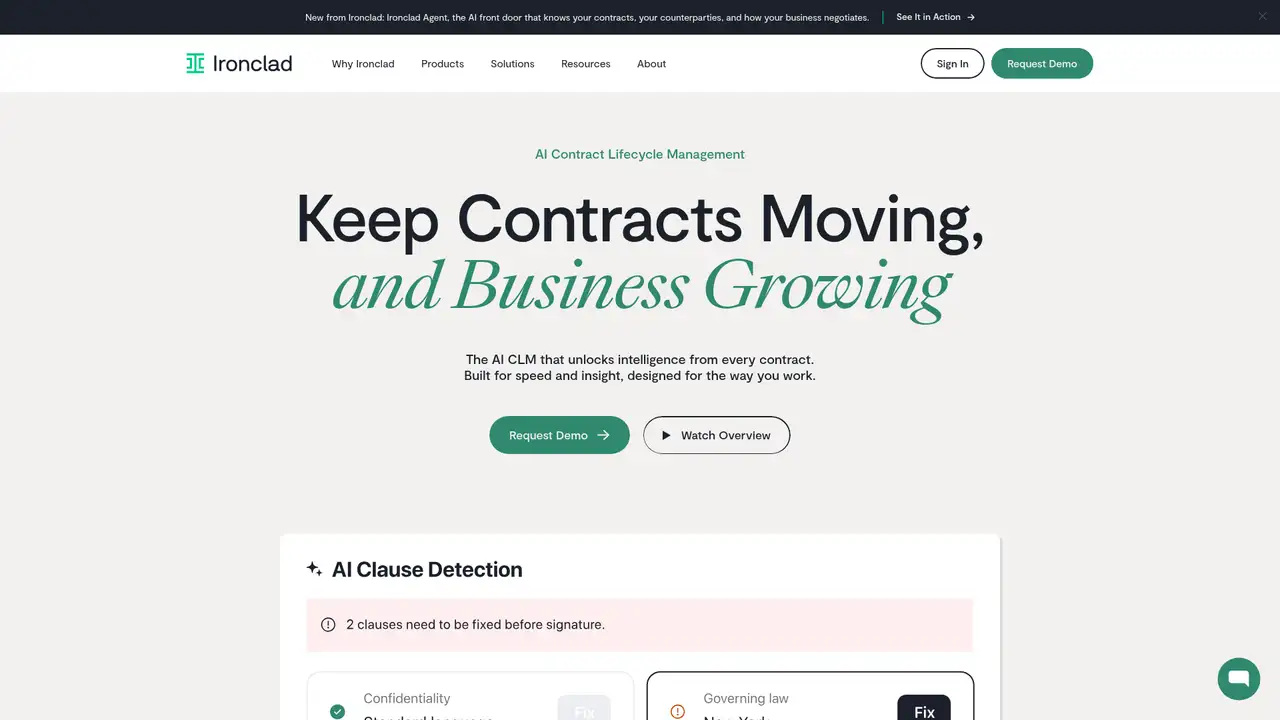
Ironclad is a contract lifecycle management platform made by Ironclad, Inc., founded in 2014 by attorney Jason Boehmig and engineer Cai Wangwilt. It launched from Y Combinator, opened its first San Francisco office in 2015, and released its contract management platform in 2017. Ironclad announced $150 million in Series E funding in January 2022, bringing reported total investment to $333 million and valuation to $3.2 billion. The company says Dan Springer became CEO in 2025 and that its platform passed two billion contracts processed that year. Its published customer examples include L’Oréal, Mastercard, the Texas Rangers, Salesforce, and Asana. The product targets organizations that need governed contracting across legal and business teams, rather than individuals seeking a document template service.
A typical Ironclad workflow begins in Workflow Designer, where teams configure forms, conditional logic, templates, and approvals without code. Business users submit contract requests, legal teams review and negotiate documents in the browser, and participants can work with DOCX files through Ironclad’s editor and Microsoft Word integration. The completed agreement can move through Ironclad Signature or a connected signing service before landing in the Repository. Smart Import uploads and indexes legacy contracts, while AI Assist, AI Playbooks, Smart Detect, and Jurist support extraction, review, drafting, and redlining. Integrations include Salesforce, Coupa, Box, HelloSign, and Microsoft Word, and the company also offers an API. Deployment still requires workflow design, permissions, and administration.
Ironclad AI supports contract generation, extraction, review, search, and analytics across the platform. Ironclad says AI features use permission controls so users receive only data they can access, and says contracts with subprocessors prohibit those providers from training their own models on customer data. The company describes zero-data-retention agreements for AI subprocessors, anonymization for selected sensitive data, and customer-managed encryption keys. Product updates in 2025 added AI Suggestions for existing Repository records, a global clause library, custom AI properties, entities, obligations, Microsoft Word support, guided Jurist prompts, precedent-based full-document redlining, and audit-log reporting. The company’s 2024 history also identifies native eSignature and Jurist, an assistant for drafting, editing, summarizing, translating, and explaining contracts.
Ironclad uses quote-based pricing. Its pricing page says the quote depends on products, users, workflows, and growth, with contract lifecycle management, AI Assistant, and eSignature offered as selectable solutions. The company does not publish a dollar entry price, free tier, public seat allowance, or public contract-volume allowance. Academy, community access, and in-app guides are included with paid solutions. API access, integrations, additional instances, and enhanced success services may be add-ons. The pricing page says security is included, while the product updates page identifies higher-entitlement options such as Security and Data Pro audit-log features and customer-managed keys. Buyers should request a quote that separates seats, implementation, signing, integrations, AI features, storage, and usage assumptions.
Ironclad’s main drawbacks are a sales-led purchase, implementation work, and pricing that makes small-team comparison difficult. Its AI safeguards and audit features support controlled enterprise deployments, but the company’s own AI policy describes user oversight for suggested changes, so legal review remains necessary. Agiloft and Sirion overlap on contract lifecycle management, while LinkSquares overlaps on legal contract management, repository, and analytics. DocuSign CLM overlaps on contract workflow and is relevant to organizations already using DocuSign services. Ironclad is the strongest fit for a larger legal department that wants configurable intake, negotiation, signature, and post-signature data in one governed system. It is a poor fit for buyers seeking instant self-service pricing.
Who is Ironclad best for?
- Corporate legal teams standardizing complex contract intake and approvals.
- Organizations that need searchable contract metadata after signature.
- Sales and procurement teams working inside governed legal workflows.
- Enterprises willing to fund implementation and administrator ownership.
Ironclad Pricing (2026)
Pricing model: Paid. All prices in USD.
| Plan | Price | What you get |
|---|---|---|
| Contract Lifecycle Management | Custom | Pricing depends on products, users, workflows, and growth. Ironclad publishes no public seat or contract-volume limit. |
| AI Assistant | Custom | Ironclad offers AI Assistant as a quoted solution. Ironclad does not publish a general allowance or feature limit. |
| eSignature | Custom | Ironclad offers eSignature as a quoted solution. Connected integrations and additional services may be add-ons. |
Pros and Cons
Pros
- Workflow Designer supports conditional approvals and varied contract types.
- Repository combines search, metadata, OCR, and AI extraction.
- DOCX editing and Microsoft Word support fit established processes.
- Security features include encryption and customer-managed key options.
Cons
- Ironclad publishes no public dollar entry price or free tier.
- Implementation requires workflow, permission, and administrator work.
- Some integrations, instances, and enhanced services may cost extra.
Who should look elsewhere?
- Individuals wanting a self-serve contract template service.
- Small teams that require a published monthly price.
- Organizations unwilling to configure workflows and permissions.
Technical Details
Frequently Asked Questions
How much does Ironclad cost?
Ironclad does not publish a dollar price. Its pricing page says quotes are shaped by products, users, workflows, and growth. Contract lifecycle management, AI Assistant, and eSignature are selectable solutions, while integrations, API access, additional instances, and enhanced services may add cost. Ask for a quote that separates seats, implementation, signatures, and AI entitlements.
Does Ironclad have a free plan?
Ironclad does not advertise a free product tier or self-serve trial. Paid solutions include access to its academy, community, and in-app guides. A prospective customer must contact Ironclad for a tailored quote and should confirm which users, workflows, integrations, environments, and support services are included.
Ironclad or DocuSign CLM: which is better?
Ironclad fits buyers prioritizing configurable intake, DOCX collaboration, AI extraction, and repository analytics. DocuSign CLM overlaps on contract workflow and is relevant to organizations already using DocuSign services. Both require a tailored purchase. Compare workflow fit, integration scope, implementation support, signing requirements, and the negotiated quote.
Does Ironclad train AI models on customer contracts?
Ironclad says its contracts with subprocessors prohibit them from using customer data to train their own models. It also describes zero-data-retention agreements for AI subprocessors, scoped user authentication, anonymization for selected sensitive data, encryption, and customer-managed key options. Customers should review the agreement and security documentation for their selected features.
Can companies use Ironclad commercially?
Yes. Ironclad is commercial business software for corporate contracting, with published customer examples including L’Oréal, Mastercard, and the Texas Rangers. Commercial use is governed by the customer’s subscription and contract, not an open-source license. Signing, API, integration, AI, user, and service rights should be confirmed in the order form.