
Smallest.ai Review, Pricing & Alternatives (2026)
Speech APIs and hosted agents for real-time voice conversations
Last updated: October 26, 2026
What is Smallest.ai?
Smallest.ai is a voice AI platform for developers and contact-center teams, offering text to speech, speech to text, speech to speech, an LLM, and hosted agents. Model APIs use metered pricing, with Lightning v3.1 at $0.175 per 10,000 characters and Pulse batch transcription at $0.003 per minute. Voice Agents starts with $10 in free credits.
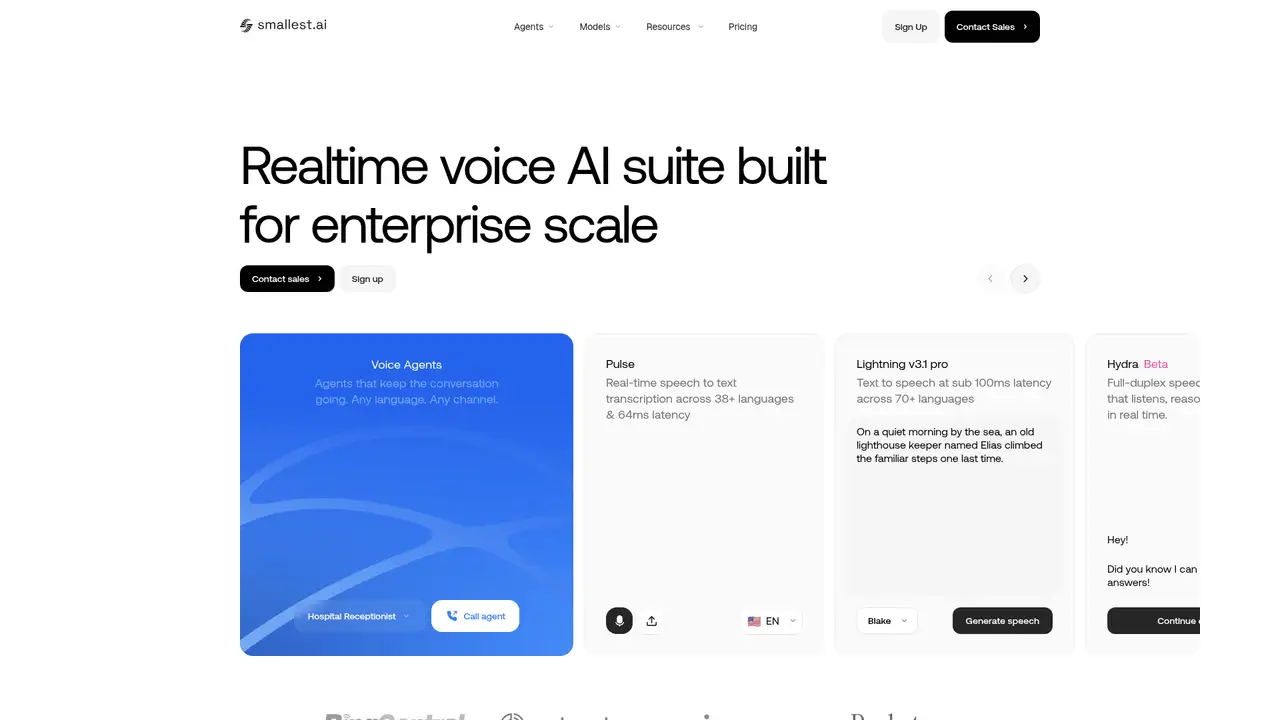
Smallest.ai is a voice AI company founded in late 2024. It develops Lightning text to speech, Pulse speech to text, Hydra speech to speech, Electron LLM, and a hosted voice-agent platform. TechCrunch reports that the company raised $13 million in Series A funding in July 2026, bringing total funding above $21 million. The round was led by Seligman Ventures, with Sierra Ventures and 3one4 Capital participating. The company announced its Series A on October 5, 2026. Smallest.ai positions the platform for real-time enterprise conversations and customer support. Its product scope makes it a developer and business infrastructure vendor rather than a consumer audio editor or general-purpose chat application. This funding supports work on real-time speech-to-speech technology and enterprise voice conversations.
Smallest.ai exposes its capabilities as separate APIs and hosted agents. A typical API workflow sends text to Lightning for streamed speech or audio to Pulse for transcription. The model overview also lists Hydra for speech to speech and Electron as an LLM. Hosted agents combine these components with web widgets, knowledge bases, testing, post-call analytics, phone numbers, and call pricing. Pulse supports streaming and non-streaming audio, while its API accepts WAV, MP3, FLAC, Opus, μ-law, A-law, and raw PCM. Pulse also offers PII and PCI redaction through request parameters, with original audio not retained after processing. These options let teams choose individual services or assemble a workflow around hosted agent operations.
Lightning v3.1 is the current TTS model described in the documentation. It produces 44,100 Hz audio, accepts 20 language codes plus automatic routing, and uses a proprietary license. The model documentation describes voice cloning and streaming, but does not state a current voice count or cloning duration. Pulse is the current multilingual STT model, with realtime pricing of $0.004 per minute and batch pricing of $0.003 per minute on its Standard Plan. It supports 100 concurrent streaming requests and 25 batch requests per minute on that plan. Pulse 2.0 is described as English-only streaming with turn detection, emotion, and gender. Lightning v2 and lightning-large are deprecated. Native scripts improve Lightning results, while Pulse redaction supports English and Hindi.
Model APIs are metered. Lightning v3.1 costs $0.175 per 10,000 characters on the model pricing page. Pulse costs $0.003 per minute for batch transcription and $0.004 per minute for realtime transcription on the Standard Plan. Voice Agents Pay As You Go starts with $10 in free credits, provides unlimited agents, and charges $0.09 to $0.21 per call minute depending on selected models. Smallest hosting adds $0.01 per minute. The plan has no monthly commitment. Enterprise pricing is custom, with calls listed as low as $0.05 per minute. A phone number costs $10 per month on Pay As You Go, while knowledge-base storage costs $3 per gigabyte per user and queries cost $2 per 1,000. These separate charges require usage estimates before budgeting.
The platform’s main limitation is that its documentation centers on APIs and hosted voice infrastructure rather than a creator-focused editing application. Pulse redaction supports English and Hindi, and Lightning v3.1 requires native scripts for best results. Its proprietary license also rules out self-hosting the model. ElevenLabs is a closer fit for creator-oriented voice production, Cartesia is another developer TTS option, and Deepgram is a direct STT alternative. Buyers should compare voice generation, transcription, agent hosting, deployment, and data-retention requirements separately. Smallest.ai is the best fit for teams that want metered speech APIs and hosted voice agents in one platform, especially when a single vendor is preferred and usage-based billing suits expected demand.
Who is Smallest.ai best for?
- Teams building hosted customer-service voice agents.
- Developers integrating multilingual speech APIs.
- Businesses needing streaming transcription with redaction.
- Projects combining speech models with managed agents.
Smallest.ai Pricing (2026)
Pricing model: Usage-based. All prices in USD.
| Plan | Price | What you get |
|---|---|---|
| Lightning v3.1 | $0.175/10,000 characters | Generated speech is metered by characters. The model pricing page does not state a monthly subscription price. |
| Pulse batch | $0.003/minute | Batch transcription is metered by audio minutes on the Standard Plan, with 25 requests per minute. |
| Pulse realtime | $0.004/minute | Realtime transcription is metered by audio minutes on the Standard Plan, with 100 concurrent streaming requests. |
| Voice Agents Pay As You Go | $10 free credits, then $0.09-$0.21/minute | Includes unlimited agents and no monthly commitment. Smallest hosting costs $0.01 per minute. |
| Voice Agents Enterprise | Custom | Enterprise pricing is quoted per team based on volume, SLA, and compliance needs. Calls are listed as low as $0.05 per minute. |
Pros and Cons
Pros
- Lightning v3.1 outputs 44,100 Hz speech and supports voice cloning.
- Pulse handles streaming and batch transcription across supported formats.
- Hosted agents include knowledge bases, web widgets, and analytics.
- Enterprise plans include zero data retention after webhook delivery.
Cons
- Voice-agent costs vary by model and call duration.
- Pulse redaction currently supports English and Hindi.
- The models use proprietary licenses and are not self-hosted.
Who should look elsewhere?
- Creators seeking a consumer audio editor.
- Teams requiring self-hosted speech models.
- Projects needing a fixed monthly subscription.
Technical Details
Frequently Asked Questions
How much does Smallest.ai cost?
Smallest.ai uses usage pricing. Lightning v3.1 costs $0.175 per 10,000 characters, while Pulse costs $0.003 per batch transcription minute or $0.004 per realtime minute on the Standard Plan. Voice Agents Pay As You Go starts with $10 in free credits and costs $0.09 to $0.21 per call minute, plus Smallest hosting and other selected charges. Enterprise pricing is custom.
Does Smallest.ai have a free plan?
Smallest.ai does not list a permanent free production plan. Voice Agents Pay As You Go starts with $10 in free credits and includes unlimited agents with no monthly commitment. After the credits are used, calls are billed by the minute. Model APIs are also metered. Enterprise customers receive quoted terms rather than a free plan.
How does Smallest.ai compare with ElevenLabs?
ElevenLabs is the closer option for creator-oriented voice production. Smallest.ai combines TTS, multilingual STT, speech to speech, an LLM, and hosted agents with features such as knowledge bases, web widgets, and call analytics. Teams choosing between them should compare creator tools, transcription, agent hosting, language needs, and deployment requirements.
Does Smallest.ai train on customer audio or retain it?
Pulse says original audio is not retained after redaction processing. Enterprise voice-agent organizations can use Zero Data Retention, under which no call content is retained after webhooks are delivered. The Lightning model card requires consent and prohibits impersonation, fraud, deceptive audio, and privacy violations. Smallest.ai does not publish a general training policy for every customer input.
Can I use Smallest.ai commercially?
The platform offers paid API access and Enterprise voice-agent plans for production workloads. Commercial users must follow the model card restrictions, including consent requirements for voice cloning and prohibitions on impersonation, fraud, deceptive audio, unlawful recording, and other illegal or unethical uses. Teams should review the current contract and acceptable-use terms for a specific deployment.
Best Smallest.ai Alternatives in 2026
These tools do the same job as Smallest.ai, with different pricing, limits and trade-offs.
Expressive speech, dubbing, music and realtime voice agents

Low-latency text-to-speech, transcription and voice agents on state space models

Speech-to-text, text-to-speech and voice agent APIs priced by the minute

Developer APIs for transcription, speech understanding, guardrails, and voice agents.