
Deepgram Review, Pricing & Alternatives (2026)
Speech-to-text, text-to-speech and voice agent APIs priced by the minute
Last updated: October 19, 2026
What is Deepgram?
Deepgram sells speech recognition, text-to-speech and voice agent APIs to developers building transcription and real-time voice products. It suits startups and enterprises that need fast streaming accuracy at low per-minute prices. New accounts get $200 in free credit, and streaming transcription starts at about $0.005 a minute.
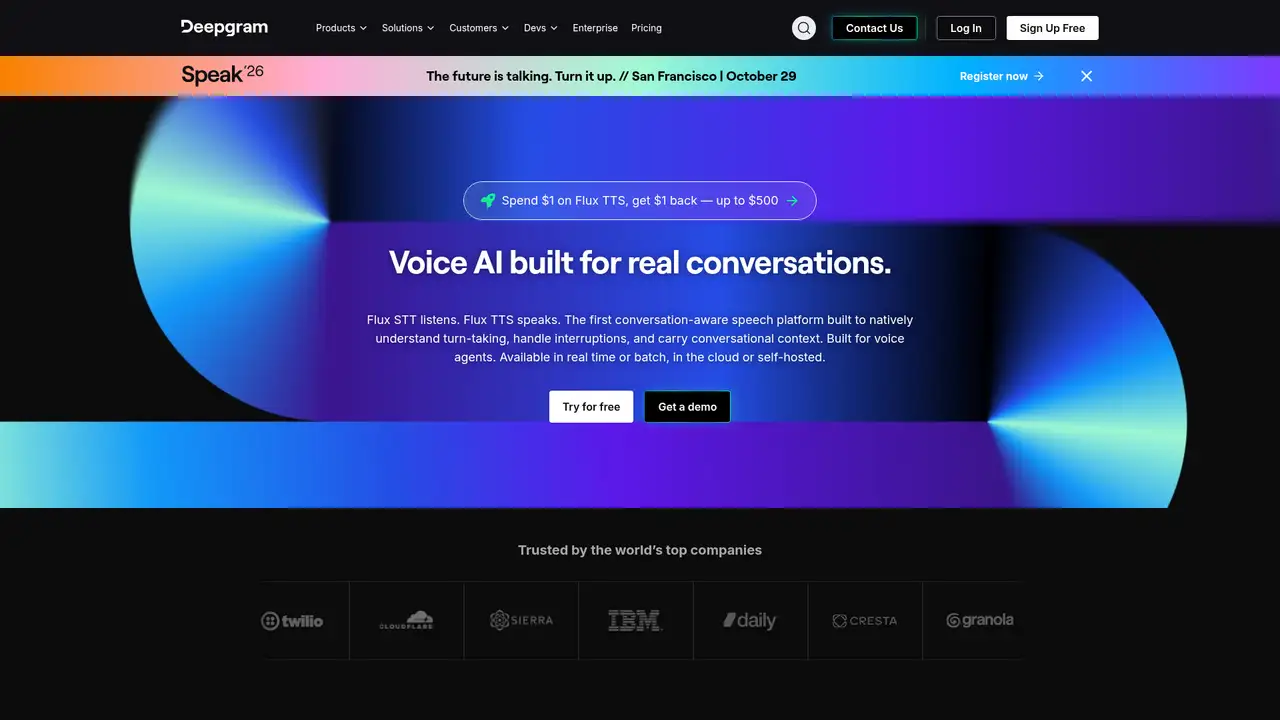
Deepgram is a San Francisco speech AI company founded in 2015 by Scott Stephenson and Noah Shutty, two physicists who had worked on dark matter detection, and it went through Y Combinator. It builds its own speech models instead of reselling others. In January 2026 it raised a $130 million Series C led by AVP at a $1.3 billion valuation, taking total funding past $215 million, and Stephenson told TechCrunch the company was cash-flow positive the year before. Investors include In-Q-Tel, Madrona, Tiger, Twilio and SAP. Deepgram says more than 1,300 organisations use its models, among them the meeting notetaker Granola, the voice agent platform Vapi and Twilio. Alongside the round it bought OfOne, a Y Combinator startup that builds drive-through ordering agents for quick-service restaurants.
Deepgram offers four API families. Speech-to-text covers pre-recorded files over REST and live audio over WebSockets, with speaker diarization, smart formatting, keyterm prompting for jargon and automatic language detection across 45-plus languages. Text-to-speech, sold under the Aura name, streams spoken replies for agents. The Voice Agent API bundles transcription, a language model and speech into one WebSocket so developers do not have to orchestrate three vendors. Audio Intelligence adds summaries, topic detection, sentiment and intent on top of transcripts. A typical build sends a phone or meeting audio stream to the API and receives word-level timestamps within a few hundred milliseconds. Developers get SDKs for Python, JavaScript, Go and .NET, plus a playground in the console for comparing models on their own audio.
Nova-3 is the flagship transcription model, available in monolingual and multilingual versions tuned for background noise, crosstalk and far-field audio. Flux, released in 2025, is a conversational recognition model built for voice agents: it predicts when a speaker has finished a turn and handles interruptions inside the model, which removes a separate voice activity detection step. Flux Multilingual followed in 2026 for calls that switch languages mid-conversation. Deepgram also hosts OpenAI's Whisper for teams that want it. Customers can train custom models on their own data, and the whole stack can run self-hosted in a private cloud or on-premises for organisations that cannot send audio to a third party. The company says its text-to-speech returns first audio in as little as 80 milliseconds.
Deepgram's pricing is pay as you go with no minimums and a $200 credit that does not require a card or expire, which covers tens of thousands of transcription minutes. At October 2026 promotional rates, streaming Nova-3 costs $0.0048 a minute ($0.29 an hour) and Nova-3 Multilingual $0.0058 a minute. Flux English is $0.0065 a minute and Flux Multilingual $0.0078. The Growth plan starts at $4,000 a year in prepaid credit, cuts rates by up to 20% and raises concurrency, for example from 150 to 225 live WebSocket streams. Enterprise contracts add custom models, self-hosting, volume discounts and SLAs. Costs climb when you add Audio Intelligence features or text-to-speech on top of transcription, and when concurrency needs pass the self-serve caps.
Deepgram is an API for developers, so anyone who wants a finished meeting notetaker or dictation app should look at Otter.ai or similar products built on top of it. Self-serve support is limited to the community and Discord until you sign an enterprise contract. AssemblyAI is the closest rival, with comparable accuracy, strong audio intelligence features and similar per-hour pricing. Speechmatics is stronger on broad language coverage and on-premises deals in Europe, and OpenAI's speech models are convenient for teams already on the OpenAI API. ElevenLabs leads on expressive text-to-speech, where Deepgram's Aura voices are tuned for speed over range. Pick Deepgram when you need low-latency streaming transcription for agents or call analytics at high volume, especially if self-hosting is a requirement.
Who is Deepgram best for?
- Voice agent builders who need streaming transcription with turn detection under a few hundred milliseconds.
- Call centres analysing thousands of hours of recordings a month at low cost.
- Regulated organisations that must run speech models on their own servers.
- Developers who want generous free credit to test accuracy on their own audio.
Deepgram Pricing (2026)
Pricing model: Usage-based. All prices in USD.
| Plan | Price | What you get |
|---|---|---|
| Pay As You Go | $0.0048/minute | Nova-3 streaming at promotional rates. $200 free credit with no card, no minimums, up to 150 WebSocket streams, community support. |
| Growth | $4,000/year | Prepaid annual credit with up to 20% lower rates, such as Nova-3 at $0.0042 a minute, and higher concurrency limits. |
| Enterprise | Custom | Volume pricing, custom-trained models, self-hosted or on-premises deployment, dedicated support and uptime SLAs. |
Pros and Cons
Pros
- Streaming rates under half a cent a minute for Nova-3 undercut most rivals.
- Flux handles end-of-turn detection inside the model, which simplifies voice agent pipelines.
- Self-hosted and custom-trained models are available for strict data requirements.
- The $200 credit does not expire and needs no credit card.
Cons
- Aura text-to-speech voices have less emotional range than ElevenLabs.
- Many headline prices are promotional and may rise later.
- Requests feed model training by default unless you add an opt-out flag to each call.
Who should look elsewhere?
- People who want a ready-made transcription app instead of an API.
- Creators who need expressive, emotional voiceover for videos or audiobooks.
- Small teams expecting live support without an enterprise contract.
Technical Details
Frequently Asked Questions
How much does Deepgram cost?
Deepgram charges per minute of audio. At its October 2026 promotional rates, streaming Nova-3 costs $0.0048 a minute, or $0.29 an hour, on pay as you go, and Flux English for voice agents costs $0.0065 a minute. The Growth plan starts at $4,000 a year in prepaid credit and lowers rates by up to 20%. Enterprise pricing is negotiated.
Does Deepgram have a free tier?
Deepgram gives every new account $200 in free credit with no credit card and no expiry date. At Nova-3 rates that covers more than 40,000 minutes of streaming transcription, enough to test accuracy and latency on real audio. The credit works across speech-to-text, text-to-speech and the Voice Agent API. There is no ongoing free monthly allowance once it is spent.
Deepgram vs AssemblyAI: which is better?
Both offer accurate speech-to-text APIs at similar prices. Deepgram is stronger on low-latency streaming for voice agents, with Flux handling turn detection, and it offers self-hosted deployment. AssemblyAI is known for its audio intelligence features and developer documentation. Teams building live phone agents usually lean toward Deepgram, while those analysing recorded audio should benchmark both on their own files.
Does Deepgram use my audio to train its models?
By default, yes. Deepgram enrols API requests in its Model Improvement Program and keeps the audio and transcripts to train future models. Add mip_opt_out=true to a request and Deepgram deletes the data once the response is returned, giving zero data retention. Enterprise customers can enforce opt-out across an account, or run Deepgram self-hosted so audio never leaves their network.
Can I use Deepgram in a commercial product?
Yes. Deepgram's API is licensed for commercial use on every plan, including pay as you go, and is used inside products such as Granola, Vapi and Twilio. You can resell features built on its transcription inside your own app. High-volume or embedded deployments usually move to the Growth plan or an enterprise contract to get higher concurrency limits and better rates.
Best Deepgram Alternatives in 2026
These tools do the same job as Deepgram, with different pricing, limits and trade-offs.

Developer APIs for transcription, speech understanding, guardrails, and voice agents.

Accurate speech-to-text in 55+ languages, from the cloud to on-premises servers
Expressive speech, dubbing, music and realtime voice agents

Low-latency text-to-speech, transcription and voice agents on state space models
Automatic meeting transcription, summaries, and searchable conversation memory