
AssemblyAI Review, Pricing & Alternatives (2026)
Developer APIs for transcription, speech understanding, guardrails, and voice agents.
Last updated: October 22, 2026
What is AssemblyAI?
AssemblyAI provides cloud APIs for recorded and real-time transcription, speech understanding, guardrails, voice agents, and model access. Usage pricing starts at $0.15 per audio hour for Universal-2, with separate session or token billing for other products and $50 in eligible new-account credits. Its pricing and usage limits depend on the selected subscription and production workflow.
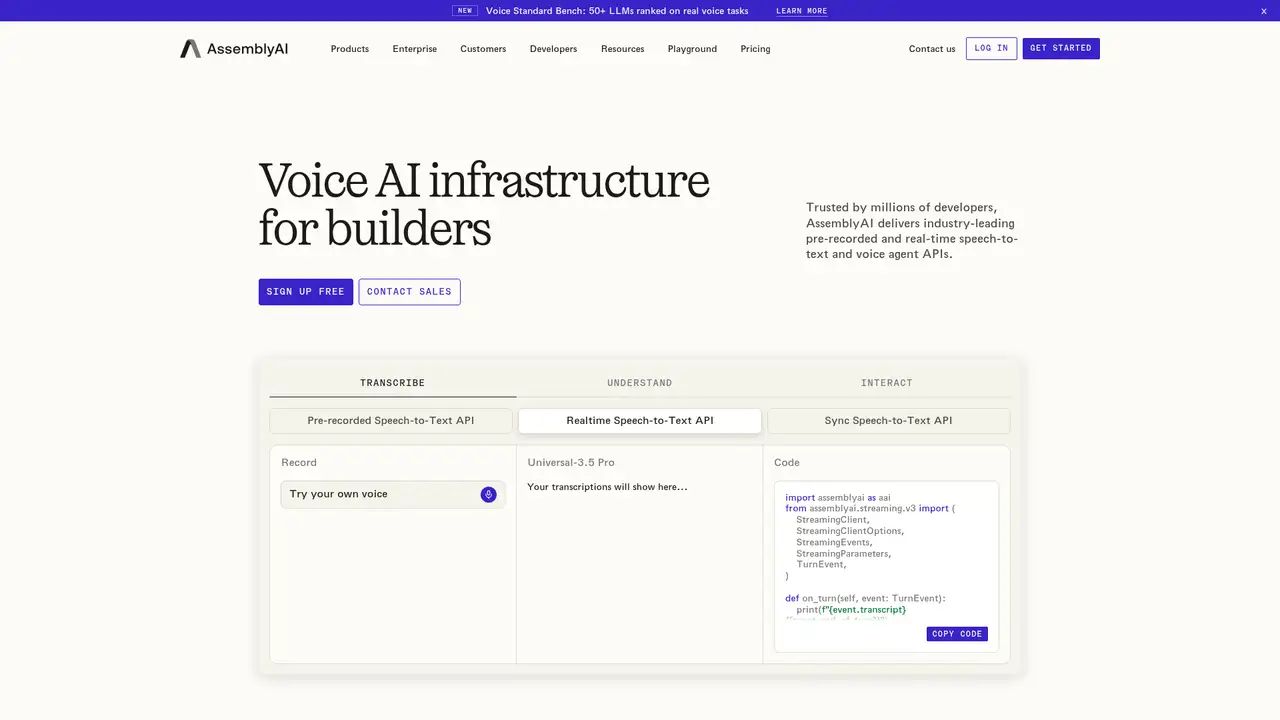
AssemblyAI was founded in late 2017 by machine-learning engineer Dylan Fox after he found existing speech models inaccurate and difficult for developers to use. Its cloud platform serves product and engineering teams through APIs for recorded transcription, real-time speech, speech understanding, guardrails, voice agents, and language-model access. In December 2023, TechCrunch reported that AssemblyAI had raised $50 million in an Accel-led round, bringing total funding to $115 million. The company said its paying customer base had grown 200% year over year to 4,000 brands, while more than 200,000 developers used its platform. AssemblyAI also reported handling roughly 25 million API calls and more than 10 terabytes of data daily.
AssemblyAI’s workflow begins with choosing a product and model, then sending recorded audio through an HTTP request or opening a WebSocket for live transcription. For asynchronous files, developers select Universal-2 at $0.15 per audio hour or Universal-3.5 Pro at $0.21, add options such as speaker diarization, entity detection, or Medical Mode, and receive a transcript after processing. Streaming applications open a session, send audio frames, consume partial and final results, and send a termination message when finished because idle WebSocket time remains billable. Voice applications can connect to the Voice Agent API, provide a system prompt and tools, exchange audio in both directions, and handle turn detection and interruptions. Teams can then pass transcripts to Speech Understanding or the LLM Gateway for structured analysis.
AssemblyAI’s 2025-2026 releases extend its speech stack beyond transcription. Universal-3 Pro Streaming, introduced in the company’s April 2026 recap, targets voice agents with prompting, dynamic key terms, real-time diarization, sub-200-millisecond latency, and six launch languages; AssemblyAI reports an 8.14% English word error rate in its benchmark. The current pricing reference names the successor Universal-3.6 Pro Realtime at $0.45 per session hour. Also launched in April 2026, the Voice Agent API combines cascaded speech recognition, LLM Gateway access, text-to-speech, turn detection, and interruption handling through one WebSocket, priced at $4.50 per hour. The LLM Gateway added Claude Opus 4.7, Kimi 2.5, Qwen 3, and GPT-5.5, providing one endpoint for models from multiple providers.
AssemblyAI uses pay-as-you-go billing with no contracts, minimums, or monthly subscription. Pre-recorded transcription starts at $0.15 per audio hour for Universal-2 and $0.21 for Universal-3.5 Pro, prorated to the exact second. Streaming Universal models start at $0.15 per session hour, while Universal-3.6 Pro Realtime costs $0.45 per hour. Streaming charges follow WebSocket open time, including idle periods, so sessions should be closed promptly. The Voice Agent API costs $0.075 per minute, or $4.50 per hour, covering speech recognition, language-model reasoning, text-to-speech, and orchestration. Add-ons stack on base rates, and multichannel files bill per channel. New accounts receive $50 in eligible speech credits without a card, but LLM Gateway usage is excluded. Free-tier streaming concurrency is five new streams per minute, versus 100 for pay-as-you-go accounts.
AssemblyAI’s main limitations are cost complexity and developer overhead. Unlike Deepgram and Speechmatics, it bills streaming by open WebSocket duration, so idle time counts; add-ons, multichannel audio, and separate LLM Gateway token charges can also complicate forecasts. Google Cloud Speech-to-Text and AWS Transcribe may suit organizations already committed to those clouds, while AssemblyAI is a standalone API platform rather than a broader cloud suite. Its terms permit use of customer data to maintain, develop, and improve services, including model training, subject to applicable opt-out arrangements, so privacy reviews matter for sensitive workloads. AssemblyAI offers $50 in eligible credits, no monthly minimums, EU speech endpoints at US prices, and a $4.50-per-hour Voice Agent API. Choose it for API-first voice products needing transcription plus speech intelligence; choose competitors for cloud consolidation or simpler procurement.
Who is AssemblyAI best for?
- Voice product engineering teams
- Meeting and call applications
- Real-time captions and agents
- Speech analytics pipelines
AssemblyAI Pricing (2026)
Pricing model: Usage-based. All prices in USD.
| Plan | Price | What you get |
|---|---|---|
| Free credits | $0 | $50 in credits for eligible speech products; no card required; LLM Gateway excluded. |
| Universal-2 pre-recorded | $0.15 per audio hour | Pre-recorded audio is prorated to the exact second; multichannel files bill per channel. |
| Universal-3.5 Pro pre-recorded | $0.21 per audio hour | Pre-recorded audio is prorated to the exact second; add-ons cost extra. |
| Universal-Streaming | $0.15 per session hour | Billing follows open WebSocket duration, including idle time. |
| Universal-3.6 Pro Realtime | $0.45 per session hour | Streaming session billing; supported add-ons are billed separately unless included. |
| Voice Agent API | $0.075 per minute | $4.50 per hour; session billing covers STT, LLM, TTS, and orchestration. |
| LLM Gateway | Model-dependent token rates | Input and output tokens are billed separately; in-region pricing may differ. |
| Enterprise | Custom | Volume discounts and invoicing are available by agreement. |
Pros and Cons
Pros
- It covers recorded transcription, streaming, understanding, guardrails, agents, and gateway access.
- Pay-as-you-go billing has no monthly subscription or usage minimum.
- New accounts receive $50 in eligible speech-product credits without a credit card.
- US and EU speech endpoints are published at the same price.
Cons
- Streaming idle time remains billable while a WebSocket is open.
- Add-ons and channel-based billing complicate cost estimates.
- LLM Gateway charges vary by model and token direction.
Who should look elsewhere?
- No-code content creators
- Finished video editing workflows
- Buyers wanting flat monthly pricing
Technical Details
Frequently Asked Questions
How much does AssemblyAI cost?
AssemblyAI uses pay-as-you-go pricing rather than a standard monthly subscription. Published rates start at $0.15 per audio hour for Universal-2 pre-recorded transcription and $0.21 for Universal-3.5 Pro. Streaming starts at $0.15 per session hour, Universal-3.6 Pro Realtime is $0.45 per hour, and Voice Agent API is $0.075 per minute.
Is AssemblyAI free?
New accounts receive $50 in credits for eligible pre-recorded STT, real-time STT, Voice Agent API, Speech Understanding, and Guardrails use. AssemblyAI’s billing documentation says no credit card is required for the credits. LLM Gateway usage is excluded. After credits are exhausted, customers add funds to continue using the API.
What is AssemblyAI’s closest competitor?
Deepgram is a close comparison for developer speech-to-text and real-time transcription APIs. Speechmatics, Google Cloud Speech-to-Text, AWS Transcribe, and Rev AI are other alternatives. AssemblyAI differentiates its product set by combining transcription with speech understanding, guardrails, an LLM Gateway, and a managed Voice Agent API.
How does AssemblyAI handle privacy?
AssemblyAI’s privacy policy describes collection, disclosure, security, and retention practices for personal data. Its terms grant rights to process customer data for providing and improving services, including model training, subject to applicable opt-out arrangements. Customers should review the current DPA, BAA, retention settings, training controls, and selected US or EU routing.
Can businesses use AssemblyAI commercially?
AssemblyAI’s terms provide business access to its services under applicable order forms, and its billing documentation describes enterprise invoicing and possible volume discounts. The platform is designed for developers embedding APIs into products. Commercial customers remain responsible for lawful inputs and outputs and should review service terms, data agreements, usage restrictions, and any required order form.
Best AssemblyAI Alternatives in 2026
These tools do the same job as AssemblyAI, with different pricing, limits and trade-offs.