
Cartesia Review, Pricing & Alternatives (2026)
Low-latency text-to-speech, transcription and voice agents on state space models
Last updated: November 5, 2026
What is Cartesia?
Cartesia makes Sonic text-to-speech, Ink speech-to-text and a managed voice agent platform, all tuned for real-time conversation. It suits developers building phone agents and live voice apps where latency matters most. A free plan includes 20,000 credits a month, and paid plans with commercial rights start at $5 a month.
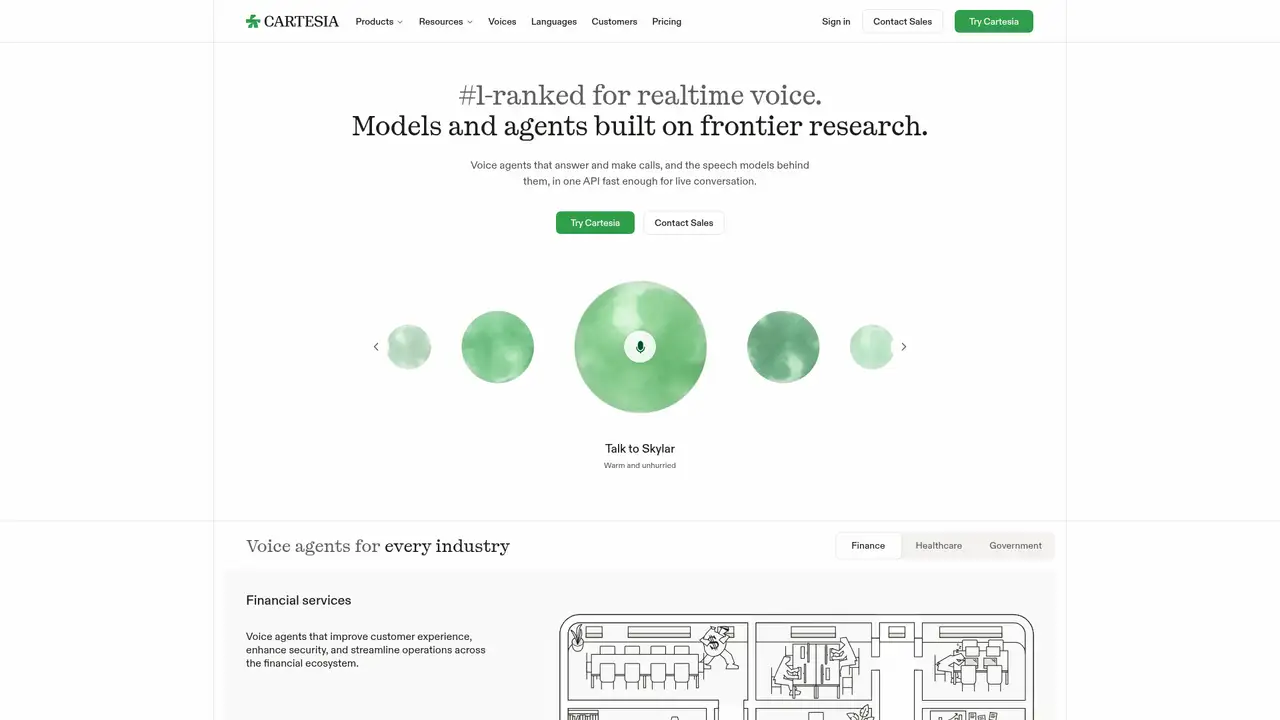
Cartesia is a San Francisco startup founded in 2023 by Karan Goel, Albert Gu, Arjun Desai, Brandon Yang and Chris Ré, researchers from Stanford's AI lab. Gu co-created the S4 and Mamba state space model architectures, which process long sequences with less memory than transformers, and that research is the basis of the company's products. Cartesia launched its Sonic text-to-speech model in 2024 and raised a $64 million Series A led by Kleiner Perkins in March 2025, bringing total funding to $91 million, according to Fortune. Its homepage names ServiceNow, Retell, Blue Machines and Quora among customers. The company's pitch is speed: models that start speaking quickly enough for live phone conversation, sold through one API that covers speech generation, transcription and complete voice agents.
Developers reach Cartesia through a REST and WebSocket API or the browser playground. Sonic turns text into streaming audio, with controls for speed, emotion and pronunciation, and supports more than 40 languages. Instant voice cloning creates a voice from a few seconds of audio on paid plans, and professional cloning trains a closer copy from longer recordings on the Startup plan and above. A localisation feature gives a cloned voice a new accent. Ink transcribes live audio for agents that need to hear callers. Managed Agents, the newest product, hosts complete phone agents with telephony, so a team can define an agent's prompt and tools without wiring a separate orchestration layer. Cartesia also offers on-premises and on-device deployment for customers with data residency rules.
The current text-to-speech model is Sonic-3.6, and the transcription model is Ink-2. Because state space models carry a compact running state instead of re-reading the whole input, Cartesia says Sonic can return first audio in well under 100 milliseconds, which matters when an agent has to reply mid-conversation. In 2025 and 2026 the company climbed the Artificial Analysis Speech Arena, an independent blind listening leaderboard, and its homepage says Sonic ranks first there and on the Artificial Analysis speech-to-text leaderboard. Sonic-3 added laughter, breathing and emotional tags, and later versions improved multilingual pronunciation. The research team also published H-Nets, an architecture that learns its own tokenisation, which hints at where future models are headed. Voice agent platforms such as Retell and Vapi offer Cartesia voices as a built-in option.
Cartesia bills in credits, where one character of generated speech costs one credit. The free plan gives 20,000 credits a month, about 27 minutes of Sonic audio, plus $1 of agent usage, but no commercial licence. Pro costs $5 a month for 100,000 credits (about 133 minutes), commercial rights and instant cloning. Startup is $49 for 1.25 million credits, roughly 1,667 minutes, and adds professional cloning and team organisations. Scale costs $299 for 8 million credits, about 10,667 minutes, with priority support and higher concurrency. Managed Agents bill at $0.03 a minute for call duration, and each plan includes prepaid agent credit equal to its price. Enterprise adds data processing agreements, business associate agreements for HIPAA and SSO.
Cartesia's voice library and creator tools are thinner than ElevenLabs, which also offers dubbing, sound effects and music, so it is a weaker fit for video producers and audiobook narrators. Managed Agents are newer than Vapi or Retell and have fewer integrations. Credit-based billing means long-form narration gets expensive faster on the low tiers. ElevenLabs Flash competes directly on latency with a larger voice catalog. Deepgram's Aura voices are cheaper per minute but less expressive, and Hume, once a rival on expressive speech, is closing its TTS API in November 2026. Pick Cartesia when you are building a real-time voice agent or interactive app and the delay before the first syllable is the metric you care about, or when you need on-device or on-premises speech models.
Who is Cartesia best for?
- Developers building phone or in-app voice agents where response delay must stay low.
- Voice agent platforms that need a fast, expressive default voice in many languages.
- Companies that must run speech models on-premises or on devices.
- Startups wanting commercial text-to-speech rights for $5 a month.
Cartesia Pricing (2026)
Pricing model: Freemium. All prices in USD.
| Plan | Price | What you get |
|---|---|---|
| Free | $0/month | 20,000 credits a month (about 27 minutes of speech) and $1 of agent usage. No commercial licence. |
| Pro | $5/month | 100,000 credits (about 133 minutes), $5 of agent usage, commercial licence and instant voice cloning. |
| Startup | $49/month | 1.25 million credits (about 1,667 minutes), $49 of agent usage, professional voice cloning and team organisations. |
| Scale | $299/month | 8 million credits (about 10,667 minutes), $299 of agent usage, priority support and higher concurrency. |
| Enterprise | Custom | Volume pricing, custom concurrency, DPAs and BAAs, SSO, shared Slack channel and security reviews. |
Pros and Cons
Pros
- First audio in well under 100 milliseconds suits live conversation.
- Ranked first on the Artificial Analysis Speech Arena, according to the company.
- Speech generation, transcription and hosted agents share one account and API.
- On-device and on-premises deployment options are rare among TTS vendors.
Cons
- The free plan carries no commercial rights.
- Smaller voice library and fewer creator tools than ElevenLabs.
- Managed Agents are new and have fewer integrations than Vapi or Retell.
Who should look elsewhere?
- Video creators who want dubbing, sound effects and a large community voice library.
- Audiobook producers generating many hours a month on a small budget.
- Non-technical users who want a finished voiceover studio.
Technical Details
Frequently Asked Questions
How much does Cartesia cost?
Cartesia's Pro plan costs $5 a month for 100,000 credits, about 133 minutes of Sonic speech, with a commercial licence. Startup is $49 for 1.25 million credits and Scale is $299 for 8 million. One character of text uses one credit. Managed voice agents bill at $0.03 a minute for call duration. Each plan includes prepaid agent credit equal to its monthly price. Enterprise pricing is custom.
Is there a free Cartesia plan?
Yes. The free plan includes 20,000 credits a month, roughly 27 minutes of generated speech, plus about two hours of Ink transcription and $1 of agent usage. It is meant for testing, because it does not include a commercial licence or voice cloning. Upgrading to the $5 Pro plan adds both, and you can pause or cancel paid plans at any time.
Cartesia vs ElevenLabs: which should I use?
Cartesia focuses on speed for live voice agents and says its Sonic model ranks first on the Artificial Analysis Speech Arena. ElevenLabs has a far larger voice library, dubbing, sound effects and creator tools, and its Flash model also targets low latency. Pick Cartesia for real-time agents or on-premises deployment, and ElevenLabs for video, audiobooks or a wide choice of voices.
Does Cartesia train on my data?
Cartesia's enterprise plan offers data processing agreements, HIPAA business associate agreements and security reviews, and on-premises deployment keeps audio inside your own network. The company states SOC 2 Type II compliance. Teams on self-serve plans should read its privacy policy and terms on data use before sending sensitive text or voice samples, and avoid cloning anyone's voice without consent.
Can I use Cartesia voices commercially?
Commercial use requires a paid plan. The Pro plan at $5 a month and every tier above it include a commercial licence for generated audio, while the free plan does not. Cloned voices need consent from the speaker under Cartesia's terms. Companies embedding Cartesia inside their own product at scale typically sign an enterprise agreement for volume pricing and concurrency.
Best Cartesia Alternatives in 2026
These tools do the same job as Cartesia, with different pricing, limits and trade-offs.
Expressive speech, dubbing, music and realtime voice agents

Speech-to-text, text-to-speech and voice agent APIs priced by the minute
Text-to-speech with ultra-realistic voice cloning at scale

Developer platform for building phone and web voice agents on any model stack